Let me paint you a picture that might feel very familiar.
It's 9:20 AM. The market just opened. You've been watching NIFTY futures since 8:45, cup of chai in hand, charts open on your phone and laptop simultaneously. You spot a setup. A perfect one — the kind that makes your pulse spike. You hover over the buy button.
And then you hesitate.
"Is this really the right entry? What if it's a fakeout? Let me wait for one more candle."
By the time you click buy, the option has already moved ₹18 against you. You enter late. The trade barely hits your target. Or worse — it reverses, and now you're sitting on a loss you weren't planning for at 9:21 AM.
This isn't a skills problem. This isn't a strategy problem. This is a structural problem with manual trading itself — and it affects 9 out of 10 retail traders in India every single day.
In this guide, we're going to break down exactly why traditional manual trading is working against you — and then walk through, feature by feature, how ALGORAM's automated trading platform is built to fix every single one of these problems.
The Real Problems With Manual Trading
When most traders lose money, they blame the market. The volatility. The "operators." But after working with thousands of Indian retail traders over the years, the pattern is always the same. The market isn't the problem. The method is.
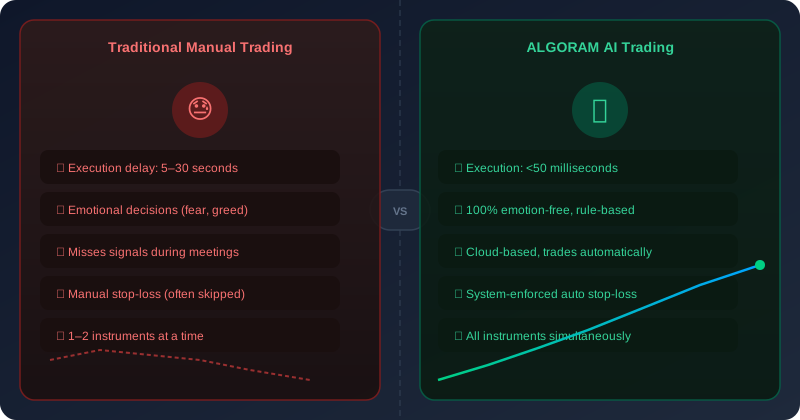
Manual trading has five deep structural problems that no amount of chart-reading skill can fully overcome:
Each of these problems, on its own, is damaging. Together, they make consistent profitability from manual trading extremely difficult — not because you're doing it wrong, but because these are inherent limitations of human-driven execution.
How Emotions Silently Destroy Your P&L
Here's something most trading courses never tell you: the biggest variable in your trading results isn't your strategy. It's your psychology on any given day.
Research in behavioral finance consistently shows that retail traders — regardless of their technical skill level — make systematically worse decisions under two conditions: when they're winning (overconfidence), and when they're losing (panic and hope). The market, conveniently, puts you in one of those two states for most of the session.
You make a solid plan. Market opens — you feel confident. You take a trade outside your plan because "this one feels different." It goes against you. Now you're anxious. You don't exit at your stop-loss because "it'll come back." It doesn't. You finally exit at double your planned loss. Now you're angry. You revenge trade to "get it back." You lose more. By 1 PM you've violated every rule you set at 9 AM. Sound familiar?
This isn't weakness. It's neuroscience. Studies show that the prospect of financial loss activates the same fear-response pathways in the brain as physical danger. Your fight-or-flight system — designed for survival, not trading — literally hijacks your rational thinking at exactly the moment you need it most.
And here's the cruel irony: the harder you try to "stay disciplined" in real-time, the more mental energy you burn — leaving less capacity for clear analysis. Decision fatigue is real, and after two or three emotionally-charged trades, your judgment for the rest of the session is genuinely compromised.
"You cannot think your way out of an emotional reaction. You can only build a system that removes the need for that decision entirely."
— Ankit Patel, Co-Founder, ALGORAMMissed Entries & Delayed Exits — The Hidden Cost
Let's talk about the cost of being just a few seconds late. Because most traders dramatically underestimate it.
Priya is a 29-year-old trader from Pune. She's been trading NIFTY options for 18 months. She spots a momentum signal on the 5-minute chart at 10:47 AM — RSI crossing 60, volume surge, breakout above resistance. Her strategy says buy the ATM Call.
She opens her Zerodha terminal, checks the option chain, selects the strike, types in the quantity, reviews the price — and clicks buy at 10:47:38 AM.
The signal fired at 10:47:00 AM. In those 38 seconds, the option moved from ₹112 to ₹131. She entered 17% more expensive than the signal price. Her planned risk-reward of 1:2 is now barely 1:1.2. She holds. The trade hits her original target, but barely covers brokerage. Net result: a ₹0 trade on a setup that should have returned ₹4,200.
Cost of the delay: ₹4,200. Time wasted watching the trade: 2.5 hours.
This isn't a rare edge case. On expiry days and during high-volatility sessions, NIFTY ATM options can move ₹15–₹40 in under a minute. Every second of manual execution delay costs real money.
And it's not just entries. Exits are equally critical. When your target hits on a fast-moving option, every second you spend deciding whether to book profit is a second where the market can reverse. Options don't wait for you to feel ready.
If you trade NIFTY options with 5-lot positions (50 units each), a ₹15 slippage per lot due to delayed entry = ₹750 lost per trade. At 2 trades per day, 20 trading days per month — that's ₹30,000/month in pure execution losses, before any strategy errors. Automated execution eliminates nearly all of this.
Screen-Watching Fatigue: The Burnout Nobody Talks About
Ask any manual trader what their day looks like and you'll hear a variation of the same answer: up before 9 AM, glued to charts from market open, barely able to take a bathroom break without worrying about missing a move, exhausted by 3:30 PM.
This is not a sustainable or healthy way to operate — and more importantly, it's not even effective. Research on sustained attention shows that human concentration degrades significantly after 90–120 minutes of focused work. Yet manual traders expect peak attention for 6+ consecutive hours, often under financial stress.
The result? The worst trading decisions of the day happen in the final two hours — when fatigue has accumulated, discipline has eroded, and the brain is looking for shortcuts. This is also, not coincidentally, when the highest-impact expiry moves happen.
Studies in cognitive performance show that mentally fatigued people take more risks, are more susceptible to loss aversion, and make decisions 40% slower. For a trader, this means: wider stop-losses, longer holds on losing positions, and slower exits on winning ones — all when it matters most. The best algo trading software India has to offer eliminates this problem entirely.
And that's just the daily toll. Over weeks and months, the cumulative mental exhaustion of screen-watching leads to trader burnout — a very real phenomenon where experienced, capable traders simply lose their edge because the process itself has worn them down.
The Discipline Gap: Knowing vs. Doing
Here's the thing that separates consistently profitable trading from everything else: it's not rare knowledge. Most active traders in India already know the rules. Use a stop-loss on every trade. Don't average down on losers. Exit when the target hits. Don't revenge trade after a bad day. Position size correctly.
The rules are simple. Following them — under real market conditions, with real money, in real time — is an entirely different challenge.
This is what we call the discipline gap: the space between what you know you should do and what you actually do when the market is moving against you. Every manual trader lives in this gap. It's where the vast majority of trading losses originate.
When you're watching a position move against you in real time, your brain isn't making a calm, rational calculation. It's under chemical stress — cortisol and adrenaline are flooding your system, pattern-matching is running in overdrive, and your cognitive bandwidth for rule-following is severely reduced. This is why "just be more disciplined" is not a strategy. You need a system that removes the need for real-time discipline entirely.
How ALGORAM Solves Every One of These Problems
ALGORAM wasn't built as a charting tool or a signal app. It was built as a complete automated execution engine — a smart trading system that runs your entire strategy from signal to settlement without requiring any real-time input from you.
The philosophy is simple: you bring the strategy. ALGORAM handles the execution. Flawlessly. Consistently. Emotionlessly. Every single time.
Here's how each feature directly addresses each problem we've just discussed:
Auto Entry & Exit — Never Miss a Signal Again
ALGORAM's execution engine monitors your chosen instruments in real time — tick by tick — and fires orders the instant your strategy conditions are met. We're talking about execution in under 50 milliseconds. That's 0.05 seconds. Compared to the average 20–40 second manual execution time, this is a transformational difference.
Signal Detected Instantly
ALGORAM's engine scans every tick for your entry conditions — RSI, volume, price action, moving averages, or custom multi-indicator logic — and detects the signal the moment it forms.
Order Placed in <50ms
Before you've even seen the candle close on your chart, ALGORAM has already placed the order through your connected broker API — at the exact price your strategy specified.
Exit Rules Run Simultaneously
The moment the entry is filled, your exit logic activates — profit target, stop-loss, and trailing stop all armed and monitoring in real time. No manual oversight required.
You Receive Instant Notifications
Every entry and exit fires a notification to your phone. You stay informed without being chained to the screen. Review after the fact, not in the middle of the action.
For Priya's scenario above — the one where a 38-second delay turned a ₹4,200 profit into a breakeven trade — ALGORAM would have entered at ₹112, not ₹131. The difference over a month of trading is enormous.
Trailing Stop Loss — Lock In Profits Automatically
One of the most common ways traders leave money on the table isn't in losses — it's in winners. You enter a trade, it moves in your favour, you're up ₹8,000. But instead of booking profit, you hold on hoping for more. The market reverses. You exit at ₹2,000. A great trade becomes a mediocre one.
ALGORAM's Trailing Stop Loss solves this automatically. Here's how it works:
You define a trailing distance — say ₹15. As your trade moves in your favour, the stop-loss automatically moves up with it, always staying ₹15 below the highest point the trade has reached. If NIFTY CE moves from ₹100 to ₹140, your stop trails to ₹125. If it then drops to ₹125, ALGORAM exits automatically — locking in ₹25 profit per unit. You captured 83% of the move without watching a single candle.
No manual watching. No agonising decision about when to exit. The system locks in profit as the trade moves and exits the moment momentum stalls. This one feature alone is responsible for a significant portion of the return improvement ALGORAM users see compared to their manual trading history.
Capital Protection Mode — Your Absolute Safety Net
Markets can move against you in ways no strategy anticipates — a sudden RBI policy surprise, an unexpected global event, a circuit-breaker moment. In these scenarios, the difference between a bad day and a portfolio-destroying event is having a hard, automatic limit on how much you can lose.
ALGORAM's Capital Protection Mode is exactly that safety net.
You set a maximum portfolio drawdown threshold — for example, 15% of total capital. If your live portfolio value drops below that threshold at any point during market hours, ALGORAM automatically closes all open positions and halts all new trade execution for the rest of the session. No manual action required. Your capital is protected even if you're away from your phone entirely.
Think about what this means in practice. Imagine NIFTY gaps down 2% at open after an overnight event. A manual trader, not watching at that exact moment, might wake up to find their positions deep in loss territory, with no stops triggered because of circuit-breaker gaps. An ALGORAM user with Capital Protection Mode active? The system would have identified the drawdown threshold breach and closed positions before the losses compounded further.
This is the kind of institutional-grade risk management that was previously only available to HNIs and fund managers. ALGORAM brings it to every retail trader, regardless of capital size.
Daily Loss Limit Auto Stop — End Revenge Trading Forever
Of all the features in ALGORAM, this one might be the most psychologically powerful — because it protects you not just from the market, but from yourself.
Every experienced trader knows the revenge trade spiral. You take two losses in the morning. You feel the need to "recover." You take a third trade outside your strategy. Another loss. Now you're emotionally compromised, and every trade you take for the rest of the day is driven by frustration, not analysis. One bad morning can turn into a devastating week.
Rohan is a 41-year-old business owner from Surat. He uses his lunch hours to trade. On a Tuesday, his first two trades both hit stop-losses — a total loss of ₹6,400. Frustrated, he takes three more trades in the afternoon, deviating from his strategy, trying to recover. He loses ₹14,200 more. Total day: ₹20,600 down.
With ALGORAM's Daily Loss Limit set to ₹7,000 — the system would have halted automatically after the second loss. His total loss for the day: ₹6,400. Not great, but recoverable. The ₹14,200 of emotional trading? Never happened.
The feature didn't just protect capital that day. It protected his entire month's strategy.
Here's how to think about Daily Loss Limit Auto Stop: it's not a restriction on your trading. It's a commitment device — a way to make a rational, calm decision about your maximum acceptable loss for the day before the emotions of the session can override your judgment. You set the limit when you're thinking clearly. The system enforces it when you might not be.
Most experienced traders recommend setting your daily loss limit at 2–3% of total trading capital. For a ₹3,00,000 account, that's ₹6,000–₹9,000. Once this limit is hit, ALGORAM automatically stops all trading for the day — no override, no exception. You can review what went wrong in the evening with a clear head and resume the next morning with your capital intact.
ALGORAM vs Traditional Trading — The Full Picture
Let's put everything together in one clear comparison. This isn't theoretical — it's the real, practical difference between what your trading day looks like with ALGORAM versus without it.
| Problem / Feature | Manual Trading | ALGORAM Automated |
|---|---|---|
| Entry Execution Speed | 15–45 seconds (human delay) | Under 50 milliseconds |
| Emotional Interference | High — fear, greed, panic, FOMO | Zero — rules-based, always |
| Stop-Loss Discipline | Often moved or skipped under pressure | Pre-set, enforced automatically |
| Trailing Stop Loss | Requires constant manual adjustment | Fully automatic, tick by tick |
| Capital Protection | Relies on trader judgment in crisis | Capital Protection Mode auto-exits |
| Daily Loss Control | Subject to revenge trading spiral | Daily Loss Limit Auto Stop |
| Screen Time Required | 6+ hours of active monitoring | Near zero — system runs itself |
| Strategy Consistency | Varies day by day with mood/fatigue | 100% identical execution every day |
| Multi-Instrument Monitoring | Practically impossible manually | Simultaneous, across all instruments |
| Broker Compatibility | N/A | Zerodha, Upstox, Angel One, 5paisa & more |
The column on the right isn't a fantasy. It's what running a strategy on ALGORAM's best algo trading software actually looks like for traders every single market day. The column on the left is the reality for anyone still trading manually — and most of them don't even realise how much it's costing them.
The ALGORAM Feature Stack — Built for Indian Markets
ALGORAM's automation capabilities are specifically engineered for NSE/BSE market conditions — the volatility patterns, the expiry dynamics, the liquidity windows. Here's the full feature set working together:
Sub-50ms order placement the instant your strategy conditions are met. No human delay, no slippage from hesitation.
Automatically follows price in your favour, locking in gains as the trade moves while protecting against reversal.
Set a portfolio drawdown limit. If breached, all positions close and trading halts. Your capital is always protected.
Define your maximum acceptable daily loss. ALGORAM enforces it absolutely, ending revenge trading for good.
Every trade follows the same rules, regardless of market noise, previous losses, or time of day. Consistency is built in.
Multi-indicator confluence logic filters out false signals, entering only on high-probability setups backed by 20 years of backtested data.
Let ALGORAM Handle Execution While You Focus on Strategy
Stop losing money to delayed entries, emotional exits, and revenge trades. Connect your broker in under 60 seconds and run your first automated trade today — completely free for 7 days.
What Changes When You Switch to ALGORAM
Traders who move from manual to automated trading on ALGORAM consistently report the same set of changes — and the most surprising ones are rarely about the returns. Here's what actually shifts:
Your strategy actually runs as designed
For the first time, you see what your strategy truly performs like — not a version distorted by emotional interference and execution slippage. This clarity is valuable regardless of the result: it tells you what to refine versus what's already working.
Your evenings and weekends come back
Without the need to be glued to screens, traders report a dramatic improvement in their relationship with trading itself — and with the rest of their lives. Work, family, health — all of it stops being sacrificed at the altar of open positions.
Bad days stop becoming bad weeks
With Daily Loss Limits and Capital Protection Mode, a rough session is contained. It doesn't cascade. Your capital — and your psychological equilibrium — is preserved for the next day.
You start thinking like a systems operator
The shift from "what should I do right now?" to "is my system running correctly?" is profound. You become a strategist who evaluates and improves — not a reactive button-pusher. This is the mindset of every consistently profitable trader.
Frequently Asked Questions
The Bottom Line
Manual trading isn't failing you because you lack knowledge or skill. It's failing you because it's structurally designed to put human psychology in conflict with consistent execution — and human psychology almost always loses that battle.
ALGORAM doesn't ask you to be a better, more disciplined, more emotionless trader. It removes the need for real-time discipline entirely by automating the execution layer — and then adds a comprehensive risk management framework that protects your capital even when the market behaves unpredictably.
The result isn't magic. It's structure. And structure, applied consistently in Indian markets, is what produces results over months and years rather than just lucky weeks.
Start your 7-day free demo with ALGORAM today. Connect your broker, run your first automated strategy on paper money, and see exactly what your trading looks like without the emotional interference, delayed execution, or discipline gaps. No credit card required. No commitment. Just clarity.
Let ALGORAM handle execution while you focus on strategy. You've spent enough time watching screens and fighting your own psychology. It's time to let the system do its job.

Ankit is the architect behind ALGORAM's automated execution engine and risk management framework. With 15+ years of experience designing algorithmic trading systems for Indian markets, he built ALGORAM to give every retail trader access to the same execution infrastructure used by institutional desks — without requiring a single line of code.