Why Timing Matters More Than Strategy
Here's a question that surprises most new traders: two traders use the identical NIFTY strategy. One trades only between 9:15–9:25 AM. The other trades only between 10:30 AM–12:00 PM. Their results over the same period are dramatically different — not because the strategy changed, but because the market sessions behave fundamentally differently.
Most traders focus almost entirely on what to trade: which indicator, which option strategy, which direction. Very few think systematically about when to trade. The market isn't the same instrument across all hours. The NIFTY you're trading at 9:17 AM is a different creature than the NIFTY at 11:30 AM or 3:00 PM — different volatility, different liquidity, different institutional participation, different option premium behavior.
Understanding these differences is one of the most undervalued edges available to retail traders.
NIFTY Trading Hours on NSE
The National Stock Exchange (NSE) operates the following market sessions:
- Pre-open session: 9:00–9:15 AM — Order collection, price discovery, no actual trades execute until 9:15 AM
- Regular trading session: 9:15 AM–3:30 PM — All actual trading occurs here
- Post-close session: 3:40–4:00 PM — Closing price calculation, Block Deal window
The 6 hours and 15 minutes of regular trading can be divided into four behaviorally distinct sessions — each requiring a different approach.
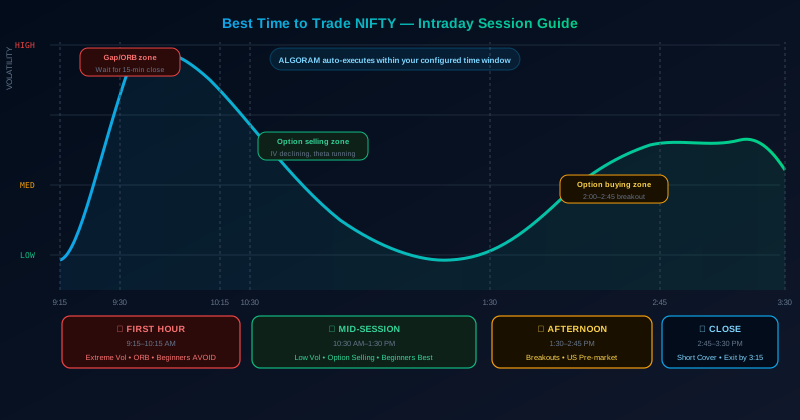
Session 1: First Hour (9:15 AM – 10:15 AM)
The opening hour is driven by: overnight global market movements (SGX Nifty, Dow Jones, Asian markets), FII/DII bulk order execution, news and corporate announcements from previous evening, and position adjustments from options writers managing expiry risk.
The first 15 minutes specifically (9:15–9:30 AM) are the most treacherous. Gap openings frequently reverse within 30 minutes. A gap-up to 24,300 might attract sellers who anticipate filling the gap — creating a sharp reversal that traps buyers who entered at the open. Wait for the opening range to establish before trading.
Opening Range Breakout: Mark the high and low of the first 15-minute candle (9:15–9:30 AM). Wait for a confirmed break above the high (go long CE) or below the low (go long PE) with volume above 3x average. Avoid entering during the first 15 minutes — wait for the candle to close before acting on the range.
Session 2: Mid-Market (10:30 AM – 1:30 PM)
The mid-market session is where the morning's established trend either continues or consolidates. If NIFTY opened bullish and held above VWAP through 10:30 AM, the path of least resistance is upward during this session. Trend continuation setups — pullbacks to VWAP or EMA support — work well here.
This is also the best window for option selling strategies. IV has declined from opening spikes, theta decay is running at full speed, and market direction is clearer — reducing the risk of explosive adverse moves.
Session 3: Afternoon (1:30 PM – 2:45 PM)
Around 1:30–2:00 PM, market volume picks up as US pre-market activity begins (US markets open at 7:00–7:30 PM IST, but pre-market moves from 1:30 PM onwards influence Indian markets). FIIs often adjust large positions in the afternoon window. This creates genuine breakout opportunities from morning consolidation ranges — often the cleanest second entry point of the day.
Session 4: Closing Hour (2:45 PM – 3:30 PM)
The last 45 minutes are driven by position squaring — intraday traders closing positions, options writers managing expiry risk, and FIIs executing closing portfolio adjustments. This creates genuine momentum in the prevailing trend's direction but also sharp reversals as leveraged positions are forced out.
Critical rule: If you're trading intraday, set a hard exit by 3:15 PM at the latest. Do not hold intraday positions overnight unless you specifically intend to — the market can gap significantly at next day's open.
How Volatility Changes Throughout the Day
Best Time by Trading Style
| Trading Style | Best Time Window | Why | Risk Level |
|---|---|---|---|
| Scalping | 9:30–10:15 AM | Highest volatility = biggest intraday moves | High |
| ORB Intraday | 9:30–11:30 AM | Opening range establishes direction | Medium |
| Trend Following | 10:30 AM–2:45 PM | Clear trend, pullback entries available | Lower |
| Option Buying | 9:30–11:30 AM & 2:00 PM | IV declining from peak, direction established | Medium |
| Option Selling | 10:30 AM–2:30 PM | Theta decay running, IV declining, lower risk | Lower |
| Expiry Trading | 10:00–11:30 AM expiry day | After opening move established, before gamma accelerates | Very High |
| Swing Entries | 3:00–3:30 PM | Closing prices most reliable for next-day S/R | Low |
| Beginners | 10:30 AM–1:30 PM | Lowest volatility, clearest trends, manageable moves | Lowest |
Best Time for NIFTY Options Trading
Option Buying — When to Enter
The biggest mistake option buyers make is entering at market open (9:15–9:20 AM) when implied volatility is at its daily peak. You're paying maximum premium for an option when IV is highest — and if the market moves sideways or IV declines even without price moving against you, the option loses value through IV crush.
Optimal option buying windows:
- 9:30–10:00 AM: After the opening IV spike subsides, if direction is clear
- 10:00–11:30 AM: Best window — IV declining, direction established from morning price action
- 2:00–2:45 PM: Afternoon breakout window — fresh directional move, 90 minutes to target
Avoid option buying: At 9:15–9:20 AM (peak IV), between 12:00–1:30 PM (low momentum, theta destroying premium), and after 2:45 PM unless very close to target (time decay accelerating).
Option Selling — When to Enter
Option sellers benefit from IV decline and theta decay. The ideal conditions for selling are: IV declining from its peak (after 10:30 AM), clear range established (market not in strong trend that could run through your sold strikes), and sufficient time premium remaining (not immediately before expiry when gamma risk is maximum).
10:30 AM–12:30 PM on non-expiry days. IV has dropped from opening spike. Opening range is established — you can sell OTM strikes with confidence they'll stay OTM. Theta is running at full speed. The market is typically consolidating in mid-session, which is the ideal environment for short premium positions (straddles/strangles).
Best Indicators for Each Session
| Session | Primary Indicator | Secondary Indicator | Why |
|---|---|---|---|
| 9:15–10:15 AM | VWAP | Volume | VWAP establishes daily bias. Volume confirms institutional moves. |
| ORB entry | Opening Range High/Low | Option Chain OI | 15-min ORB levels with OI confirmation prevents fake breakout entries. |
| 10:30 AM–1:30 PM | EMA (20/50) | RSI | EMA crossovers give trend confirmation. RSI identifies pullback entries in trend. |
| 1:30–2:45 PM | MACD | Volume Profile | MACD identifies afternoon momentum shifts. Volume Profile shows acceptance zones. |
| 2:45–3:30 PM | Price Action | Open Interest | Candlestick patterns at key levels. OI unwinding confirms short covering. |
Expiry Day Trading — Different Rules Apply
Thursday (Bank Nifty weekly) and the last Thursday of the month (Nifty monthly) behave fundamentally differently from regular trading days:
- Morning (9:15–9:45 AM expiry): Even more extreme opening volatility. ATM options can move 200–400% in 30 minutes. Do NOT trade in the first 15 minutes on expiry day without extremely tight stops.
- Mid-morning (10:00–11:30 AM): Best window to enter expiry day trades after the opening chaos settles. Look for NIFTY establishing a range relative to Max Pain. Short Straddle/Strangle setups work well here if VIX is below 18.
- Afternoon (1:30–2:30 PM): Max Pain mechanics begin pulling price toward the max pain strike. Directional option buys can work well if you're going with the Max Pain direction.
- Last 30 minutes (3:00–3:30 PM): Gamma acceleration creates extreme moves. ATM options can double or halve in 10 minutes. If you're not a professional expiry day trader, close all expiry positions before 3:00 PM.
Common Timing Mistakes Traders Make
- Trading immediately at 9:15 AM without confirmation. The opening print is rarely the actual day's direction. Wait for the first 15-minute candle to close before acting on opening price action.
- Buying options at market open (peak IV). You're paying 20–40% more premium than you would at 10:30 AM for the same strike. IV crush after opening guarantees losing value even if direction is correct.
- Holding intraday positions into the closing hour without awareness. Many intraday traders accidentally become overnight traders by "just one more minute." Set a 3:15 PM hard exit alert.
- Trading during 12:00–1:30 PM with option buying strategies. Mid-session is the weakest period for directional option purchases — low volume, low momentum, maximum theta working against you.
- Ignoring India VIX levels before entering. VIX above 20 means all options are expensive and volatility is unpredictable. VIX below 12 means directional moves are small and option premiums offer poor reward for buyers.
- Following the same strategy on expiry day as regular days. Expiry day is a different market. Apply expiry-specific rules or reduce position size dramatically on these days.
- Overtrading during low-volume mid-session. When volume is low and NIFTY is moving in a 50-point range, most trades will hit stops before reaching targets. Patience through low-volume periods is a skill.
How Automated Trading Removes Timing Mistakes
The most common timing mistakes share a root cause: human emotional override. A trader knows not to trade at 9:17 AM before confirmation — but when they see a big gap-up, FOMO overrides the rule. A trader knows to exit by 3:15 PM — but when they're profitable, greed says "just five more minutes."
Automated trading via ALGORAM enforces time rules at the system level:
- Time window configuration: Define "only execute signals between 9:30 AM and 11:30 AM." The system literally cannot enter trades outside these hours — no override possible.
- Automatic time-based exit: Configure "close all positions at 3:10 PM." The system exits regardless of P&L — no forgetting, no "just a few more minutes."
- Session-aware strategy switching: Configure aggressive momentum strategies for the morning window and conservative option selling for mid-session — switched automatically by time, not human judgment.
- Expiry day settings: Tighter stops, smaller positions, or complete pause of automated trading on expiry day — all configurable without any programming knowledge.
Read more: How No-Code Algo Trading Helps Options Traders and Top 10 Trading Mistakes to Avoid
🤖 Trade NIFTY at the Right Time, Automatically
ALGORAM executes only within your defined time windows — no FOMO entries, no missed exits. 7-day free demo on real NSE data.
🚀 Launch Offer — First 100 Customers
Conclusion
There is no single "best" time to trade NIFTY for everyone. The ideal session depends on your trading style, risk tolerance, and strategy. An experienced momentum trader thrives in the 9:30–10:15 AM window. An option seller prefers the calm of 10:30 AM–12:30 PM. A beginner learning the market is safest starting between 10:30 AM and 1:00 PM when volatility is manageable and trends are clearer.
What matters most is consistency: picking a time window that suits your style, testing a strategy within that window, and having the discipline to only trade during your defined hours. The traders who try to trade every session with every approach are the ones who find that "every session" is unprofitable for them.
Automation takes this discipline to its most reliable form. When a platform enforces your time rules without exception, the biggest source of timing-related trading mistakes is eliminated entirely.
Beginner: 10:30 AM–1:00 PM, trend continuation only
Intermediate: 9:30–10:15 AM (ORB) + 2:00–2:45 PM (afternoon breakout)
Option buyer: 10:00–11:30 AM (IV declining, direction clear)
Option seller: 10:30 AM–12:30 PM (theta running, IV stable-low)
Automate your window: → ALGORAM 7-day free demo
Frequently Asked Questions

After 15 years of NIFTY and Bank Nifty trading, Ankit mapped every trading session's statistical behavior across thousands of days of market data before building ALGORAM's time-window execution features. "Most trading mistakes aren't strategy failures. They're timing failures — trading the right strategy at the wrong session."