Introduction
Options trading is simultaneously the most powerful and most demanding style of market participation available to Indian retail traders. The leverage, the speed of premium movement, the complexity of multi-leg payoffs, the time decay mechanics of expiry week — all of it creates an environment where even traders with sound analytical frameworks consistently underperform their strategy's theoretical potential.
The core problem isn't analysis. Most options traders understand their setups reasonably well. The problem is execution. Entering at the wrong premium because the market moved in the 8 seconds it took to place the order. Holding a losing leg of a spread too long out of hope. Missing the exit signal because you were in a meeting. Revenge trading after a theta-decay loss on expiry day.
No-code algorithmic trading addresses all of these execution failures — and it does so without requiring any programming knowledge, server infrastructure, or technical background. This guide covers exactly how.
The Real Challenges of Manual Options Trading
Speed — Where Manual Trading Fails Most Visibly
Options premiums in Nifty and Bank Nifty can move 15–30% in under a minute during high-volatility events. A manual trader who identifies a breakout signal, navigates to the terminal, selects the correct strike, checks the premium, and clicks buy has introduced 8–25 seconds of delay. At a Nifty CE premium of ₹80, that delay can mean entering at ₹95 instead — a 19% worse entry price that fundamentally changes the risk-reward of the trade.
For multi-leg strategies, the problem is worse. Buying ATM CE + ATM PE for a Straddle with 10 seconds between each leg means the market has moved between legs — creating unintended directional exposure in what was supposed to be a direction-neutral position.
Emotion — The Primary Cause of Options Account Losses
Options are uniquely emotionally charged instruments. Watching a long CE move from ₹80 to ₹220 and back to ₹60 in a single session creates an emotional rollercoaster that degrades every subsequent decision. Fear causes exits at ₹140 instead of ₹220. Greed keeps the position past the ₹220 peak hoping for ₹300. Hope holds the position at ₹60 hoping for recovery.
On expiry day, gamma acceleration means options can double or halve in 15 minutes. Making manual decisions in this environment — with P&L swinging dramatically every few minutes — is cognitively unsustainable. Automation removes the human from the moment-to-moment execution entirely.
Complexity — Multi-Leg Strategies Exceed Manual Capacity
An Iron Condor requires four simultaneous orders: sell OTM CE, buy further OTM CE, sell OTM PE, buy further OTM PE. Done manually in sequence, slippage across 4 legs can be 5–8% of premium received, destroying the already-tight edge of a premium selling strategy. Automated simultaneous execution eliminates this entirely.
How No-Code Algo Trading Works for Options Traders
No-code algo trading platforms allow options traders to define their strategy rules through a visual configuration interface — without writing code. The trader specifies: which instrument and strike to trade, what condition triggers entry, how to exit (stop-loss, target, trailing, time-based), how much capital to allocate, and what the maximum daily loss is. The platform then executes these rules automatically via broker API.
Traditional: Write Python → connect broker API → build order management logic → deploy on server → maintain and debug → months of development.
No-code: Open platform → select instrument → choose strategy template → configure entry/exit rules → click Start → runs automatically. Time from decision to live execution: 60 seconds.
The Automation Workflow
Define Strategy Rules in Plain Language
Write your entry condition (e.g., "VWAP breakout on Nifty 15-min with OI confirmation"), exit conditions (target: ₹50 profit, stop-loss: ₹25 loss, trailing stop: 30% of premium), strike selection (ATM or ATM+100 OTM), and daily loss limit. This becomes your automation blueprint.
Configure in the Platform
In ALGORAM's interface, configure your instrument, expiry, option type (CE/PE/both), entry trigger, stop-loss type (fixed/trailing), target, time window, and position size. No code. Dropdown menus and sliders replace every technical element.
Backtest on 20 Years of NSE Data
Run the strategy against historical data. Review win rate, max drawdown, average P&L, best and worst months. Identify whether the strategy works across different market regimes (2020 COVID crash, 2022 rate-hike volatility, 2024 bull market). Adjust parameters based on results.
Paper Trade for 7 Days
Activate demo mode — the system runs on live market data with virtual capital. Verify every entry and exit matches your design. Check that stop-losses trigger correctly. See how the strategy performs across a real market week before any live capital is involved.
Go Live and Monitor via Mobile
Connect broker API. Start with minimum capital (₹25,000–50,000) to verify live execution matches paper trading. The platform sends push notifications for every trade event. Monitor from your phone during the day. Scale capital once consistency is confirmed.
Options Strategies You Can Automate
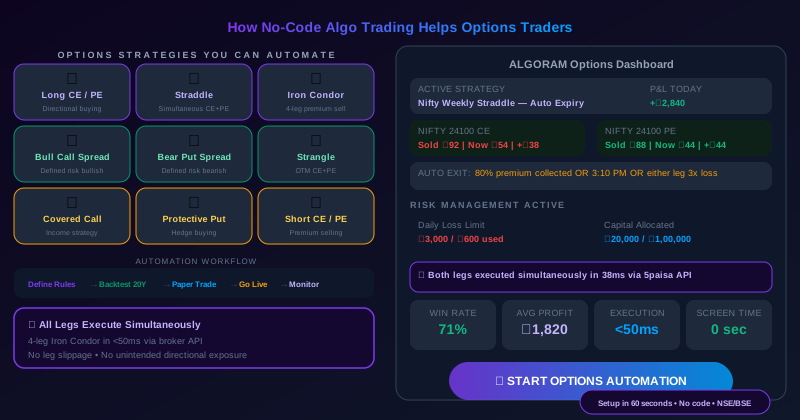
Every rule-based options strategy can be automated. Here are the most common with their automation structure:
Automate entry at breakout signal, auto SL at 50% premium loss, auto target at 100% gain, trailing stop once in profit.
Sell OTM options at specific delta/distance. Auto buy-back at 80% profit or SL at 3x premium received.
Buy ATM CE + ATM PE simultaneously. Auto-exit both legs based on combined P&L or individual leg targets.
Buy OTM CE + OTM PE simultaneously. Wider strikes, lower premium cost, requires larger move to profit.
Sell OTM CE + PE, buy further OTM CE + PE. All 4 legs execute simultaneously. Auto-close on breach of defined P&L limit.
Buy lower strike CE, sell higher strike CE simultaneously. Max profit and loss defined from entry. Clean auto-exit at expiry or target.
Buy higher strike PE, sell lower strike PE simultaneously. Bearish view with defined maximum loss.
Hold equity position, sell OTM CE to generate premium income. Auto-renew every monthly expiry cycle.
Hold equity position, buy OTM PE for protection. Automated based on portfolio delta or VIX threshold.
Entry, Exit and Stop-Loss Automation
Automated Entry Options
- Indicator-based: RSI crosses below 30 → buy ATM CE. VWAP breakout → buy OTM CE at specific delta.
- OI-based: When Put OI exceeds 50 lakh at S1 strike → confirm long CE entry.
- Time-based: Enter short Straddle at 9:35 AM every Thursday (post-opening range establishment).
- Price action: First 15-minute high breakout → automated entry with volume confirmation.
- Combination: Enter only when RSI > 55 AND price above VWAP AND Call OI at resistance is declining (confirming breakout).
Exit Automation Types
| Exit Type | How It Works | Best For |
|---|---|---|
| Fixed Stop Loss | Exits when premium drops to defined level (e.g., SL at ₹25 when entry ₹80) | Clear technical SL levels |
| % Premium Stop Loss | Exits when premium falls X% from entry (e.g., 40% of entry premium) | Buying strategies |
| Trailing Stop Loss | Follows premium upward — locks in gains as premium rises | Trending moves, avoid premature exit |
| Fixed Target | Exits when premium reaches defined profit level (e.g., target ₹140) | Clear resistance levels |
| % Profit Target | Exits when premium reaches X% gain (e.g., 80% of premium received) | Premium selling strategies |
| Time-Based Exit | Closes all positions at specified time (e.g., 3:10 PM sharp) | Theta decay management, overnight risk |
| Combined Multi-Leg Exit | Closes all legs when combined strategy P&L hits target/stop | Straddle, Iron Condor, Spreads |
Risk Management Automation
Risk management in options trading is more complex than equities due to leverage, time decay, and volatility sensitivity. No-code automation enforces these controls at the system level:
- Daily Loss Limit Auto-Stop: When cumulative daily losses hit your defined threshold (e.g., ₹3,000), all trading halts for the day. No override possible. This single feature prevents the most common options trading catastrophe — continued trading after a bad start accelerates losses.
- Capital-Based Position Sizing: Position size calculated automatically from your capital allocation setting — never from "confidence level." A 10% capital allocation on a ₹1,00,000 account always means ₹10,000 per trade, regardless of how strong the setup appears.
- Maximum Open Positions Limit: Set a maximum number of simultaneous open positions. Prevents concentration risk in multi-strategy setups.
- Per-Trade Risk Limit: Maximum loss per individual trade defined in rupees or percentage. Each entry comes with this limit enforced.
- Capital Protection Mode: Additional safeguards activate during high-VIX environments — reduced position sizes, tighter stops, or complete pause of new entries.
Options buyers lose to time decay every day they hold. A ₹100 ATM CE premium on Monday may be worth ₹60 by Thursday morning with no price movement — purely from theta decay. Automated time-based exits enforce strict holding period rules, preventing the common pattern of holding options long past the point where they're worth trading. This single rule saves options traders significant capital annually.
OI and Volume-Based Options Automation
Option Chain data is uniquely valuable for options strategies because it directly reflects institutional positioning. Automation makes this data usable in real-time without manual monitoring:
- OI-Confirmed Entry: System checks option chain OI data before executing. If Put OI at support is declining (unwinding), the support is weakening — long CE entry is blocked. If Put OI is rising (fresh writing), the system confirms entry.
- PCR-Filtered Trading: Define trading rules that only activate when PCR is within defined ranges. E.g., "Only take long CE trades when PCR is above 1.0 (bullish)" — prevents fighting the institutional trend.
- Volume-Spike Entry: Automated entry triggers when options volume at a specific strike spikes above 3x its average — indicating institutional participation in a directional move.
- Max Pain Tracking: System automatically identifies Max Pain before market opens and sets a price target for expiry-day Straddle exits accordingly.
For the complete guide to option chain analysis: How to Identify Support and Resistance Using Option Chain
Intraday Options Automation
Intraday options automation is the most common use case for Indian retail traders. Key setups:
ORB (Opening Range Breakout) — Nifty CE/PE
Rule: First 15-minute high/low establishes the opening range. When Nifty breaks above the 15-min high with rising volume AND Call OI at ATM+100 is declining (breakout confirmed), automatically buy Nifty CE. Stop: below the 15-min high level. Target: 1.5x the opening range size. Time exit: 2:00 PM if target not hit.
VWAP Reclaim — Bank Nifty CE
Rule: If Bank Nifty is above VWAP and pulls back to VWAP, then bounces above it with volume confirmation, automatically buy ATM+200 CE. Stop: 40% of premium. Trailing stop activates after 50% profit. Time exit: 3:10 PM.
Expiry Day Short Straddle
Rule: On weekly expiry day (Thursday), at 10:30 AM, check that VIX is below 18 and PCR is between 0.8–1.2 (neutral). Automatically sell ATM CE + ATM PE. Auto-close when combined premium received is down 60% OR either leg is up 3x. Time exit: 3:10 PM regardless.
Expiry day is the highest-risk session for options. Gamma acceleration can move ATM premiums 100–300% in 15 minutes. If trading expiry day manually without defined rules, the emotional pressure is extreme. Automation with hard stop-losses and a time-based exit at 3:10 PM makes expiry day tradeable for systematic traders.
Backtesting and Paper Trading
Before risking live capital on any automated options strategy, two validation steps are essential:
Backtesting
Historical backtesting runs your configured strategy against past NSE market data to generate objective performance statistics. What you're evaluating:
- Win rate: What % of trades were profitable?
- Average profit vs average loss: Is the risk-reward positive over time?
- Maximum drawdown: What was the worst consecutive loss sequence? Can you survive it psychologically and financially?
- Sharpe ratio: Returns per unit of risk — higher is better
- Best and worst periods: Does the strategy fail in specific market conditions (e.g., high-VIX months)?
ALGORAM's backtesting engine runs strategies against 20 years of NSE tick data, covering multiple market regimes including the 2008 crisis, 2020 COVID crash, and 2022 rate-hike period.
Paper Trading
After backtesting, 7+ days of paper trading on live market data validates that the strategy behaves as designed under real conditions — with real bid-ask spreads, real liquidity, and real market microstructure. Never skip this step for options strategies where slippage can significantly affect performance.
Manual vs No-Code Automated Options Trading
| Factor | Manual Options Trading | No-Code Automated Trading |
|---|---|---|
| Execution Speed | 8–25 seconds from signal to order | <50ms via broker API |
| Multi-Leg Execution | Sequential — 5–15 sec between legs | All legs simultaneously |
| Stop Loss | Manual — often skipped under pressure | Auto-placed with every entry |
| Daily Loss Limit | Willpower only — frequently violated | System-enforced auto-stop |
| Time-Based Exit | Manual — often missed | Automatic at configured time |
| Trailing Stop Loss | Extremely difficult to manage manually | Fully automated |
| OI Confirmation | Manual refresh every 15 min | Auto-evaluated before every entry |
| Emotional Decisions | FOMO, revenge trading, hope-holding | Zero — system never deviates |
| Backtesting | Manual chart scrolling — subjective | Systematic on 20Y NSE data |
| Working Hours Trading | Impossible without leaving work | Trades automatically in background |
| Coding Required | None needed | Zero — no-code platform |
| Setup Time | Instant (no setup) | Under 60 seconds |
How ALGORAM Powers Options Trading Automation
ALGORAM is built specifically for Indian retail options traders who want to automate their strategies without any technical background. The platform integrates all the components needed for complete options automation into a single, unified interface.
Key Capabilities for Options Traders
- Option Chain Integration: Real-time OI and volume data is automatically evaluated as a confirmation layer before every entry. No manual option chain checking required.
- Multi-Leg Simultaneous Execution: Straddle, Strangle, Iron Condor, and Spread strategies execute all legs via broker API in under 50ms — eliminating leg slippage entirely.
- Trailing Stop Loss: Options-specific trailing stop that follows premium upward and locks in gains — the most underutilised but highest-value feature for options buyers.
- Time-Based Exits: Critical for options — configure "close all positions at 3:10 PM" to avoid overnight risk and expiry-day gamma surprises.
- Daily Loss Limit Auto-Stop: Set once, never violated. Prevents the spiral of options losses that typically happens 15–30 minutes after a first bad trade.
- Backtesting Engine: Test any options strategy against 20 years of NSE data. Evaluate across high-VIX and low-VIX periods separately.
- Demo Mode: 7-day paper trading on live market data — see exactly how the strategy performs before deploying capital.
- Mobile Dashboard: Full monitoring, P&L tracking, and one-click Start/Stop from your phone. Platform runs on cloud servers — trades continue during office hours automatically.
Read: Top 10 Benefits of No-Code Algo Trading Platforms and How Beginners Can Start Algo Trading Without Coding
🔰 Automate Your Options Strategies Today
7-day paper trading demo on real NSE data. Straddle, Iron Condor, and directional CE/PE strategies — all fully automated, no code required.
Common Beginner Mistakes in Options Automation
- Automating a strategy without backtesting first. Running an untested strategy live is the equivalent of live trading a strategy you've never evaluated. Always backtest, then paper trade, then go live.
- Setting stop-loss too wide for options. A 50% premium stop-loss might be too loose for fast-moving expiry-day options. Tight stops (30–35% for buying strategies) preserve more capital for the next trade.
- Not setting a daily loss limit. Without a daily limit, one bad expiry-day session can wipe out weeks of gains. Set it at 1–2% of total capital per day maximum.
- Using weekly expiry for swing strategies. Weekly options have aggressive theta decay that makes them unsuitable for holding multiple days. Use monthly expiry for swing positions.
- Ignoring IV before entry. Entering a Straddle when IV is at a 6-month high means paying maximum premium — and IV crush when market stabilises can lose money even on a correct directional call.
- Not testing multi-leg strategy in paper mode first. Multi-leg execution in real markets may behave differently than expected. Paper trading reveals any issues with leg sequence, simultaneous execution, and combined P&L calculation.
Pre-Live Checklist for Options Automation
The Future: AI-Powered Options Trading
The current generation of no-code options automation platforms executes predefined rules reliably and consistently. The next generation is incorporating AI layers that go beyond rule execution:
- Dynamic strike selection: AI selects the optimal strike based on current IV rank, expected move, and historical win rates at different delta levels — rather than fixed ATM or fixed OTM rules.
- Regime-adaptive strategies: AI detects the current market regime (low-volatility range, trending, high-volatility event) and automatically switches to the strategy with the highest historical edge in that regime.
- Natural language strategy creation: "Sell Bank Nifty weekly straddle every Thursday at 10 AM if VIX is below 16 and PCR is between 0.9 and 1.1, exit at 3:10 PM or when 60% of premium is collected" — spoken or typed, instantly converted to executable automation.
- Continuous strategy optimisation: AI monitors live performance against backtest expectations and suggests parameter adjustments when performance diverges — catching market regime changes before they cause significant drawdowns.
Read: How AI is Changing Stock Market Trading in 2026
🚀 Launch Offer — First 100 Customers
Conclusion
Options trading is where the advantages of automation are most concentrated. Speed matters more (premiums move faster). Emotion causes more damage (leverage amplifies every mistake). Multi-leg strategies are genuinely impossible to execute well manually. And the risk management complexity — daily limits, time-based exits, IV-adjusted position sizing — exceeds what humans can reliably maintain under market pressure.
No-code automation addresses all of these systematically. The strategy is still yours — your analysis, your setups, your conviction. What automation provides is consistent execution of that strategy, every time, without the emotional interference that turns good analysis into poor outcomes.
The 7-day paper trading demo lets you see exactly this difference on real market data — at zero financial risk.
Start automating: → ALGORAM 7-day free options demo
Best offer: → Open 5paisa for 3 months free access
Option chain guide: → How to Use Option Chain for S&R
Avoid costly mistakes: → Top 10 Trading Mistakes to Avoid
Strategy overview: → Top 10 Algo Trading Strategies
Frequently Asked Questions

Rahul architected ALGORAM's options automation engine — including the simultaneous multi-leg execution system, OI confirmation layer, and options-specific trailing stop logic. He built these specifically after studying the execution gaps that cause most Indian options traders to underperform their analytical edge.