Introduction
Every professional algo trader has something the average retail trader doesn't: a strategy they've tested, refined, and trust enough to automate. Not a gut feeling. Not a Telegram tip. A systematic approach that tells the algorithm exactly when to enter, exit, and how much to risk — under any market condition.
The strategies professionals use aren't secret. They're based on established technical analysis concepts — trend following, mean reversion, momentum, breakouts — implemented with precision and discipline that actually works in live markets.
The difference between a retail trader using RSI manually and a professional using an RSI-based algo isn't the strategy. It's execution: consistent, emotionless, and faster than any human can manage by hand.
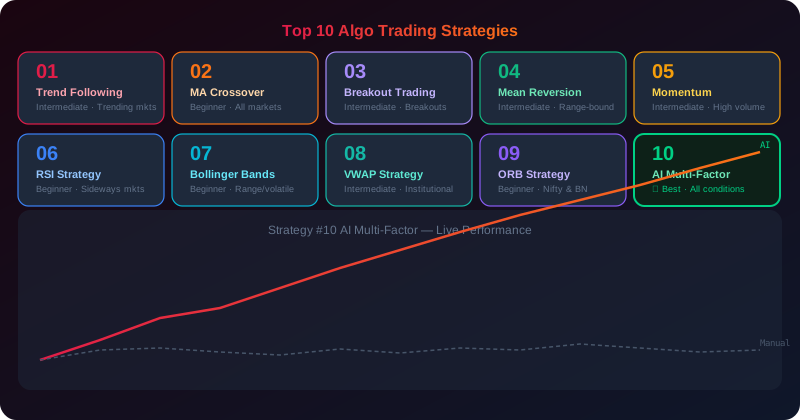
This guide covers all 10 most widely used algorithmic trading strategies with complete entry logic, exit logic, risk management, and suitability ratings for Indian markets.
No trading strategy guarantees profits. All strategies have winning and losing periods. The goal of algorithmic trading isn't to eliminate losing trades — it's to execute a proven strategy consistently, remove emotional deviations, and let the statistical edge play out over time. Always backtest before going live and use a paper trading demo first.
What is an Algo Trading Strategy?
An algo trading strategy is a set of rules that tells a system when to buy, when to sell, how much to trade, and how to manage the position. Every decision is pre-defined. The algorithm executes exactly those rules, every time, without exception.
A complete strategy has five components: entry signal (when to open), exit signal (when to close), position sizing (how much capital), stop-loss (maximum loss per trade), and market condition filter (when to trade and when to sit out).
Why Professional Traders Use Algorithmic Trading
- Consistency — Same rules on Monday and Friday, after 5 wins and 5 losses
- Speed — Sub-50ms execution captures prices manual trading misses
- Scale — Multiple strategies across multiple instruments simultaneously
- Backtesting — Validate performance before risking real capital
- Emotion-free execution — No fear, greed, or FOMO overriding the plan
For why automation consistently outperforms manual trading: Manual Trading vs Automated Trading: Which Wins in 2026?
Things to Consider Before Using Any Strategy
📊 Test All 10 Strategies Risk-Free
ALGORAM provides pre-built, 20-year backtested versions of these strategies — ready on a 7-day paper trading demo. See live performance before risking capital.
The Top 10 Algo Trading Strategies
Trend following is the foundation of professional algo trading. Identify the dominant market direction and trade in that direction until the trend ends. Moving averages, ADX, and price action structure define the trend; the algo enters on pullbacks within the trend and exits when the trend reverses.
Price above 50 EMA (uptrend) AND RSI between 40–65 (not overbought) AND volume confirms. Enter on next candle open after all conditions met.
Price closes below 50 EMA with volume, OR stop-loss triggered (1.5× ATR below entry), OR trailing stop after 2% profit.
Stop-loss at 1.5× ATR below entry. Position size: max 1% capital risk per trade. Daily loss limit: 2% of capital.
Nifty and large-cap stocks in directional phases. Avoid during sideways/choppy conditions (ADX below 20).
When a shorter-period MA crosses above a longer-period MA, it signals upward momentum (golden cross — buy). When the short MA crosses below the long MA, it signals downward momentum (death cross — sell/exit). Simple, visual, and one of the best starting strategies for beginners.
9 EMA crosses above 21 EMA on 15-minute chart with volume above 20-period average. Enter buy on close of crossover candle.
Opposite crossover occurs, OR stop-loss triggered. Trail stop below the short EMA after 1.5% profit.
Fixed stop-loss 0.8% below entry for intraday. Max 2 positions simultaneously. Daily loss limit applies.
Nifty futures, large-cap stocks. Works across timeframes — 5 min (scalping) to daily (swing trading).
Use ADX as a confirmation filter. A MA crossover with ADX above 25 is significantly more reliable. Without it, you'll take many false signals in sideways markets.
When price breaks through a significant resistance or support level with strong volume, the move often continues. The algo monitors key levels — consolidation ranges, previous day highs/lows — and fires an entry the moment price breaches the level with volume confirmation.
Price closes above resistance level (consolidation high over 5+ candles) with volume at least 1.5× 20-period average. Enter on next candle open.
Fixed target: 2× the breakout candle's range. Stop-loss: below the breakout candle's low. If price returns inside range — exit immediately.
Never trade breakouts without volume confirmation. Risk per trade: max 1% of capital. Avoid breakouts within 30 mins of market close.
All instruments — Nifty, Bank Nifty, stocks. Most effective at daily breakouts from multi-week consolidation ranges.
Mean reversion bets that when price moves significantly away from its historical average, it will return toward the mean. This is the opposite of trend following — and it's why professional algo portfolios often run both simultaneously to balance performance across market regimes.
Price moves more than 2 standard deviations from its 20-period MA (touches lower Bollinger Band). RSI below 30 confirms oversold. Enter long. Reverse for short entries.
Price returns to 20-period MA (the mean), OR RSI reaches 50–55 (neutral zone). Fixed target: 0.8× standard deviation from entry. Stop: 0.5% below entry.
Critical: avoid in strongly trending markets — mean reversion against a trend creates large losses. Use ADX below 20 as market condition filter.
Large-cap stocks, Nifty in consolidation phases. Most effective on 15-minute to hourly charts for intraday trading.
Momentum strategies buy what's already going up and sell what's going down. The principle: instruments moving strongly in one direction tend to continue for a period. The algo identifies instruments with above-average price momentum and volume, enters in the direction of momentum, and rides it until momentum fades.
Price up 1.5%+ from day's open with expanding volume. RSI above 60 (confirmed momentum). Enter within first 2 hours of market open when momentum is strongest.
Volume declining significantly (momentum fading), OR price gives back 50% of the day's gain, OR fixed time exit at 2:30 PM. Trail stop after 2% gain.
Stop-loss: 0.8% below entry for intraday momentum. Never hold through 12–1 PM when momentum typically fades. Full exit by 2:45 PM mandatory.
Bank Nifty options (high volatility amplifies momentum), midcap stocks with news catalysts, Nifty on post-data release days.
Momentum is the strategy where execution speed matters most. A 5-second delay on a fast Bank Nifty option can mean 15–20% worse fill price. This is where sub-50ms algorithmic execution changes everything.
The Relative Strength Index (RSI) measures how overbought or oversold an instrument is on a scale of 0 to 100. The algo buys when RSI drops below 30 (oversold) and sells when RSI rises above 70 (overbought). Additional filters dramatically improve reliability in live Indian market conditions.
RSI(14) drops below 30 on 15-minute chart (buy signal). RSI rises above 70 (sell signal). Filter: only trade in direction of daily trend. Volume above 20-period average.
Buy exits when RSI reaches 60+ (mean territory). Sell exits when RSI reaches 40. Stop-loss: 1% below entry for longs, 1% above for shorts.
Always confirm RSI signals with at least one other indicator. Never use RSI alone in trending markets — it generates repeated false signals.
Large-cap stocks, Nifty in range-bound conditions. Works across 5-minute (scalping) to daily (swing) timeframes with adjusted parameters.
Bollinger Bands place two standard deviation bands above and below a moving average. Price touching the upper band signals potential sell. Lower band signals potential buy. The band squeeze — bands narrowing dramatically — signals a major move is building. Professional algo traders combine Bollinger Bands with volume and trend filters for best results.
Price touches lower Bollinger Band (2σ, 20-period MA) + RSI below 35 + volume above average = buy signal. Reverse for sell. Band squeeze + breakout = directional trade.
Price reverts to 20-period middle band (mean reversion target). Or price reaches opposite band (breakout plays). Stop: candle close outside band in opposite direction.
Position size based on band width — wider bands = higher volatility = smaller position. Never average down on mean reversion trades.
Large-cap stocks, Nifty in sideways phases. Band squeeze strategy works ahead of major announcements (RBI policy, earnings).
The Volume Weighted Average Price (VWAP) is the benchmark used by every institutional trader. When price is above VWAP, institutions are comfortable buying. Below VWAP, they sell. The VWAP algo exploits this institutional behaviour by entering trades at VWAP retest levels — one of the most reliable intraday strategies for Indian markets.
Price above VWAP → buy on first pullback to VWAP with bounce confirmation (bullish candle at VWAP level). Price below VWAP → short on first bounce to VWAP with rejection.
Target: previous session high/low or VWAP ±0.5%. Stop: candle close through VWAP by more than 0.2%. Time exit: avoid after 2 PM when VWAP loses reliability.
VWAP most reliable 9:30–11:30 AM. Avoid on low-volume days or around major news events. Risk per trade: max 1% of capital.
Nifty and Bank Nifty futures/options, high-volume large-cap stocks (Reliance, HDFC, Infosys). Best for intraday strategies.
VWAP is the most-watched level by institutional traders in India. When Nifty returns to VWAP after a morning breakout, watch for extreme volume concentration — that's institutional accumulation happening in real time.
The Opening Range Breakout is one of the most popular strategies among Indian intraday traders. The first 15–30 minutes of the trading session often establish the day's directional bias. ORB defines the high and low of this opening range, then trades the breakout when price exits that range with conviction. Works remarkably well on Nifty and Bank Nifty.
Define opening range: 9:15–9:45 AM high and low. Buy when price closes above ORB high with volume expansion. Sell when price closes below ORB low with volume expansion.
Target: 2× the ORB range above the breakout point. Stop-loss: midpoint of the ORB for buys. Trail stop after 1× range achieved. Mandatory exit before 3 PM.
Skip ORB on high-volatility event days (RBI policy, budget, F&O expiry). Max 1 trade per direction per day. Risk: 1% of capital per trade.
Nifty and Bank Nifty options — the primary use case. Also works on Nifty futures and high-beta stocks. Best on normal trading days.
This is what separates modern algorithmic trading from the nine strategies above. Instead of relying on a single indicator, an AI multi-factor strategy combines multiple signals — technical indicators, OI data, market regime, VIX, time-of-day patterns, volume profile — and uses machine learning to determine when their confluence produces a high-probability trade setup. ALGORAM's core strategies use this approach.
Multi-factor confluence: trend direction (EMA) + momentum (RSI/MACD) + volume + OI analysis + AI probability filter above 65% historical threshold. ALL must align before signal fires.
AI-managed trailing stop adapting to current volatility. Fixed target based on historical average move in similar setups. Time-based exit if momentum fades without hitting target.
Dynamic position sizing based on signal confidence and current VIX. Daily loss limit enforced at system level. Maximum drawdown parameters built into strategy logic.
All instruments — Nifty Options, Bank Nifty Options, Stocks. Adapts to market conditions automatically. ALGORAM's primary automated trading strategy.
All 10 Strategies — Comparison Table
| # | Strategy | Level | Best Market | Win Rate* | Risk | Nifty/BN? |
|---|---|---|---|---|---|---|
| 1 | Trend Following | Intermediate | Trending | 55–65% | Medium | ✓ Yes |
| 2 | MA Crossover | Beginner | All | 50–60% | Low | ✓ Yes |
| 3 | Breakout | Intermediate | Breakout | 55–65% | Medium | ✓ Yes |
| 4 | Mean Reversion | Intermediate | Sideways | 65–72% | Medium | Limited |
| 5 | Momentum | Intermediate | Trending | 55–65% | High | ✓ Best for BN |
| 6 | RSI-Based | Beginner | Sideways | 58–68% | Low | ✓ Yes |
| 7 | Bollinger Bands | Beginner | Range/Volatile | 60–68% | Medium | ✓ Yes |
| 8 | VWAP | Intermediate | All | 62–70% | Low–Med | ✓ Excellent |
| 9 | ORB | Beginner | Normal Days | 60–70% | Low | ✓ Best |
| 10 | AI Multi-Factor | AI-Powered | All Conditions | 70%+ | Low–Med | ✓ All |
*Historical backtested win rates. Not a guarantee of future performance.
Which Strategy is Best for Beginners?
Start simple. The three most beginner-friendly strategies in order of ease:
- ORB (Strategy #9) — Clear rules, defined time window, excellent for Nifty/Bank Nifty
- RSI-Based (Strategy #6) — Easy to understand, good for learning how indicators work
- MA Crossover (Strategy #2) — Simple, visual, teaches trend identification fundamentals
Worst strategy for beginners: Momentum (#5) — requires fast execution that manual trading cannot provide. Read: How Beginners Can Start Algo Trading Without Coding in 2026
Best Strategies for Nifty & Bank Nifty
Nifty's measured, directional moves make ORB and VWAP highly reliable. The opening range sets clear structure most days. AI multi-factor works across all conditions.
BN's high volatility makes momentum and breakout strategies powerful. Fast moves require sub-50ms execution — manual trading is severely disadvantaged here.
Common Mistakes Traders Make with Algo Strategies
- Over-optimising on historical data — Building a strategy that perfectly fits past data but fails in live markets. Fix: out-of-sample testing across 20 years.
- Using a strategy in the wrong market regime — Running trend-following in a sideways market generates repeated small losses. Know which conditions your strategy needs.
- Ignoring slippage in backtests — Without realistic slippage and brokerage costs, backtested results are inflated and misleading.
- Abandoning a good strategy during drawdown — Every strategy has losing periods. Stopping a working strategy during its normal drawdown phase destroys any edge.
- No paper trading first — Seeing a strategy perform in real conditions with virtual money builds the confidence to hold positions through normal volatility.
- No daily loss limit — Without a hard system limit, a bad day can become catastrophic. ALGORAM enforces daily loss limits at the system level.
"The strategy determines when you trade. Risk management determines whether you're still trading next month."
— Ankit Patel, Founder & MD, ALGORAMHow ALGORAM Automates These Strategies
ALGORAM provides pre-built, professionally backtested versions of the strategies in this guide — implemented with AI signal filtering and connected directly to your broker via official API. Institutional-quality strategy execution available to any Indian retail trader with no coding required.
Complete lifecycle automated — signal to entry to SL to target. Sub-50ms execution via 5paisa API.
AI-filtered ORB, VWAP, and multi-factor strategies for Nifty CE/PE. Daily & weekly expiry.
Momentum and breakout strategies calibrated for BN's volatility. Tight SL management.
Trend following and MA crossover on NSE/BSE equities with OI confirmation.
AI layer filters ~25% of false signals. Market regime detection adjusts parameters automatically.
Auto SL, hard daily loss limit, capital-based position sizing. System-enforced — never overridden.
AI signal monitoring on your instruments — even when full automation is paused.
Push notifications for every entry, exit, SL trigger, daily P&L. Always informed.
Automated options strategies with earnings event filtering and smart capital protection.
🚀 Launch Offer — First 100 Customers Only
Conclusion
The 10 strategies in this guide represent the foundation of professional algorithmic trading. None of them are secrets — all are based on proven technical analysis principles tested in markets for decades. What separates professional algo traders from retail traders isn't the strategy. It's execution: consistent, disciplined, fast, and emotion-free.
The most important decision isn't which strategy to use — it's choosing a platform that implements your chosen strategy reliably, with proper risk management, validated on Indian market data. ALGORAM was built to be that platform.
Start with the 7-day free demo. Run any of these strategies on real NSE data with zero financial risk. See how they perform before committing capital.
Step 1: Choose 1–2 strategies matching your trader type and market conditions
Step 2: → Start ALGORAM's 7-day free demo
Step 3: → Open 5paisa for 3 months free access
Learn more: → What is Algo Trading? Complete Beginner's Guide
AI in trading: → How AI is Changing Stock Market Trading (2026)
Frequently Asked Questions

Ankit spent 15+ years testing and trading algorithmic strategies on Indian markets before founding ALGORAM. He has personally backtested and traded all 10 strategies in this guide across multiple market cycles. His mission: make professional strategy execution accessible to every Indian retail trader.