Introduction
There's a debate that never quite ends in Indian trading circles. You'll find it in Telegram groups, YouTube comment sections, and trading forums: "Should I trade manually or go algorithmic?"
Both sides have passionate supporters. The manual trader will tell you about the intuition they've built from years of watching charts — the gut feeling that saved them during a flash crash or locked in a massive winner before the signal was obvious. The algo trader will show you their consistent monthly P&L and tell you about the five months where they made money even during sideways markets their manual friends struggled in.
Here's the thing: both are partially right. And the honest answer — the one this article gives you — is more nuanced than most blogs in this space are willing to admit.
We're going to compare both approaches properly: real pros, real cons, real scenarios, and a balanced verdict that helps you make the right decision for your specific situation. And yes — we'll also show you why platforms like ALGORAM exist and who they're genuinely built for.
What is Manual Trading?
Manual trading is exactly what it sounds like. You watch the markets yourself — through charts, news, price action, or some combination — identify a trading opportunity, and place the order by hand. Every decision is yours: when to enter, where to put the stop-loss, when to exit.
Most Indian retail traders start here. Your first Zerodha account. Your first Kite order. Watching the NIFTY chart and clicking the buy button. It's the natural starting point, and for good reason — direct market participation teaches you things no book can.
Manual trading spans a wide range — from someone checking intraday charts every five minutes to a positional investor who checks their portfolio once a week. What unifies them is that a human decision drives every trade.
What is Automated Trading?
Automated trading uses software — an algorithm — to execute trades based on pre-defined rules. The rules replace human decision-making: "When RSI crosses 60 and volume is above 20-day average and the 15-minute candle closes above resistance, buy NIFTY 24000CE, place SL at 0.8%, target at 2%."
Once programmed, the algorithm monitors the market continuously, identifies setups matching your criteria, and executes instantly — without waiting for you to notice, think, and click.
Modern no-code platforms like ALGORAM take this further: you don't even need to define the rules yourself. Pre-built, backtested strategies are available to activate with a single button. You configure the capital and risk parameters; the strategy handles everything else.
For a complete beginner's introduction to how this works, read: What is Algo Trading? A Beginner-Friendly Guide for Indian Traders
How Trading Has Evolved Over the Years
Twenty years ago, most Indian traders sat in physical offices watching CRT screens and calling their brokers to place orders over the phone. The concept of algorithmic trading belonged exclusively to large institutions with dedicated quant teams.
Ten years ago, online trading democratised execution. You could now trade from your laptop, access real-time charts, and place orders in seconds rather than minutes.
Today, the democratisation has extended to automation itself. Platforms like ALGORAM allow a trader in Surat with zero coding knowledge to run the same category of algorithmic execution that institutional desks in Mumbai use — at a fraction of the cost, with pre-built strategies tested across decades of data.
In 2015, algorithmic trading accounted for roughly 30% of NSE volume. By 2024, that figure had crossed 60%. This isn't a trend — it's a structural shift. The market is increasingly priced by algorithms, which has direct implications for manual traders competing in the same arena.
Manual Trading vs Automated Trading: Quick Comparison
| Factor | Manual Trading | Automated Trading |
|---|---|---|
| Execution Speed | 5–30 seconds | Under 50 milliseconds |
| Emotional Influence | High — fear, greed, FOMO | Zero — logic only |
| Strategy Consistency | Varies day to day | 100% consistent |
| Screen Time Required | 5–7 hours/day | Near zero |
| Backtesting | Not practical | Automated across 20Y data |
| Human Judgment | Full control | Limited to strategy setup |
| Adaptability | Real-time contextual | Limited to programmed rules |
| Multi-Instrument | 1–2 at a time | Unlimited parallel |
| Beginner-Friendly | Learning curve | With right platform |
| Minimum Capital | Any amount | From ₹25,000 |
Advantages of Manual Trading
Human Judgment in Complex Situations
This is manual trading's real, underappreciated advantage. An experienced trader watching markets in real time can integrate context that no algorithm easily captures: the RBI statement tone, the US Fed meeting subtext, the unusual block deal that just appeared on the screen, the sudden movement in SGX Nifty at 8:45 AM.
Good discretionary traders — the ones who've genuinely put in the hours — develop pattern recognition that goes beyond indicators. It's the "something feels off about this setup" instinct that keeps them out of a trade that looks perfect on paper but fails badly. That intuition is real, and algorithms don't have it.
Market Learning and Development
Manual trading forces engagement with the market that automation doesn't. Every trade you place manually teaches you something — about price action, about your own psychology, about market structure. Many of the best algo traders started manual and brought years of hard-won market understanding into their system design.
There's real value in that developmental period. Jumping straight to automation without understanding what you're automating has its own risks.
Flexibility and Adaptability
Markets occasionally do genuinely unusual things. Circuit breakers, sudden geopolitical events, unprecedented sector moves. A manual trader can stop, reassess, and make a judgment call. A rigid algorithm just keeps firing signals according to its rules — which may be completely wrong for that specific unusual day.
Disadvantages of Manual Trading
Emotional Decision-Making
Here's an uncomfortable truth: the advantages of manual trading described above require significant experience and exceptional discipline to actually access. The majority of retail traders — especially in the first several years — don't make nuanced macro judgments. They make fear-based and greed-based decisions that they later rationalise as "judgment."
Moving the stop-loss because you "feel" the trade will come back is not human judgment. Entering a trade because you're afraid of missing out is not intuition. These are emotional responses masquerading as analysis, and they destroy accounts.
SEBI's study of individual F&O traders in India consistently shows that over 90% lose money over any given 3-year period. The primary cause is not lack of strategy knowledge — it's inconsistent, emotional execution. Manual trading creates the conditions for these failures. Automation removes them.
Slow Execution — Fatal in Options
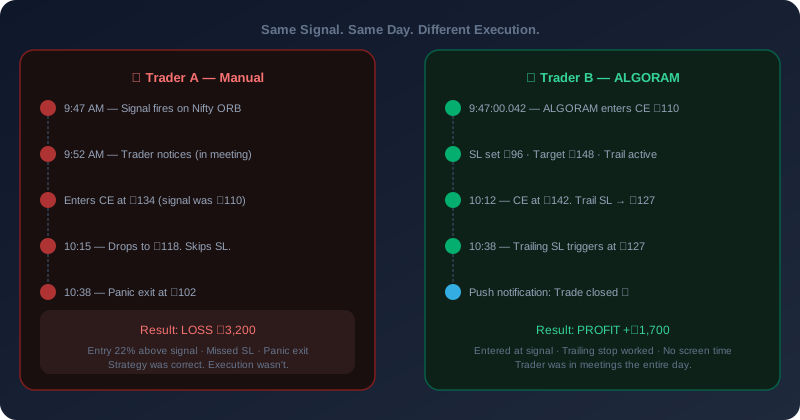
In Nifty and Bank Nifty options, a 10-second delay can mean entering at ₹140 instead of ₹115 on an ATM option during a fast move. That's a 20%+ difference in your entry price — before the trade has even begun. Manual execution speed is simply incompatible with fast-moving F&O markets.
Missed Opportunities and Inconsistency
Your setup triggers at 11:34 AM while you're in a meeting. Or you see the signal but hesitate because the previous two were losers. Or you take the trade but exit at 60% of the target because you're nervous. These micro-inconsistencies — spread across hundreds of trades — compound into significant underperformance versus your own strategy's theoretical results.
The Screen Time Cost
Five to seven hours of focused market attention every day is not a lifestyle most people can sustain indefinitely. And when it breaks down — on the days you're distracted, tired, or emotionally off — your trading suffers disproportionately. The days when your manual execution is worst tend to be the days when market conditions most reward discipline.
Advantages of Automated Trading
Execution Speed That Changes Everything
Sub-50 millisecond execution is not an incremental improvement over 10-second manual entry. It's a qualitatively different class of participation. You're in trades before most manual traders have finished identifying the setup. You're out when conditions change before most have noticed. In options specifically, this speed advantage compounds directly into better average entry prices and lower slippage.
Zero Emotional Interference
The algorithm doesn't feel fear before entering a trade. It doesn't hold a losing position hoping it'll come back. It doesn't cut profits early because it's nervous. It doesn't revenge trade after a bad session. Every rule you set is executed exactly — the same on your best day as on your worst, the same after ten wins as after three losses.
"Discipline is not a character trait. It's a system design choice. Build the discipline into the algorithm, and you never have to fight yourself again."
— Ankit Patel, Founder & MD, ALGORAMConsistent Rule-Based Decisions
The gap between what traders plan to do and what they actually do under real-time pressure is where most trading accounts underperform. An algorithm closes that gap permanently. Your strategy's theoretical edge — based on backtesting — gets realised in practice because execution matches plan.
24/7 Market Monitoring
Markets don't respect your schedule. Gaps open at 9:15 AM for reasons that happened at 9:14 AM. Pre-market SGX Nifty moves create setups before most traders have finished breakfast. An automated system monitors every tick, every second, without fatigue — and acts the moment conditions are met.
Simultaneous Multi-Symbol Execution
You cannot effectively monitor NIFTY options, BANKNIFTY options, and three stock positions simultaneously as a manual trader. ALGORAM does this routinely — scanning all configured instruments in parallel, allocating capital intelligently, and executing across multiple positions without any degradation in speed or accuracy.
Disadvantages and Limitations of Automated Trading
Honest assessment matters here. Automated trading is not magic, and overstating its advantages serves no one.
- Black swan events — Highly unusual market events (flash crashes, circuit breakers, unprecedented news gaps) can produce results that diverge significantly from backtested expectations. No algorithm is perfectly calibrated for every possible market scenario.
- Over-optimisation risk — Poorly designed automated systems can be "curve-fitted" to historical data — performing beautifully in backtesting and poorly in live markets. This is why 20-year backtesting across multiple market cycles matters, and why ALGORAM's strategy development includes rigorous out-of-sample testing.
- Initial setup and monitoring — While ongoing time requirement is minimal, initial setup requires attention. And while automation runs independently, periodic reviews of performance and strategy health are still good practice.
- Technical risks — Internet outages, broker API downtime, or software errors can occasionally affect execution. Good platforms have redundancy and error-handling built in, but no technology is 100% infallible.
- Inflexibility in unusual conditions — As discussed, some market situations benefit from human contextual judgment that rule-based systems can't replicate perfectly.
Automated trading's advantages are most powerful in the situations where most retail traders struggle most — high-frequency intraday execution, discipline during volatile periods, consistent multi-month performance. Its limitations show up in genuinely unusual events. The net result, for most retail traders, strongly favours automation. But context matters.
🚀 Experience Both — Free for 7 Days
Try ALGORAM's paper trading demo and see automated trading on real market data. Zero risk. Keep your manual trading going alongside — compare for yourself.
Real-World Trading Scenarios Comparison
Theory aside — here's how the two approaches play out in actual trading situations Indian traders face daily.
Scenario 1: The 9:20 AM Nifty Gap
SGX Nifty is down 1.2% overnight. The moment markets open, Nifty gaps down 220 points. ATM puts spike 40% in 90 seconds.
Manual trader: Wakes up at 9:18, sees the move, hesitates — "is this a gap fill or continuation?" — finally decides to enter puts at 9:21. The move has already happened. Entry is 35% worse than the initial spike.
ALGORAM user: System pre-configured overnight. Gap-down detected at market open. Puts entered at 9:15:03. Stop placed. Target set. Trader sees the trade notification on their phone at 9:16 while still having breakfast.
Scenario 2: Three Consecutive Losing Trades
It's 11:30 AM. A manual trader has had three straight losing BANKNIFTY scalps — down ₹8,000 for the day. A fourth setup appears, technically valid.
Manual trader: Emotions compromised. Either skips the trade out of fear (potentially missing a winner), or takes it with double size trying to recover (potential disaster).
ALGORAM user: System has a daily loss limit. It stopped trading automatically after the third loss hit the preset limit. No emotional decisions possible. Capital protected. Tomorrow is another day.
Scenario 3: Working Day Trade
A software engineer has a meeting from 10 AM to 12 PM. A clean NIFTY setup emerges at 10:45 AM with a well-defined risk/reward.
Manual trader: Misses it entirely. The setup runs 2.5x before they're back at their desk.
ALGORAM user: The trade was identified and executed automatically at 10:46 AM. When they check their phone at 12:05 PM, the position is already at target and closed. ₹4,200 added to their day.
Manual vs Automated: Which Suits Which Trader?
Start with demo trading manually to understand markets, then add automation via ALGORAM's pre-built strategies to avoid costly emotional mistakes early on.
If markets are open while you're working, manual trading is largely impractical. Automation is the only realistic way to participate consistently.
Core strategies on automation for consistency. Manual discretion reserved for specific high-conviction, low-frequency macro plays.
Automated systematic strategies for consistent compounding. Remove the temptation to micro-manage positions based on short-term market noise.
Why More Traders Are Moving Towards Automation
The shift is real and measurable. Here are the concrete reasons why experienced Indian traders are increasingly adding automation to their approach:
- The emotional toll is real — Most traders don't quit because of bad strategies. They quit because of the daily emotional grind. Automation removes that burden entirely.
- Time value is being reconsidered — 6 hours of chart watching every day is 1,560 hours a year. Redirected to a career, business, or family, that time has enormous value. Automation lets you have both.
- Results speak for themselves — Traders who make the switch and use platforms properly consistently report more consistent monthly P&L, not necessarily higher peaks, but fewer catastrophic months.
- Platforms have improved dramatically — Five years ago, no-code algo trading didn't really exist for retail traders in India. Today, ALGORAM delivers genuine institutional-quality execution without requiring a single line of code.
How AI is Transforming Modern Trading
The addition of AI to trading isn't about replacing human intuition — it's about extending what's computable. Modern AI trading systems like ALGORAM go beyond simple if-then rules:
- Market regime detection — AI identifies whether the current environment is trending, mean-reverting, or chaotic, and adjusts strategy parameters accordingly.
- False signal reduction — Pattern recognition across millions of historical trades identifies which setups have genuinely predictive value vs which ones are statistical noise.
- Dynamic risk adjustment — Position sizing that adapts to current volatility (VIX) rather than using fixed parameters regardless of conditions.
- Continuous learning — As market structure evolves, AI-enhanced systems can adapt their pattern libraries rather than remaining static.
This is what separates ALGORAM from a basic rule-based algo. The AI layer doesn't just execute — it filters, evaluates, and improves signal quality over time.
Why ALGORAM Is Built for Modern Indian Traders
ALGORAM wasn't designed for hedge funds or quant teams. It was designed for the working professional who trades Nifty options during lunch breaks and misses entries. For the experienced trader who knows exactly what strategy to run but keeps deviating under emotional pressure. For the beginner who understands what algo trading is but has no idea where to start.
Every feature reflects a real problem that Indian retail traders face:
- Daily loss limits — because most accounts are blown not by bad strategies but by bad days followed by revenge trading
- No-code Beginner Mode — because most traders can't and shouldn't need to write Python
- Demo Mode — because real confidence comes from seeing the system perform on real data before committing capital
- Mobile dashboard — because Indian traders have lives outside of markets
For a detailed comparison of ALGORAM vs traditional platforms, read: Best Trading Software for Indian Stock Market Traders (2026)
ALGORAM Features
Every step automated — entry, SL, targets, trailing stop, exit. Zero manual intervention needed.
Intraday and positional strategies for high-liquid NSE/BSE equities with smart position sizing.
Automated stock option strategies on top counters with earnings event protection built in.
AI-filtered Nifty CE/PE automation. Multi-timeframe + OI-based strike selection. Daily & weekly expiry.
Volatility-calibrated Bank Nifty strategies. Tight SL management for BN's fast intraday moves.
Secondary AI layer filters false signals by ~25%. Adapts to market regime and volatility conditions.
Monitor instruments and receive AI-analysed signals even when automation is paused.
Push notifications for every entry, exit, SL hit, and daily P&L summary to your mobile.
Auto SL, hard daily loss limit, position sizing, no averaging down. Capital protection is non-negotiable.
Manual Trading vs ALGORAM: Full Comparison
| Factor | Manual Trading | ALGORAM Automated |
|---|---|---|
| Entry Execution | Manual, 10–30 sec delay | Automatic, under 50ms |
| Emotional Trading | Constant risk factor | Impossible — algorithm only |
| Stop-Loss Adherence | Often modified under pressure | System-enforced, immovable |
| Daily Loss Protection | Self-discipline required | Hard limit auto-stops trading |
| Working Hours Trading | Impossible | Fully automatic |
| Strategy Consistency | Varies by mood, energy, stress | 100% identical every day |
| Backtesting Validation | Not practical | 20 years NSE data, done for you |
| Multi-Instrument | 1–2 at a time realistically | Nifty + BankNifty + Stocks parallel |
| Daily Screen Time | 5–7 hours minimum | Near zero after setup |
| Coding Requirement | None | None (Beginner Mode) |
| Demo/Paper Trading | Possible manually | 7-day live paper trading |
| Performance Analytics | Manual tracking | Automated dashboard |
🚀 Launch Offer — First 100 Customers Only
How to Get Started with ALGORAM
Open 5paisa (or connect your existing broker)
New account: use our referral for 3 months free. Existing traders: connect Zerodha, Upstox, Angel One, Fyers, Dhan, or Kotak via official API.
Sign Up and Start Your Demo
Create your account at algoram.in. 7-day paper trading demo activates immediately — no card required.
Run Demo Mode First
Watch ALGORAM trade your chosen instruments on real live data with zero financial risk. Build confidence before committing capital. 5–7 days is ideal.
Select Strategy, Set Parameters
Choose your instrument(s), capital allocation, and daily loss limit. Beginner Mode makes this a 60-second process.
Press Start — Let It Work
One tap. ALGORAM handles everything from market open to close. Check your P&L summary at end of day. Adjust next week based on performance.
Completely new to all this? Start here: How Beginners Can Start Algo Trading Without Coding in 2026
Conclusion: The Balanced Verdict
So — manual trading or automated? The honest answer is: it depends on you. And that's not a cop-out — it's genuinely the right starting point.
What's clear is this: the market environment in 2026 increasingly rewards speed, consistency, and discipline — three things algorithmic systems deliver reliably and most manual traders struggle to maintain under real pressure.
The most sophisticated approach many experienced traders take is a hybrid: automated systems handle their core recurring strategies (where consistency and speed matter most), while they retain manual discretion for specific macro-driven, low-frequency plays where their experience genuinely adds edge.
If you're currently trading manually and experiencing the emotional ups and downs most traders describe — the inconsistency, the stress, the missed entries — trying automation isn't giving something up. It's adding a layer of discipline your strategy already deserves.
Start with ALGORAM's 7-day free demo. Keep your manual trading running alongside it. Compare the results yourself.
You don't have to choose immediately. ALGORAM's demo lets you run automated strategies on real market data with zero financial commitment. Watch how it performs on the same days you're trading manually. After a week, you'll have concrete data — not just opinions — to base your decision on.
Frequently Asked Questions

Ankit spent over a decade trading Indian markets manually before founding ALGORAM. He experienced every advantage and disadvantage of manual trading firsthand — which is why he's qualified to write this comparison honestly rather than as pure promotion. His mission with ALGORAM is to give every Indian retail trader access to institutional-quality automation, regardless of their technical background.