Introduction
Think about what happened every time a big piece of economic news dropped in the last decade. The market moved. Sometimes violently. And within seconds — often before most human traders had even read the headline — prices had already adjusted to reflect the new information.
Who moved those prices? Algorithms. AI systems. Machines that don't need to read the news — they process it in milliseconds and act.
This is the new reality of stock market trading in 2026. Artificial intelligence isn't coming to trading — it's already here, already dominant in market volume, and already reshaping what it means to trade effectively. The question for Indian retail traders isn't whether to pay attention to AI. It's how to understand it, adapt to it, and — where possible — use it.
This guide covers everything: what AI is actually doing in markets, how it differs from human trading, what the real benefits and risks are, and how platforms like ALGORAM are making AI-powered trading accessible to Indian retail traders who couldn't afford institutional tools just five years ago.
What is Artificial Intelligence in Trading?
Artificial intelligence in trading refers to software systems that use machine learning, pattern recognition, and data analysis to make trading decisions — either independently or as a layer of intelligence on top of rule-based algorithms.
The key distinction from regular algorithmic trading: a basic algorithm follows fixed rules. "If RSI > 65 and volume is above average, buy." These rules don't change unless a human reprogrammes them.
AI systems learn. They analyse historical data, identify which patterns and conditions have historically led to profitable outcomes, assign probability scores to current setups, and continuously refine their assessments as new data arrives. The rules themselves evolve based on evidence.
Algorithmic trading: "If A and B, then C — every time, without exception."
AI trading: "Given A and B, the historical probability of C occurring in this specific market context is 73%. Proceed."
The first is deterministic. The second is intelligent, probabilistic, and adaptive.
How Stock Market Trading Has Evolved
Orders placed by phone or physically on trading floors. Settlement took days. Information advantage belonged to those closest to the exchange.
Internet-based trading platforms democratised market access. Charts, real-time data, and online order books became available to anyone with a computer.
Rule-based algorithms took over institutional trading. HFT firms, quant funds, and prop desks automated execution. NSE introduced co-location services.
Machine learning adds pattern recognition, adaptive signal filtering, and market regime detection. Retail traders access AI tools via platforms like ALGORAM.
Why AI is Becoming Critical in Modern Trading
There's a simple reason AI has become dominant in financial markets: the volume of relevant data has exploded beyond what humans can process.
In 2005, a skilled trader could meaningfully track 20–30 stocks, read major economic reports, and incorporate FII/DII data into decisions. In 2025, the relevant data universe includes: tick-by-tick price data across thousands of instruments, options chain data updating every second, global market correlations, social media sentiment, satellite imagery of factory output, shipping data, and thousands of other inputs.
No human can process this. AI systems can — in milliseconds.
"The information edge in modern markets isn't about who gets the data first anymore. It's about who processes it best, fastest, and most consistently. That's an AI problem, not a human problem."
— Rahul Patel, Co-Founder, ALGORAMFor Indian markets specifically, the shift has been dramatic. NSE's daily F&O turnover now exceeds ₹500 lakh crore in notional value on active days. The participants on the other side of retail trades are increasingly algorithmic. The environment retail traders are competing in has fundamentally changed.
8 Ways AI is Changing Stock Market Trading
1. Faster Data Analysis
A human analyst can review perhaps 50–100 charts meaningfully in a trading day. An AI system scans the entire NSE and BSE instrument universe — thousands of stocks and hundreds of options — every single tick, simultaneously. What takes a human hours takes AI milliseconds.
This isn't just about speed for its own sake. It means AI identifies opportunities that human traders will never see — setups that form and resolve within minutes across instruments that no individual person is watching.
2. Real-Time Market Monitoring
AI trading systems monitor markets continuously — 24/7, including pre-market SGX Nifty movements, global cues, and overnight developments. By 9:15 AM when Indian markets open, an AI system has already processed what happened in US markets, European futures, Asian sessions, and major economic releases, and has adjusted its models accordingly.
A human trader doing the same thing would need to start at 5 AM and be at peak cognitive function by 9:15. Consistently. Every trading day. That's not realistic — and the inconsistency shows in performance.
3. Pattern Recognition at Scale
This is arguably AI's most impactful capability in trading. Human traders develop pattern recognition over years of market experience. A good trader might recognise 50–100 meaningful chart patterns from memory. An AI system trained on 20 years of NSE tick data has evaluated millions of pattern instances — identifying which specific combinations of price action, volume, OI, and market context have historically produced profitable outcomes.
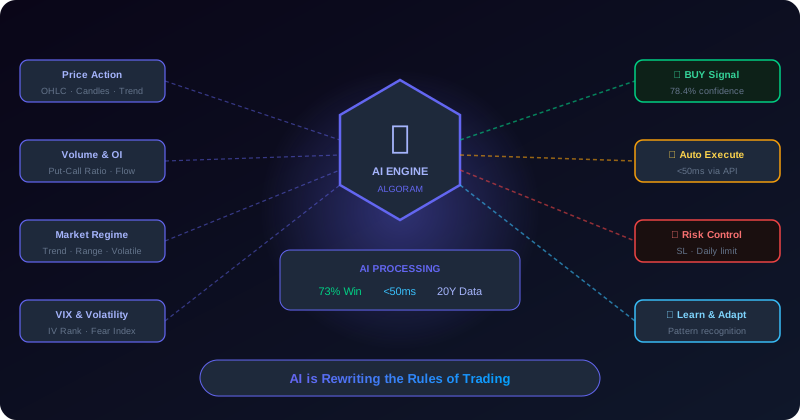
ALGORAM's AI layer uses exactly this capability — evaluating each potential trade signal against millions of historical instances of similar conditions to assess its probability before execution.
🤖 See AI Trading in Action — Free
Watch ALGORAM's AI engine trade Nifty and Bank Nifty options live on real market data. Zero risk. 7-day paper trading demo.
4. Automated Trade Execution
Once a high-probability setup is identified, AI systems execute instantly — placing the order, setting stop-losses, defining targets, and managing the position throughout its lifecycle without any human input. ALGORAM executes orders via direct broker API in under 50 milliseconds.
To put that in context: by the time a human trader sees a signal, thinks "yes, I'll take this trade," opens their trading terminal, and clicks buy — typically 10–30 seconds — an AI system has entered the trade, placed the stop-loss, and possibly already begun moving the trailing stop.
5. Risk Management
AI systems apply risk rules mechanically — without exception. Every trade has a stop-loss. Position sizes respect capital limits. Daily loss limits trigger automatic shutdowns. These rules apply equally on the AI's best day and worst day, after five consecutive winners and five consecutive losers.
Human risk management, conversely, deteriorates under emotional pressure — precisely when it matters most. The trades where risk management fails are almost never the calm ones.
6. Predictive Analytics
An important clarification: AI doesn't predict the future. Markets are inherently unpredictable due to random events, news, and the collective psychology of millions of participants. What AI does is identify patterns with higher-than-average probability of continuing — and separate these from lower-probability setups.
The practical result is a higher win rate — not because AI predicts correctly every time, but because it consistently takes the setups that historically work more often than they fail, and avoids the setups that don't.
7. Emotion-Free Decision Making
This deserves its own section because it's where most retail trader performance is lost. Fear causes premature exits. Greed causes overstaying in winning positions. FOMO causes entering low-probability setups. Revenge trading after losses causes larger losses. These aren't character flaws — they're neurological responses to financial stress that everyone experiences.
AI trading systems have no neurology. They feel nothing. They execute the same rules on Monday morning as on Friday afternoon. After a ₹50,000 winning day as after a ₹20,000 losing day. This consistency is not a minor advantage — it is the primary explanation for why systematic trading outperforms discretionary trading in most measured studies.
8. Portfolio Optimisation
Advanced AI systems dynamically allocate capital across multiple strategies and instruments based on real-time performance data, volatility, correlation, and market regime. As conditions change, allocation shifts — concentrating capital where current market conditions favour the strategy and reducing exposure where conditions are unfavourable.
AI vs Human Traders: Strengths and Limitations
| Factor | AI Trading Systems | Human Traders |
|---|---|---|
| Execution Speed | Under 50 milliseconds | 5–30 seconds minimum |
| Consistency | 100% rule adherence | Varies with mood and fatigue |
| Emotional Discipline | Zero emotional influence | Fear, greed, FOMO constant risks |
| Data Processing | Millions of data points/second | ~50 charts/day meaningfully |
| Multi-Instrument | Thousands simultaneously | 1–3 simultaneously |
| Novel Event Response | Limited — needs retraining | Human judgment adapts instantly |
| Macro Interpretation | Rule-based only | Nuanced contextual reading |
| Operating Hours | 24/7 without fatigue | Degrades after 4–6 hours |
| Backtesting | 20 years in seconds | Not practical manually |
| Creative Strategy | Cannot create novel strategies | Human creativity and intuition |
AI outperforms humans in the specific mechanics of trade execution: speed, consistency, discipline, and data processing. Humans retain edge in strategic thinking, interpreting genuinely novel macro events, and making judgment calls that require contextual understanding beyond data. The most effective approach in 2026 is a human-AI collaboration — humans design and oversee the strategy, AI executes it with precision.
Real-World Applications of AI in Trading
High-Frequency Trading (HFT)
The most extreme form — AI systems executing thousands of trades per second, profiting from tiny price discrepancies that exist for microseconds. This is institutional territory, requiring co-location servers directly at the exchange. Not relevant for most retail traders, but represents the cutting edge of AI speed in markets.
Quantitative Hedge Funds
Funds like Renaissance Technologies and Two Sigma use machine learning models trained on vast datasets to identify statistical edges across asset classes globally. These represent the most sophisticated applications of AI in markets, running models that no human fully understands in detail.
Retail AI Trading Platforms
This is where Indian retail traders now have access. Platforms like ALGORAM use AI to improve signal quality, filter false setups, and execute pre-built strategies automatically. The strategies themselves are based on proven approaches — the AI layer improves their execution quality.
Sentiment Analysis
AI systems that scan news headlines, social media, corporate announcements, and earnings call transcripts in real-time, converting text into trading signals. A company announcing a capacity expansion becomes a buy signal before the stock price moves — because the AI read and interpreted the press release in milliseconds.
Benefits of AI-Based Trading Systems
- Institutional speed for retail traders — Sub-50ms execution that was previously available only to firms spending crores on co-location infrastructure
- Emotion-free execution — Rules apply without exception, regardless of market conditions or recent P&L
- Better signal quality — AI filtering reduces false entries, improving win rates vs pure rule-based systems
- 24/7 market monitoring — No missed opportunities due to sleep, work, or inattention
- Systematic risk management — Stop-losses, daily limits, and position sizing enforced automatically
- Time freedom — The biggest quality-of-life benefit: automate the execution, reclaim your hours
- Scalability — Run multiple strategies across multiple instruments without proportional increase in effort
- Performance tracking — Clean data on every trade, enabling rigorous strategy review
Challenges and Limitations of AI Trading
Honest disclosure matters here — because overstating AI's capabilities creates unrealistic expectations that lead to poor decisions.
- Black swan events — AI models trained on historical data have no framework for truly unprecedented events. The March 2020 COVID crash behaved unlike any previous market data. AI systems that weren't paused or had circuit breakers could have generated large losses.
- Overfitting risk — Poorly designed AI models "fit" to historical data so precisely they perform well in backtesting but fail in live markets. This is why 20-year backtesting across multiple market cycles matters more than impressive recent performance numbers.
- Technical dependencies — AI trading requires reliable internet, functioning broker APIs, and operational servers. Technical failures at the wrong moment can leave positions unmanaged.
- Strategy decay — Market structures change. A strategy that worked brilliantly from 2018–2022 may underperform in 2024–2026 as market participants adapt and the statistical edge erodes.
- No judgment in genuine uncertainty — When RBI announces an unexpected rate change or a global geopolitical event creates unprecedented market conditions, AI follows its programmed rules — which may not be appropriate for the situation.
"AI trading improves consistency and removes emotional errors — but it does not eliminate market risk. Any platform claiming AI will make you consistently profitable regardless of market conditions is misleading you. Good AI trading manages risk better; it doesn't remove it."
— ALGORAM Trading TeamCommon Myths About AI Trading — Busted
"AI can predict stock prices accurately."
AI identifies patterns with higher statistical probability — it does not predict specific future prices. Markets remain inherently uncertain.
"AI trading is risk-free and guarantees profit."
AI improves consistency and reduces emotional errors, but every trading strategy has losing periods. Risk is inherent in markets.
"You need to be a programmer or data scientist to use AI trading."
Modern no-code platforms like ALGORAM make AI-powered trading accessible without any technical knowledge. Setup in under 60 seconds.
"AI trading is only for big institutional investors with crores of capital."
ALGORAM is specifically designed for Indian retail traders. Start with ₹25,000. The same AI capabilities institutional firms use, scaled for retail.
How Retail Traders Can Benefit from AI
For most of trading history, the advantages of sophisticated technology were locked inside institutional walls. The quant models, the co-location servers, the PhD teams building and refining AI systems — all of it was inaccessible to retail participants.
2026 is genuinely different. The democratisation of AI trading tools is real, and it's happening through platforms built specifically for retail traders. Here's what this means practically:
- A software engineer in Bengaluru can run the same category of algorithmic execution during office hours that a Mumbai prop desk uses
- A retiree in Ahmedabad can deploy capital in Nifty options with AI-managed risk and no screen time
- A first-year trader in Kolkata can start with backtested, AI-filtered strategies rather than learning from expensive trial-and-error
The key is choosing the right platform — one genuinely designed for Indian retail conditions, with strategies tested on Indian market data, and risk management appropriate for retail capital sizes. That's what distinguishes ALGORAM from generic global algo tools.
AI Trading vs Traditional Trading: Full Comparison
| Factor | Traditional Manual Trading | AI-Powered Trading (ALGORAM) |
|---|---|---|
| Entry Execution | Manual, 10–30 sec delay | AI-triggered, under 50ms |
| Signal Quality | Based on human analysis | AI-filtered, pattern-validated |
| Emotional Impact | Fear, greed, FOMO affect every decision | Zero emotional influence |
| Market Coverage | 1–3 instruments at a time | All configured instruments simultaneously |
| Risk Management | Self-enforced, fails under pressure | System-enforced, cannot be overridden |
| Data Processing | Charts, news, limited data | Multi-dimensional AI analysis |
| Consistency | Varies day to day | 100% same rules every session |
| Available Hours | Market hours requiring full attention | Automatic, no human presence needed |
| Backtesting | Not practical | 20 years NSE data — done for you |
| Learning Curve | Years of experience required | Start with proven AI strategies in minutes |
The Role of AI in Nifty, Bank Nifty, and Options Trading
India's F&O market — specifically Nifty and Bank Nifty options — has unique characteristics that make AI particularly valuable and particularly necessary to understand.
Why F&O Markets Demand AI Speed
Nifty and Bank Nifty options are among the most traded derivatives in the world by volume. With weekly and daily expiries, premiums can move 30–50% in under 60 seconds during volatile periods. The window between a valid signal and a meaningful entry price is often 10–15 seconds at most. Human traders entering manually almost always get worse fills than AI systems — on every single trade, compounding across hundreds of trades per month.
AI's Edge in Options-Specific Analysis
Options trading involves variables that compound in complexity: delta, gamma, theta, vega, OI-based strike selection, time value decay dynamics, and expiry-week behaviour patterns. AI systems can evaluate all of these simultaneously, selecting optimal strikes based on current market conditions and adjusting strategy parameters based on VIX levels — analysis that takes a human trader significant time and cognitive load.
Want to understand how this translates to win rates? Read: How ALGORAM Achieves 70%+ Win Rate in NIFTY Options Trading
Why More Indian Traders Are Adopting AI-Based Platforms
The shift toward AI trading in India is accelerating for specific, practical reasons:
"Five years ago, no Indian retail trader had access to institutional-quality AI trading tools. Today, platforms like ALGORAM have made this available to anyone with a smartphone and ₹25,000. That's one of the most significant democratisation events in Indian market history."
— Rahul Patel, Co-Founder, ALGORAM- Smartphone penetration — India's mobile infrastructure now supports real-time trading and monitoring from anywhere
- Broker API access — Zerodha, Upstox, 5paisa, Angel One all provide official APIs enabling third-party automation
- Working professional demographics — India's largest trading demographic works full-time during market hours — AI is the only realistic way to participate
- Awareness of consistent losses — SEBI data showing 90%+ of F&O traders losing money has created genuine demand for systematic approaches
- Proven retail platforms — ALGORAM and similar platforms have delivered enough real results for word-of-mouth to drive adoption
How ALGORAM Uses AI and Automation
ALGORAM isn't a general-purpose AI tool applied to trading. It was built from the ground up specifically for Indian markets, using 20 years of NSE and BSE tick data as its training foundation.
The platform operates at two levels:
Level 1 — Algorithmic base: Pre-built, backtested trading strategies using multi-timeframe analysis, OI-based indicators, and volume confirmation. This is the rule-based foundation.
Level 2 — AI filter: Before any signal from Level 1 proceeds to execution, ALGORAM's AI layer evaluates it against historical pattern libraries, current market regime (trending/range-bound/volatile), VIX conditions, and time-of-day performance data. Approximately 25% of signals are filtered out at this stage — these are overwhelmingly false positives that would have been losing trades.
The result: higher win rates than pure algorithmic systems, execution speeds that match institutional desks, and risk management that is enforced at the system level.
For a complete technical breakdown: Best Algo Trading Platform for Nifty & Bank Nifty Options in India (2026)
ALGORAM Features
Secondary AI filter evaluates every signal against market regime, VIX, and historical pattern quality before execution.
Complete trade lifecycle automated — signal to entry to SL to target to exit. Zero manual steps after Start.
AI-filtered CE/PE strategies with multi-timeframe analysis and OI-based strike selection. Daily & weekly expiry.
Volatility-calibrated BankNifty automation. Tight SL management for BN's fast intraday characteristics.
Intraday & positional strategies for NSE/BSE equities with smart OI and volume confirmation.
Automated stock option strategies with earnings event protection. Smart capital allocation.
AI-analysed signals on your monitored instruments, even when full automation is paused.
Push notifications for every entry, exit, SL hit, daily P&L — stay informed without screen watching.
Auto SL + hard daily loss limit + capital-based position sizing + no averaging down. System-enforced.
Future Trends in AI Trading (2026–2030)
AI systems that adapt strategies to individual trader risk profiles, capital sizes, and time availability — not one-size-fits-all approaches.
"Run a conservative Nifty strategy for the next 3 days with maximum ₹5,000 daily risk" — conversational AI interfaces for strategy control.
AI combining technical data, sentiment analysis, economic indicators, and satellite/alternative data into unified trading decisions.
AI models that learn collectively from aggregated (anonymised) trader data without sharing individual strategy details — improving for everyone simultaneously.
AI Trading Glossary
🚀 Launch Offer — First 100 Customers Only
How to Get Started with AI-Powered Trading
Open 5paisa Account (or connect existing broker)
New: use our referral for 3 months free ALGORAM access. Existing traders: connect their 5paisa account via official API.
Sign Up at ALGORAM
Create your account at algoram.in. 7-day free paper trading demo activates immediately — no card, no payment.
Run Demo Mode for 7 Days
Watch ALGORAM's AI engine trade Nifty and Bank Nifty on real live data with zero financial risk. Observe the signals, entries, exits, and risk management in real market conditions.
Choose Strategy, Set Risk Parameters
Select instruments, capital allocation, and daily loss limit. Beginner Mode keeps this to 3 simple inputs. The AI handles strategy logic automatically.
Go Live — Let AI Trade for You
One tap to activate. ALGORAM's AI monitors markets, filters signals, executes trades, and manages risk — while you focus on everything else in your life.
Conclusion
AI is not a future technology in stock market trading — it's the present reality. Over 60% of NSE's F&O volume is already algorithmically generated. The participants on the other side of retail trades are already using AI. The market environment has changed, whether retail traders adapt to it or not.
The good news is that for the first time in market history, retail traders have access to the same category of AI tools that institutional desks use. Not identical — scaled, simplified, and designed for retail capital sizes and retail lifestyles. But genuinely effective.
Understanding AI's role in markets isn't about becoming a data scientist or learning to code. It's about understanding what has changed in the competitive environment — and finding the right tools to participate effectively in that environment.
ALGORAM was built to be that tool for Indian retail traders. The AI does the pattern recognition, signal filtering, execution, and risk management. You provide the capital, the strategy oversight, and the common sense that no algorithm can replace.
Start with the 7-day free demo. See AI trading in real Indian market conditions — before risking a single rupee.
Try it free: → 7-day ALGORAM paper trading demo
Best deal: → Open 5paisa via ALGORAM for 3 months free
Understand algo basics: → What is Algo Trading? Beginner's Guide
Platform selection guide: → How to Choose Algo Trading Software India
Questions? → Contact our team
Frequently Asked Questions

Rahul is the technology architect behind ALGORAM's AI trading infrastructure. With 15+ years building automated trading systems for Indian markets, he designed ALGORAM's AI signal filtering layer, cloud execution infrastructure, and the platform's integration with 5paisa's official API. His mission is to make institutional-grade AI trading accessible to every Indian retail trader.