Introduction
Choosing the wrong algo trading software is an expensive mistake — not just in subscription fees, but in missed trades, inconsistent execution, and the frustrating experience of a platform that doesn't match how you actually trade.
The Indian algo trading market has grown significantly. There are now dozens of platforms claiming to offer the "best" automated trading experience. Some are genuinely excellent. Some look impressive in demos but fail in live conditions. Some are built for institutional clients and are simply too complex for retail traders. And a small number — be direct about this — are outright scams promising guaranteed returns.
This guide is your framework for cutting through the noise. By the end, you'll have a clear checklist of what to look for, what to avoid, and how to evaluate any platform you're considering — including ALGORAM, which we'll present honestly with the same critical lens we apply to everything else.
What is Algo Trading Software?
Algo trading software is any application that uses computer algorithms to automate some or all of your trading process. The spectrum is wide:
- Signal-only tools — Identify setups and alert you, but you place orders manually.
- Semi-automated platforms — You approve signals before execution.
- Fully automated platforms — The system identifies signals, places orders, manages stop-losses, and exits — entirely without your intervention.
- AI-powered platforms — A step beyond rule-based automation, using machine learning to improve signal quality and adapt to market conditions.
For Indian stock market trading specifically — especially F&O — the most impactful category is fully automated with AI filtering. That's what ALGORAM falls into. But the right category for you depends on your goals, which we'll help you clarify.
New to the concept entirely? Read: What is Algo Trading? A Beginner-Friendly Guide for Indian Traders
Why Choosing the Right Algo Trading Software Matters
The platform you choose affects almost everything about your trading experience and results:
- Execution quality — A slow or unreliable platform costs you on every trade.
- Strategy availability — If the pre-built strategies aren't suited to Indian markets, backtested results won't translate to live performance.
- Risk protection — Platforms without built-in daily loss limits can allow a bad day to become catastrophic.
- Learning curve — A platform that requires coding will remain unused by 90% of retail traders who don't have that background.
- Support quality — When something goes wrong (and it will, at some point), who do you call?
Consider this: Ravi, an experienced BANKNIFTY trader from Pune, paid ₹15,000 for a one-year algo subscription that looked impressive in the demo. In live trading, execution was consistently 3–5 seconds delayed because the platform used a webhook system rather than direct broker API. Over 6 months of BANKNIFTY options trading, that execution delay cost him — conservatively — 15–20% worse average fill prices. The subscription fee was the smallest part of the cost.
Common Problems Traders Face with the Wrong Platform
- Promised features that work differently in live conditions than in the demo
- Poor broker API integration causing frequent disconnections
- No mobile access — you're tied to a desktop during market hours
- Overly complex interface with a steep learning curve
- Customer support that disappears after the sale
- Strategies backtested only on recent bull market data
- No daily loss limit feature — leading to large losses on bad days
- Hidden costs: extra charges per strategy, per broker, or per instrument
- Lock-in contracts with no refund option
- No paper trading or demo mode to test before going live
10 Key Factors to Evaluate When Choosing Algo Trading Software
Ease of Use — No-Code is the Standard in 2026
Unless you're a developer, you should not need to write code to use trading automation software. The best platforms in 2026 have no-code interfaces where you select strategies, configure parameters, and click start. If a platform requires Python scripting just to activate a pre-built strategy, it's designed for the wrong user.
Automation Capability — Full, Not Partial
Distinguish between platforms that merely alert you to setups (you still place manually) and platforms that execute the full trade cycle automatically: entry, stop-loss placement, target management, trailing stop, and exit. Only the latter genuinely solves the execution and discipline problems manual trading creates.
Broker Integration — Official API Only
The platform must connect to your broker via their official, SEBI-approved API. Be deeply suspicious of any platform that asks for your broker username and password directly — that's a security risk and potential regulatory violation. Look for API-key-based integration where you grant only trade execution permission.
Risk Management — Non-Negotiable Features
Every trade must have automatic stop-loss placement. The platform must have a configurable daily loss limit that auto-stops trading when hit. Position sizing should be based on capital, not fixed lots. These aren't optional extras — they're table stakes for a safe trading platform.
Execution Speed — Direct API vs Webhook
For F&O trading, execution speed is critical. Ask specifically: does the platform use direct broker API integration (sub-100ms) or a webhook/third-party relay (1–5 seconds)? The difference sounds technical but it directly affects the prices you get on every entry and exit.
Real-Time Alerts & Notifications
Even in full automation, you want to know what's happening. Look for platforms that send push notifications for every entry, exit, SL hit, and daily P&L summary. These keep you informed without requiring you to watch screens — the core benefit of automation.
Mobile Accessibility — Full Feature, Not Just Monitor
A mobile app that only shows P&L but can't start/stop strategies or adjust settings isn't truly mobile-accessible. The best platforms in 2026 offer complete strategy management from the mobile app, including starting, pausing, and modifying strategies mid-session.
Customer Support — Test Before Subscribing
Send a pre-sales query to the support team and time the response. Ask a specific technical question. The quality of pre-sales support is an accurate predictor of post-sales support. A platform that takes 3 days to respond to a demo query will take even longer when you have a live execution problem.
Scalability — Can It Grow With You?
Today you might want one strategy on NIFTY options. In 6 months, you might want to run BANKNIFTY and two stock strategies simultaneously. Does the platform support this? Is it included in your subscription or an extra charge? Plan for where you want to be, not just where you are today.
Security & Data Protection
Algo trading platforms access your trading account. Verify: API key encryption, two-factor authentication, SSL/TLS for all data transmission, and clear policies on what data is stored and for how long. Never share your broker credentials (username/password) with any third-party platform — only API keys.
Essential Features Every Algo Trading Platform Should Have
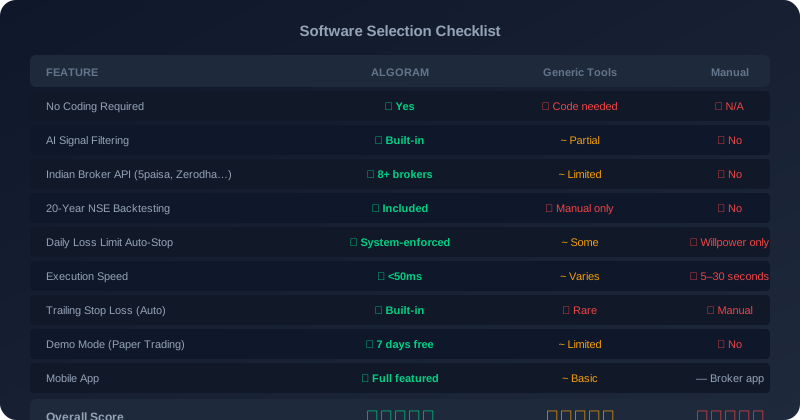
Use this as your minimum baseline. A platform missing any of these items should be disqualified regardless of its other features:
✅ See ALGORAM's Checklist Score
ALGORAM meets all 10 checklist requirements above. Try the 7-day free demo and verify for yourself — no payment needed.
12 Questions to Ask Before Selecting an Algo Trading Platform
These questions cut through marketing language and reveal what you actually need to know. Ask them of any platform you're evaluating seriously — including ALGORAM.
Red Flags to Avoid When Choosing Algo Trading Software
These aren't minor concerns — each one below has been associated with real trader losses in India. Treat any of these as a disqualifying signal:
Beginner-Friendly vs Advanced Trading Platforms
Be honest with yourself about where you sit on the technical spectrum. The best platform for a quant developer is not the same as the best platform for a working professional who wants simple, consistent automation.
| Factor | Beginner-Friendly Platforms | Advanced Platforms |
|---|---|---|
| Setup Time | Under 5 minutes | Hours to days |
| Coding Required | None | Python, Pine Script, or similar |
| Strategy Source | Pre-built, backtested | Build your own |
| Risk Management | Automated, built-in | Manual configuration |
| Target User | Retail, working professionals | Developers, quant traders |
| Time Investment | Minimal ongoing | Significant ongoing |
| Best For | Consistent automation | Custom strategy development |
| ALGORAM Category | ✓ Beginner-friendly | — |
Even experienced traders benefit from starting with a beginner-friendly platform to validate how automated trading performs before diving into custom strategy development. ALGORAM's pre-built strategies have 20 years of NSE validation behind them — that's a head start that even custom-built strategies take years to replicate.
AI-Based Trading Software vs Traditional Rule-Based Algo Platforms
This distinction matters more in 2026 than it did five years ago. Here's the practical difference:
Traditional rule-based algo: "Buy when RSI > 60 AND volume > 20-day average AND price breaks 15-minute resistance." The system fires whenever these conditions are met — every single time, regardless of current market context.
AI-based algo: Same base conditions, plus a secondary evaluation layer: "How has this exact setup performed historically under today's specific conditions — market regime, VIX level, time of day, recent trend strength?" Only signals that pass the AI filter proceed to execution.
The practical result: AI-based systems typically produce 20–30% fewer trades, but the trades they do take have meaningfully higher win rates. ALGORAM's AI filter eliminates approximately 25% of signals that a pure rule-based version would have executed — and most of those eliminated signals would have been losses.
For a detailed look at how this affects win rates specifically in Nifty: Best Algo Trading Platform for Nifty & Bank Nifty Options in India (2026)
Comparison Table: What Makes a Great Algo Trading Platform?
| Feature | Must Have | Good to Have | ALGORAM Status |
|---|---|---|---|
| No-code interface | ✓ Essential | — | ✓ Full Beginner Mode |
| Direct broker API | ✓ Essential | — | ✓ Sub-50ms execution |
| Auto stop-loss | ✓ Essential | — | ✓ On every trade |
| Daily loss limit | ✓ Essential | — | ✓ Hard system limit |
| Paper trading demo | ✓ Essential | — | ✓ 7-day live demo |
| 20-year backtesting | — | ✓ Strongly preferred | ✓ Full 20-year NSE |
| AI signal filtering | — | ✓ Significant advantage | ✓ Built-in AI layer |
| Multi-broker support | — | ✓ Preferred | ✓ 8+ major brokers |
| Full mobile app | — | ✓ Preferred | ✓ Full mobile control |
| Transparent pricing | ✓ Essential | — | ✓ Published plans |
Why Modern Traders Are Moving Toward AI-Powered Automation
Three converging trends are driving the shift to AI-powered algo trading in India specifically:
The F&O Market Has Changed
Daily and weekly expiries have transformed India's options market. The rapid theta decay dynamics, the volume concentration around expiry days, and the increasing participation of algorithmic institutional players have all made the environment significantly more demanding for manual traders. AI-powered systems that adapt to regime changes are simply better suited to this environment than static rule-based approaches.
Speed Now Determines Fill Quality
When you're trading weekly BANKNIFTY options that move 50–100% in 60 minutes on expiry day, the difference between a sub-50ms execution and a 10-second manual entry isn't just convenience — it's the difference between entering at the right price and chasing an already-moved market.
Retail Traders Have Access to Better Tools
AI-powered trading software that would have cost ₹5–10 lakh per year at institutional scale is now available to retail traders at ₹2,000–4,000 per month through platforms like ALGORAM. The democratisation of professional tools has created an opportunity that didn't exist 5 years ago.
Why ALGORAM Is Designed for Indian Traders
"We didn't build ALGORAM to compete with Bloomberg terminals. We built it for traders who work regular jobs, have limited time, and want professional-grade automation without a PhD in computer science."
— Ankit Patel, Founder & MD, ALGORAMALGORAM scores highly against the evaluation framework in this guide because it was built specifically to address the problems this guide describes. The checklist requirements came from what traders were asking for — not from what was technically impressive to build.
When we evaluated competitor platforms during ALGORAM's development, the most common complaints from Indian retail traders were: too complex, too slow in execution, too few broker integrations, no meaningful risk management, and strategies not designed for Indian market structure. ALGORAM was built as the response to each of those complaints.
ALGORAM Features — Against the Buyer's Checklist
Complete trade lifecycle automation. Entry, SL, targets, trailing stop, exit — zero manual steps after start.
Intraday & positional strategies on NSE/BSE high-liquid equities. Smart OI + volume entry confirmation.
Automated options on top stock counters. Earnings event filtering built in for capital protection.
AI-filtered Nifty CE/PE strategies. Multi-timeframe analysis with OI-based strike selection.
Volatility-calibrated BankNifty automation. Tighter SL for BN's characteristically fast intraday moves.
Secondary AI layer filters ~25% of false signals before execution. Market regime aware.
AI signal monitoring on any instrument even when full automation is paused.
Push notifications for every entry, exit, SL hit, and daily P&L to your phone — always informed.
Auto SL + hard daily loss limit + position sizing + no averaging down. Non-negotiable protection.
Real-World Example: Right Platform, Different Outcome
Here's a composite of a situation we hear regularly from new ALGORAM users:
Priya, a banking professional from Mumbai, had been using a competitor algo platform for 4 months. The strategies looked impressive in their marketing demos, but in live trading she experienced consistent slippage because the platform used a webhook relay rather than direct API. On three separate occasions, the platform's execution failed entirely during high-volatility periods — exactly when she most needed it to work.
She also had no daily loss limit feature, which meant that when the platform's algorithm had an unusually bad session on an RBI announcement day, there was nothing to stop it automatically.
After switching to ALGORAM: direct API execution meant fills within 50ms instead of 3–5 seconds. The daily loss limit auto-stopped trading after the second losing BANKNIFTY trade on an unexpectedly volatile day — saving the rest of the capital. She stopped checking market news during office hours because she didn't need to monitor anything.
"The difference was discipline by design, not willpower," she said. "The system does what you tell it and stops when it should. That's all I needed."
🚀 Launch Offer — First 100 Customers Only
How to Get Started with ALGORAM
Open a 5paisa Account (For the Best Value) or Connect Existing Broker
New account via 5paisa referral = 3 months free. Existing traders: connect via any of 8+ supported brokers using official API key. 30 seconds to connect.
Start Your 7-Day Free Demo
No credit card required. Paper trading on live NSE market data begins immediately. See exactly how ALGORAM performs before any money is involved.
Run the Buyer's Checklist Against ALGORAM
Use the 10-item checklist from this article during your demo week. Verify execution speed, risk management, mobile access, and support quality firsthand.
Choose Your Strategy in Beginner Mode
Select Nifty Options, Bank Nifty, Stocks, or a combination. Set capital allocation and daily loss limit. Everything else is pre-configured based on 20 years of backtesting.
Go Live When Confident — Not Before
Demo for the full 7 days. Only activate live trading when you've seen how the system performs across multiple market conditions. That's the right sequence — every time.
📋 You Now Have the Checklist — Use It
Whether you choose ALGORAM or another platform, the 10-factor framework and 12 questions in this guide will help you make a genuinely informed decision. If you want to see ALGORAM against those criteria firsthand — the demo is free.
*5paisa offer for first 100 customers · 7-day demo open to everyone
Conclusion
Choosing algo trading software isn't a casual decision — it affects every trade you make for the duration of your subscription. The stakes justify taking the time to evaluate properly.
Use the 10 factors. Ask the 12 questions. Run the checklist. Look for the red flags. Take the demo before paying anything. These aren't abstract suggestions — they're the direct lessons from what goes wrong when traders skip this process.
The right platform is one that matches your trading style, technical comfort level, broker, and goals — and can grow with you. In 2026, the best platforms for Indian retail traders combine genuine automation with ease of use, robust risk management, and strategies specifically validated for NSE/BSE market dynamics.
If ALGORAM matches that profile for you — the 7-day free demo is the best way to confirm it. No payment, no risk, full live market data. That's the right way to choose.
Download this checklist mentally: 10 factors, 12 questions, 8 red flags.
Best offer: → Open 5paisa via ALGORAM referral for 3 months free
Start demo: → algoram.in/demo — 7-day free paper trading
Learn more: → Manual vs Automated Trading: Which Wins in 2026?
Questions? → Contact us — we respond within 2 hours
Frequently Asked Questions

Before building ALGORAM, Ankit spent years evaluating and testing various Indian algo trading platforms as a retail trader — and experiencing firsthand the gap between demo performance and live reality. This guide reflects that experience. He built ALGORAM to address every pain point he personally encountered in the market.