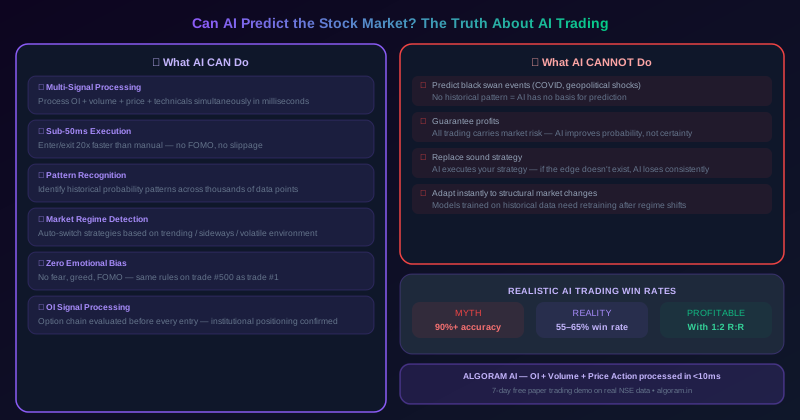
The Question Everyone's Asking
AI is everywhere in 2026. It writes code, generates images, answers questions, and drives cars. So it's natural to ask: if AI can do all of that, can it predict the stock market?
The honest answer is more nuanced than either "yes, AI can predict everything" or "no, markets are random." The truth is somewhere more interesting — and more practically useful for traders.
This guide covers what AI can actually do in trading, what it fundamentally cannot do, common myths propagated by trading software marketing, and how platforms like ALGORAM use AI practically to improve execution — not claim to predict the unpredictable.
Common AI Trading Myths — Busted
"AI can predict market movements with 90%+ accuracy"
No verified AI system maintains 90%+ accuracy on live market data over any significant period. Win rates of 55–65% with proper risk management represent excellent AI trading performance.
"AI eliminates trading risk entirely"
AI reduces behavioral risk (emotional decisions, inconsistent execution) but cannot eliminate market risk. Losses are still possible with AI-powered trading — proper risk management remains essential.
"AI trading is only for large institutions and hedge funds"
No-code AI trading platforms like ALGORAM have made algorithmic and AI-assisted trading accessible to retail traders in India with accounts starting from ₹25,000. No programming required.
"AI will replace human traders completely"
AI handles execution and pattern recognition better than humans. Humans retain advantages in creative adaptation to novel market conditions and qualitative macro judgment. The future is human strategy + AI execution.
How AI Actually Works in Trading
When a trading platform claims to use AI, it typically means one or more of the following:
- Pattern recognition: Scanning historical price, volume, and derivatives data to identify recurring patterns — not predicting the future, but identifying situations where specific outcomes have historically had elevated probability
- Signal filtering: Evaluating multiple technical and market microstructure signals simultaneously before generating a trade recommendation — reducing false signals compared to single-indicator approaches
- Adaptive strategy switching: Detecting current market regime (trending, sideways, high-volatility) and activating the strategy most suited to that environment
- Risk optimization: Dynamically adjusting position sizes based on current volatility, recent performance, and market conditions
None of these involve "predicting" the future in any mystical sense. They involve processing large amounts of historical and current data to make statistically better-informed decisions — faster and more consistently than a human trader could manually.
Machine Learning in Trading — Explained Simply
Machine learning is the practice of teaching a computer to identify patterns by showing it many examples, rather than explicitly programming the rules.
Traditional trading rule: "Buy when RSI crosses above 30 AND price is above VWAP." This rule is written by a human based on their analysis.
Machine learning approach: Show the algorithm 10 years of Nifty data with thousands of features (RSI, VWAP, OI, volume, candlestick patterns, PCR, etc.) and thousands of labeled outcomes (this situation led to a 2% gain within 2 hours; this situation led to a 1% loss within 2 hours). The algorithm identifies which combinations of features most consistently preceded positive outcomes — without a human explicitly defining the rules.
The result isn't a crystal ball. It's a probability statement: "Historically, when these 8 conditions are simultaneously true in Nifty, the market has moved upward within 2 hours approximately 67% of the time." That's more sophisticated than a single RSI rule — but it's still a historical probability, not a future certainty.
The biggest risk in ML trading models: overfitting. A model can learn the historical data so well that it achieves 95% accuracy on past data but performs only 48% on live data. The model memorised the history rather than learning generalizable patterns. This is why ALGORAM backtests on out-of-sample data and validates with paper trading before any strategy goes live.
AI vs Human Trading — Honest Comparison
| Factor | AI Trading | Human Trading |
|---|---|---|
| Execution Speed | <50ms via broker API | 8–25 seconds manually |
| Emotional Consistency | Zero — no fear, greed, FOMO | High variance under pressure |
| Data Processing | Thousands of signals simultaneously | 3–5 indicators realistically |
| Rule Adherence | 100% — no override | Frequently violated under pressure |
| Adapting to Novel Events | Limited — no historical pattern | Human judgment adapts |
| Multi-market Monitoring | Simultaneous, continuous | One market at a time realistically |
| 24/7 Availability | Continuous operation | Limited by human attention |
| Qualitative Judgment | Cannot assess news quality | Human interprets context |
| Pattern Recognition | Identifies non-linear patterns | Limited to visible chart patterns |
What AI Can Do Well in Indian Markets
- Option Chain OI analysis: Simultaneously evaluate Put OI, Call OI, OI Change, PCR, and volume across all strikes to identify institutional positioning — a task that takes humans 15–20 minutes and AI platforms milliseconds
- Market regime detection: Identify whether the current market is trending, sideways, or high-volatility and switch strategies accordingly — removing the human judgment call that traders often get wrong
- Risk-adjusted position sizing: Calculate optimal position sizes based on current volatility, account equity, and recent performance — dynamically, before every trade
- Multi-signal entry confirmation: Require simultaneous confirmation from price action + OI data + volume + technical indicator before executing — dramatically reducing false signals compared to single-indicator approaches
- Backtesting on 20 years of data: Evaluate strategy performance across multiple market regimes in minutes — including 2008 crash, 2020 COVID, 2022 rate-hike period
What AI Cannot Do — Be Clear-Eyed
- Predict black swan events: No model saw COVID-19, Russia-Ukraine war, or sudden Fed policy pivots in its training data. These create unprecedented market movements that AI systems cannot anticipate.
- Guarantee profits: AI improves the probability of better decisions. It doesn't guarantee profitable outcomes. All trading carries inherent market risk.
- Replace sound strategy: AI executes your strategy better than you can manually. But if the underlying strategy has no edge, AI will execute it consistently into losses. Garbage in, garbage out.
- Adapt to structural market changes: If Indian market microstructure changes significantly (new regulations, new instruments), models trained on historical data need retraining.
Be skeptical of any AI trading platform that claims: "90%+ accuracy," "guaranteed profits," "AI predicts market movements," "zero risk with AI." These claims are either false or refer to cherry-picked historical backtests without proper out-of-sample validation. No legitimate platform makes these claims. ALGORAM doesn't.
AI in Nifty and Bank Nifty Options Trading
For Indian retail traders focused on Nifty and Bank Nifty options, AI adds the most value in three specific areas:
1. Option Chain Signal Processing
Manually reviewing the full option chain — checking Put OI, Call OI, OI Change, volume, and PCR across 30+ strikes — takes 15–20 minutes per refresh. ALGORAM's AI layer processes this data continuously and evaluates it as a confirmation input before every entry signal. The option chain analysis that informs each trade happens in milliseconds, not minutes. Related: How to Identify Support and Resistance Using Option Chain
2. Market Regime Classification
Nifty and Bank Nifty behave differently in trending vs. sideways vs. high-VIX markets. A directional CE/PE buying strategy that works beautifully in trending conditions will lose in sideways markets. ALGORAM's Auto Strategy Switch uses pattern recognition to detect the current regime and activate the appropriate strategy — without requiring manual assessment each morning.
3. Expiry Day Pattern Recognition
Expiry day behavior (gamma acceleration, Max Pain mechanics, short covering patterns) follows identifiable patterns that machine learning can weight appropriately in entry decisions. AI-assisted strategies on expiry day can incorporate these patterns as entry filters — reducing the risk of being trapped by common expiry day moves.
How ALGORAM Uses AI Practically
ALGORAM doesn't claim to predict the future. It uses AI-enhanced signal processing to improve the quality and consistency of entry decisions:
Multiple data inputs — OI, volume, price action, technical indicators — evaluated simultaneously. Entry only when sufficient confluence signals confirm.
Market regime detected automatically. Trending → directional strategy. Sideways → premium selling. High VIX → reduced exposure.
Option chain OI processed continuously. Institutional positioning evaluated before every trade. No manual refresh required.
Position sizes adjusted based on current VIX, recent performance, and capital rules. Never based on conviction.
All of this is accessible through ALGORAM's no-code interface — no programming required. Read: Why Traders Are Switching to AI-Based Algo Trading
🤖 Experience AI-Powered Trading
7-day paper trading demo on real NSE data. See how AI signal filtering improves entry quality — zero financial risk.
The Future of AI in Indian Stock Markets
By 2026, algorithmic trading (including AI-powered systems) accounts for over 60% of NSE F&O volume. By 2030, this is projected to exceed 80%. The trajectory is clear: the Indian market is becoming increasingly algorithmic.
For retail traders, this has two implications. First, competing against purely manual analysis becomes increasingly challenging as institutional algorithms process more data, faster. Second, access to AI-assisted tools is now available to retail traders — meaning the competitive gap can be narrowed.
The retail traders who will thrive in the next decade aren't necessarily those with the most sophisticated AI models. They're the ones who use AI practically: to execute their strategies consistently, manage risk systematically, and remove behavioral interference from execution.
Should Beginners Use AI Trading Platforms?
Yes, with the right approach. For beginners, AI trading platforms provide the most value not through complex signal generation but through execution discipline — enforcing the risk rules and entry criteria that beginners struggle to follow manually under live market pressure.
Start with ALGORAM's 7-day paper trading mode. Watch how an AI-assisted system executes on real market data without emotional interference. That demonstration alone — seeing consistent rule-based execution — is more valuable than any strategy course. Related: How Beginners Can Start Algo Trading Without Coding
🚀 Launch Offer — First 100 Customers
Conclusion
AI cannot predict the stock market. No technology can — and any platform claiming otherwise is misleading you. What AI can do is process more data, faster, more consistently, and without emotional bias. In trading, that combination — multi-signal processing, fast execution, and zero emotional interference — produces measurably better outcomes than purely manual trading for most retail traders.
The practical takeaway: stop looking for an AI that predicts prices and start using AI to execute your strategy better. That's a realistic, verifiable edge. And it's available today through platforms like ALGORAM, without writing a single line of code.
Try AI-assisted trading: → ALGORAM 7-day free paper trading demo
Understand the basics: → What is Algo Trading? Complete Guide
Risk management first: → Risk Management in Algo Trading
Option chain AI signals: → Option Chain Support & Resistance Guide
Frequently Asked Questions

Rahul architected ALGORAM's AI signal processing engine — including the multi-factor OI confirmation layer and Auto Strategy Switch system. He's been clear from the start: "We don't predict markets. We process them better and execute consistently." That philosophy shapes every AI feature in the platform.