Introduction
Two traders. Same strategy. Same market. Same entry signals. Completely different outcomes over 12 months.
Trader A ends the year down 42%. Trader B ends the year up 31%. The strategy had a 58% win rate in backtesting. It should have worked for both. What happened?
Trader A had no position sizing rules. Risk management was based on conviction — "this is a strong setup" meant a larger trade. When the strategy hit a 5-loss streak (which every strategy does), Trader A's oversized positions turned manageable drawdowns into account-threatening losses. The emotional pressure from large losses led to revenge trading, which made it worse.
Trader B risked exactly 1% of capital per trade. Every trade. No exceptions. The same 5-loss streak cost Trader B approximately 5% of capital. Recoverable. Strategy continued. The edge played out over the remaining trades of the year.
The strategy was identical. The outcome was determined entirely by risk management — or the absence of it.
This is what this guide covers: the systematic, professional approach to risk management in algorithmic trading — and how automation enforces these rules when human willpower reliably fails.
Why Risk Management Matters More Than Strategy
SEBI's data consistently shows that over 90% of F&O traders lose money over any 3-year period. The narrative that this is because retail traders have poor strategies is largely incorrect. Most retail traders understand basic technical analysis, trend following, or options selling mechanics. The strategies themselves have edges — when applied consistently.
The problem is in surviving long enough to let the edge play out.
Every profitable strategy has losing streaks. A strategy with a 60% win rate will have sequences of 5, 6, even 8 consecutive losses. Without proper position sizing and daily loss limits, these statistically normal sequences destroy accounts — not because the strategy failed, but because the trader wasn't capitalised well enough to survive the drawdown.
"In 15 years of trading, I have never met a professional who says their edge comes from better strategy. Every single professional I know — whether in options selling, algo trading, or institutional fund management — says the same thing: survival is the edge. You survive losing streaks through risk management. The strategy is secondary."
The Professional Trader Mindset: Protect Capital First
Professional traders think about risk in a fundamentally different way from retail traders:
- Retail trader: "What can I make on this trade?" → focuses on upside before entering
- Professional trader: "What can I lose on this trade?" → defines maximum loss before considering potential gain
This isn't pessimism. It's mathematics. Consider the arithmetic of losses:
- Lose 10% → need 11.1% to recover
- Lose 25% → need 33.3% to recover
- Lose 50% → need 100% to recover
- Lose 75% → need 300% to recover
A 50% drawdown requires a 100% return just to break even. If your strategy makes 25% per year in good conditions, that's 4 years of perfect performance wasted recovering from one period of poor risk management.
Professional traders treat their trading account as their inventory — the raw material of their business. Destroying inventory doesn't just cause a loss; it eliminates the ability to generate future returns. Capital preservation is not about being conservative. It's about staying in the game long enough for your edge to compound.
Core Principles of Risk Management
1. Capital Preservation
The first goal of every trade is not to make money — it's to ensure the loss doesn't exceed the predefined maximum. Profit is secondary to preserving the capital needed for future trades. A string of small, controlled losses is survivable. One large uncontrolled loss can wipe out weeks of gains.
2. Consistency Over Big Wins
The most dangerous trades are often the ones that make the most money — they reinforce oversized position taking. Professional traders care more about the consistency of returns than the magnitude of any single win. Consistent application of small, disciplined positions compounds more reliably than inconsistent large positions.
3. Probability Thinking
No individual trade is "certain." Even your best setups fail some percentage of the time. Professional traders think in terms of expected value across many trades, not in terms of individual trade outcomes. This probabilistic mindset is what allows them to place stop losses without emotion — because the stop is part of the system, not an admission of failure.
4. Risk Before Reward
Every trade has both a risk and a reward. Professional traders evaluate risk first: "If I'm wrong, how much do I lose?" Only if the risk is acceptable do they evaluate reward: "If I'm right, how much do I make?" Never enter a trade where the acceptable risk level doesn't come with sufficient potential reward.
Top 10 Risk Management Techniques Used by Professional Algo Traders
Position sizing determines how many units/lots/contracts to trade based on your defined risk tolerance. It's the most important risk management technique because it ensures that no single trade — regardless of how it performs — can cause disproportionate damage to your capital.
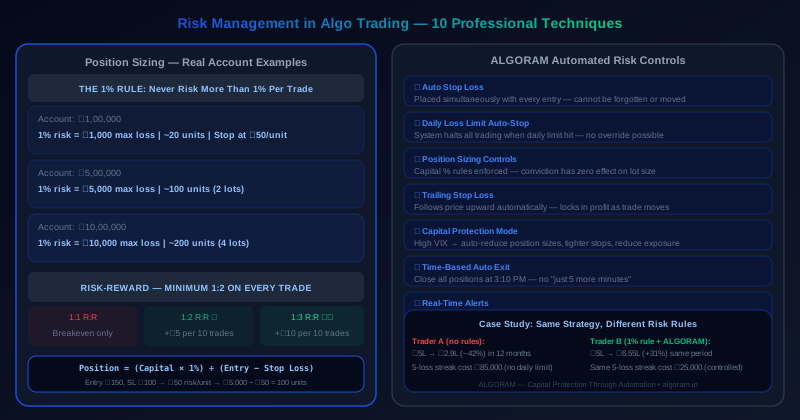
Account: ₹5,00,000 | Risk: 1% = ₹5,000 | Entry: NIFTY CE ₹150 | SL: ₹100 | Risk per unit = ₹50
Position Size = ₹5,000 ÷ ₹50 = 100 units ≈ 2 lots of NIFTY
Regardless of how strong a setup appears, the maximum capital at risk on any single trade is fixed as a percentage of total capital. This percentage doesn't change based on conviction — it's a hard rule.
₹1,00,000 account @ 1%: Max loss per trade = ₹1,000
₹5,00,000 account @ 1%: Max loss per trade = ₹5,000
₹10,00,000 account @ 1%: Max loss per trade = ₹10,000
At 1% risk: 50 consecutive losses = ~40% account decline. Survivable. Strategy has runway to recover.
The single biggest difference between professional traders and retail traders is this: professionals enforce a fixed risk percentage regardless of market conditions or conviction level. Retail traders increase size when they "feel confident" — which correlates with their most emotionally compromised state.
A stop loss is a predefined price level at which a losing trade is automatically closed, limiting the loss to your maximum acceptable amount. It must be placed before entry — never decided in real-time under emotional pressure.
Stop loss placement approaches:
- Percentage-based: Exit when premium falls X% from entry (e.g., 40% of options premium)
- ATR-based: Stop = Entry ± (1.5–2 × ATR) — adjusts for current market volatility
- Support/resistance-based: Stop below key price action level or Put OI support
- Trailing stop: Follows price in profitable direction, locking in gains progressively
Entry: NIFTY 24,000 CE @ ₹120 | Stop-loss: ₹80 (33% decline)
Maximum loss = ₹120 − ₹80 = ₹40 × 50 units = ₹2,000 on 1 lot
Risk-reward ratio compares your potential loss (risk) to your potential profit (reward). A 1:2 ratio means you risk ₹1 to potentially make ₹2. This single rule determines whether a strategy is mathematically viable before the first trade is placed.
1:1 R:R, 50% win rate → breakeven (before costs)
1:2 R:R, 40% win rate → profitable: 4 wins × ₹2 − 6 losses × ₹1 = +₹2
1:3 R:R, 33% win rate → breakeven
1:2 minimum means even mediocre strategies can survive.
The daily loss limit is the maximum cumulative loss permitted in a single trading session. Once hit, all trading stops for the day — no overriding, no "one more trade to get it back."
Account: ₹5,00,000 | Daily limit: 2% = ₹10,000
After losing ₹10,000 in the day: ALL trading stops. System halts automatically.
Tomorrow starts fresh — no emotional carry-over, no revenge trading.
Without daily limit: One bad morning can become a catastrophic day.
This is the single most important automated risk feature for intraday and options traders. The spiral of bad days — where one loss leads to revenge trading which leads to a bigger loss — is the most common account-destroying pattern. Daily limits eliminate it structurally.
Drawdown is the peak-to-trough decline in account value. Maximum drawdown control means pausing the strategy when cumulative losses from peak exceed a defined percentage (e.g., 15–20%).
10% drawdown → need 11.1% to recover
20% drawdown → need 25% to recover
30% drawdown → need 42.9% to recover
50% drawdown → need 100% to recover
Stopping at 15% drawdown and reviewing is rational. Allowing 50% destroys recovery runway.
Professional algo traders run multiple non-correlated strategies simultaneously. A NIFTY directional strategy and a Bank Nifty premium selling strategy have different strengths — one performs well in trending markets, the other in range-bound markets. Running both smooths overall performance and reduces reliance on any single market condition.
Capital allocation across strategies should be sized so that even if one strategy hits a maximum drawdown simultaneously with another, the combined impact doesn't breach your portfolio drawdown limit.
Market volatility changes. India VIX at 12 vs VIX at 22 are completely different trading environments. Options premiums are 80% more expensive at VIX 22. Position sizes should adjust accordingly.
Normal position: 4 lots at VIX 14 (baseline)
Current VIX: 22 → Adjusted = 4 × (14 ÷ 22) = 2.5 lots (round down to 2)
High volatility = smaller positions, wider outcomes, higher risk.
The most sophisticated risk management system is worthless if it can be overridden in the moment of emotional pressure. The value of automation in risk management is not in executing faster — it's in executing without exception. ALGORAM's automated risk controls enforce every rule mechanically: stop losses placed with entries, daily limits enforced upon breach, position sizes calculated from capital rules, not conviction.
Individual trade risk management is necessary but not sufficient. If you have 4 trades open simultaneously, each risking 2% of capital, your total portfolio risk is 8%. Professional traders define maximum total portfolio risk — the sum of all open position risks — typically 4–8% of capital. Opening a 5th trade when portfolio risk is already at 8% is not permitted, regardless of how good the next setup looks.
Position Sizing Explained with Real Account Examples
Notice what position sizing does: it scales position size proportionally to account size. A ₹1 lakh trader and a ₹10 lakh trader both risk exactly 1% of their respective capitals. The ₹10 lakh trader has more units, but not more risk relative to their capital. This is the foundation of sustainable account growth — risk remains constant as a percentage while the absolute position size grows with account equity.
Understanding Risk-Reward Ratio
The risk-reward ratio determines whether a strategy is mathematically viable regardless of win rate. This table shows the minimum win rate required to break even at different risk-reward ratios:
| Risk-Reward Ratio | Minimum Win Rate to Break Even | At 50% Win Rate (10 trades) | Verdict |
|---|---|---|---|
| 1:0.5 (risk ₹2 to make ₹1) | 67%+ | 5×₹1 − 5×₹2 = −₹5 Loss | Unviable |
| 1:1 (equal) | 50% | Break even (before costs) | Marginal |
| 1:1.5 | 40% | 5×₹1.5 − 5×₹1 = +₹2.5 | Viable |
| 1:2 (recommended minimum) | 33% | 5×₹2 − 5×₹1 = +₹5 | Strong |
| 1:3 | 25% | 5×₹3 − 5×₹1 = +₹10 | Excellent |
Never take a trade with risk-reward below 1:2. Even when a setup "looks strong," a poor risk-reward makes it mathematically inferior to simply not trading.
Common Stop Loss Strategies Used by Professionals
| Stop Loss Type | How It Works | Best For | Example |
|---|---|---|---|
| Fixed % of Premium | Exit when premium falls X% from entry | Options buying | Entry ₹120, SL at 35% loss = exit at ₹78 |
| ATR-Based | Stop = 1.5–2 × ATR below entry | Index/stock trades | ATR = ₹100, Entry ₹24,050, SL = ₹23,850 |
| Price Action Level | Stop below S/R or OI support | Confluence setups | Stop below Put OI S1 level |
| Trailing Stop | Moves up with price, locking in gains | Trending markets | Trailing 30% of profit: position up ₹100, SL now at +₹70 |
| Time-Based Exit | Exit at specific time regardless of P&L | Options (theta risk) | Close all positions at 3:10 PM |
Case Study: Trader A vs Trader B — Same Strategy, Different Risk Management
The difference was not the strategy — it was identical. The difference was not intelligence — both traders understood the same setups. The difference was entirely in risk management: position sizing, stop loss discipline, and daily limits. Trader B's edge was not strategy sophistication. It was survival.
🛡️ Enforce Risk Rules Automatically
ALGORAM's automated risk management places stop losses with every entry, enforces daily loss limits, and sizes positions from capital rules. 7-day free demo — real NSE data, no financial risk.
Risk Management in NIFTY and Bank Nifty Options Trading
Options trading has unique risk characteristics that require specific management approaches:
- Options can go to zero. Unlike equity, a long option position can lose 100% of premium. Position sizing must account for total premium loss as the worst case — never just stop-loss level.
- Time decay (theta) works against buyers every day. The longer you hold a long option, the more premium decay erodes value even without price movement. Time-based exits are mandatory for options buyers.
- Gamma acceleration on expiry day. ATM options near expiry can double or halve in 10 minutes. Expiry day positions require the tightest risk management of any session.
- IV crush after events. Buying options before high-IV events (Budget, RBI meeting) and holding through the event often loses money through IV collapse even when direction is correct.
1. Maximum 1–2% of capital in any single options position (full premium can be lost)
2. Hard exit by 3:10 PM for all intraday options positions
3. On expiry day: half normal position size, tighter stops, exit before 3:00 PM
4. Check India VIX before entry — above 20, reduce position size by 30–50%
5. For multi-leg strategies: define maximum loss on combined position, not individual legs
How Algo Trading Improves Risk Management
Manual risk management fails in one consistent way: under emotional pressure, humans override the rules they've defined. Stop losses get moved. Daily limits are ignored for "one more trade." Position sizes get increased for "high-conviction" setups. These failures are well-documented and predictable — not because traders don't know better, but because the human brain under financial stress makes systematically worse decisions.
Automation removes this failure point entirely:
- Stop losses: Placed by the API simultaneously with entry. The trader cannot forget or delay them under pressure.
- Daily loss limits: When the configured threshold is hit, the platform stops all trading for the day. Not negotiable. No override.
- Position sizing: Calculated from capital-percentage rules before every trade. Conviction level has no input into the calculation.
- Time-based exits: Positions close at the configured time regardless of P&L. No "just five more minutes."
- Capital Protection Mode: At higher VIX or after consecutive losses, position sizes automatically reduce — the system self-adjusts its risk profile.
Read: Manual vs Automated Trading: The Execution Gap and Why Traders Are Switching to AI-Based Algo Trading
Manual Risk Management vs Automated Risk Management
| Risk Rule | Manual Execution | Automated (ALGORAM) |
|---|---|---|
| Stop Loss Placement | Often forgotten, delayed, or moved | Placed simultaneously with entry, every trade |
| Daily Loss Limit | Frequently overridden after losses | System-enforced, no override possible |
| Position Sizing | Changes with conviction; oversized on "strong" setups | Mathematical calculation from capital %, always |
| Time-Based Exit | Often missed (distraction, greed) | Automatic at configured time, every day |
| Trailing Stop | Extremely difficult to manage manually | Fully automated, adjusts in real-time |
| VIX Adjustment | Rarely applied consistently | Capital Protection Mode adjusts automatically |
| Consistency | High variance — depends on emotional state | 100% consistent — algorithm has no emotional state |
| Revenge Trading | Common after losses | Impossible — daily limit stops all trading |
Common Risk Management Mistakes That Blow Accounts
- Moving the stop loss after entry. "It'll come back" is the most expensive phrase in trading. If your stop is hit, exit. The stop was placed by your rational self. Don't let your emotional self override it.
- Increasing position size to recover losses. Doubling position size after a loss is the fastest way to turn a bad day into a catastrophic one. Losses should reduce conviction, not increase it.
- Trading without a daily loss limit. Every serious trader — retail or institutional — has a maximum daily loss beyond which they stop. Without this rule, one bad morning can destroy a month of gains.
- Treating options premium as "only ₹500 so it doesn't matter." The absolute amount is irrelevant. What matters is the percentage of capital. ₹500 on a ₹25,000 options account is 2% — high risk. ₹500 on a ₹5 lakh account is 0.1% — low risk. Always think in percentages.
- Not adjusting for volatility. Trading the same position size when VIX is 22 as when VIX is 12 means your actual risk exposure has increased significantly — even though your capital hasn't changed.
- Confusing trading frequency with profitability. More trades = more transaction costs, more opportunities for behavioral errors, and more noise in performance evaluation. Quality over quantity is a risk management principle.
How ALGORAM Helps Traders Manage Risk
ALGORAM was designed from the ground up with risk management as its core feature — not an add-on. Every part of the platform reflects the principle that capital preservation comes before profit generation.
Every trade includes a stop loss placed simultaneously with entry via broker API. Cannot be forgotten or removed during the trade. Fixed, trailing, and ATR-based options available.
Position sizes calculated from capital percentage rules before every trade. Conviction level has zero input. Smart Capital Allocation ensures consistent risk regardless of setup quality.
When cumulative daily losses reach your configured threshold, all trading halts for the day. No override. Prevents revenge trading, overtrading after losses, and compounding bad days.
Additional safeguards during high-VIX environments — automatic position size reduction, tighter stops, and optional pause of new entries during market stress.
Automatically follows profitable positions upward, locking in gains as price moves in your favour. Eliminates fear-driven premature exits while protecting accumulated profit.
Push notifications for every trade event: entry, exit, stop hit, daily limit reached. Full awareness of platform activity without staring at screens during market hours.
Test your strategy on 20 years of NSE data. Evaluate maximum drawdown, worst losing streak, and recovery time — before risking live capital.
7-day demo on live market data with virtual capital. Verify risk rules execute correctly — stops, limits, sizing — before any real money is at stake.
Read: How Beginners Can Start Algo Trading Without Coding | Top 10 Algo Trading Strategies | How to Choose Algo Trading Software in India
Golden Rules of Capital Protection
Risk Management Checklist for Every Trader
🚀 Launch Offer — First 100 Customers Only
Conclusion
The most important truth in trading is this: your strategy's edge is meaningless if your risk management doesn't allow you to survive long enough for that edge to play out.
Every profitable strategy has losing streaks. Every professional trader has bad months. The difference between those who survive and compound their capital over years, and those who blow their accounts and leave the market, is not strategy sophistication. It's risk management discipline.
The 10 techniques in this guide — from position sizing to drawdown control to volatility-based adjustment — are not complex. Most traders know them intellectually. The challenge is consistent execution under live market pressure, when emotions are running high, when recent losses are stinging, and when every instinct says to make it back quickly.
That's what automation solves. Not by making better trades, but by executing risk rules without exception — every trade, every session, regardless of emotional state or recent performance. ALGORAM was built on this foundation: the belief that consistent capital preservation, enforced mechanically and without exception, is the professional trader's real edge.
Start with 7-day paper trading: → ALGORAM free demo — no financial risk
Best offer: → Open 5paisa for 3 months free platform access
Next read: → What is Algo Trading? Complete Guide
Strategies: → Top 10 Algo Trading Strategies Used by Professionals
Avoid mistakes: → Top 10 Trading Mistakes That Destroy Accounts
Frequently Asked Questions

Ankit spent 15 years learning the hard way that risk management matters more than strategy. "I blew two accounts before I understood this. Every professional I've met since has said the same thing: the strategy was fine — the risk management wasn't." ALGORAM was built to enforce, by automation, the rules that traders know intellectually but consistently violate under emotional pressure.