This is general education, not investment advice. Rates are as published for October–December 2026 and change regularly. ALGORAM is trading software, not an investment product. It is not a SEBI-registered investment adviser, and nothing here is a recommendation to buy any product. For a plan built around your own income, goals and tax situation, consult a SEBI-registered investment adviser.
Why Your Savings Account Is Quietly Losing Money
The number that matters is your real return: what you earn after inflation (and after tax). Retail inflation in India was 5.54% in September 2026, the highest reading since October 2024. Most large banks now pay roughly 2.5–3% a year on ordinary savings balances. That gap means money parked in a savings account buys a little less every year.
Illustrative example
| Where the money sits | Interest | After 30% tax | Inflation (Sep 2026) | Real return |
|---|---|---|---|---|
| Savings account | 2.7% | 1.89% | 5.54% | about −3.7% |
| Bank FD | 6.5% | 4.55% | 5.54% | about −1.0% |
Illustrative rates, ignoring cess and the small tax deduction available on savings interest. Your bank's rates and your tax slab will differ.
The lesson isn't "never keep money in a savings account". Your emergency money should be instantly available. The lesson is that money you won't need for a while has better places to sit, as long as you understand what each one asks of you in risk and lock-in.
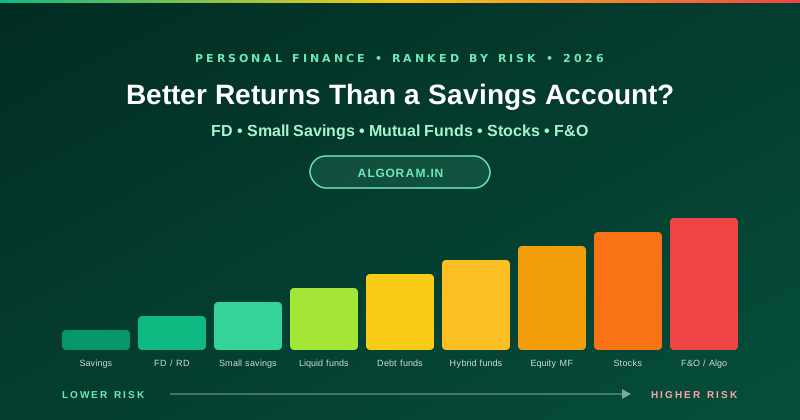
The Risk Ladder: Nine Options, Lowest Risk to Highest
Here is every mainstream option in one table, ordered by risk to your capital, not by return. Read it from the top: each step down the table offers more potential return and asks you to accept more risk, more volatility or a longer lock-in.
| Option | Risk | Returns | Getting your money | Lock-in | Tax |
|---|---|---|---|---|---|
| 1. Savings account | Very low | About 2.5–3% at large banks; 4% at the post office | Instant | None | Interest at your slab rate |
| 2. Bank FD / RD | Very low | Fixed for the tenure; varies by bank | Break early, usually with a small penalty | The tenure you pick | Interest at your slab rate; TDS applies |
| 3. Small savings: PPF, POMIS, NSC, SCSS | Very low | Fixed, reset quarterly: PPF 7.1%, POMIS 7.4%, NSC 7.7%, SCSS 8.2% | Limited; early exit restricted or penalised | 5 years (POMIS, NSC, SCSS); 15 years (PPF) | PPF tax-free; others' interest taxable |
| 4. Liquid & overnight funds | Low | Market-linked; tracks short-term rates | Usually next working day | None | Gains generally at your slab rate |
| 5. Debt funds | Low–moderate | Market-linked; moves with interest rates and credit quality | 1–3 working days | None (some exit loads) | Gains generally at your slab rate |
| 6. Hybrid funds | Moderate | Market-linked; a mix of debt and equity | 1–3 working days | None (exit loads common in year one) | Depends on the equity share |
| 7. Equity mutual funds / SIP | High | Market-linked; can fall sharply in the short term | About 2–3 working days | None (ELSS: 3 years) | 20% within 12 months; 12.5% above ₹1.25 lakh a year after that |
| 8. Direct stocks | High | Market-linked; depends on the companies you pick | Sell any trading day; settles next day | None | Same as equity funds |
| 9. F&O and algo trading | Very high | No expected return; most individual traders lose money | Close a position any trading minute; withdraw as per broker timelines | None | Business income at your slab rate |
Small savings rates are for October–December 2026 and are reviewed every quarter. Tax rules are summarised for FY 2026-27 and simplified; check the details for your situation with a CA.
Rungs 1–3: Fixed Returns, Very Low Risk
1. Savings account
Your money is available instantly, and bank deposits are insured by DICGC up to ₹5 lakh per depositor per bank, including interest. The catch is that the cover is combined across all your accounts and FDs at the same bank. The rate (about 2.5–3% at large banks, 4% at the post office) usually trails inflation. Use it for your emergency fund and day-to-day money, not for long-term savings.
2. Bank fixed and recurring deposits
An FD locks in a rate for a tenure you choose, from a week to ten years. A recurring deposit does the same for a fixed monthly amount. Both come under the same DICGC cover as your savings account. You can usually break an FD early, but the bank cuts the interest rate as a penalty. Interest is taxed at your slab rate and TDS applies above a threshold, so the after-tax return is lower than the headline rate, especially in the higher slabs. The RBI raised its repo rate to 5.50% on 7 October 2026, so it is worth comparing current FD rates before you lock in.
3. Government small savings schemes
These are backed by the Government of India, and their rates are reset every quarter. The government kept them unchanged for October–December 2026:
| Scheme | Rate (Oct–Dec 2026) | Term | Good for |
|---|---|---|---|
| Public Provident Fund (PPF) | 7.1% | 15 years | Long-term, tax-free savings; limited partial withdrawals after the first few years |
| Post Office Monthly Income Scheme (POMIS) | 7.4% | 5 years | Interest paid every month |
| National Savings Certificate (NSC) | 7.7% | 5 years | Fixed growth, paid at maturity |
| Senior Citizens' Savings Scheme (SCSS) | 8.2% | 5 years | Quarterly income for people aged 60 and above |
| Post office savings account | 4.0% | None | Instant access |
The trade-off is liquidity. These schemes reward you for staying put, and early exits are either not allowed or come with a deduction.
Rungs 4–6: Liquid, Debt & Hybrid Funds
From here on, returns are market-linked: no rate is promised, and the value of your investment can go down as well as up.
- Liquid and overnight funds invest in very short-term instruments. They are the closest market-linked option to a savings account. Redemptions usually reach your bank by the next working day, which makes them a common home for part of an emergency fund.
- Debt funds hold bonds and are exposed to interest-rate risk. When rates rise, the prices of existing bonds fall, so longer-duration funds can show short-term dips. With the RBI now in a "calibrated tightening" stance, that risk is real. Debt funds also carry credit risk if the issuers they lend to get into trouble.
- Hybrid funds mix debt and equity. The more equity a fund holds, the more it behaves like the next rung, in both potential return and volatility.
For most debt-oriented funds, gains are taxed at your slab rate however long you hold them. That removes much of their old tax edge over FDs, so compare them on flexibility and risk rather than on tax.
Rungs 7–8: Equity Mutual Funds & Direct Stocks
Equity is where long-term wealth is usually built. It's also where the ride gets bumpy: in a bad year, a well-diversified equity fund can fall sharply, and a single stock can fall much further. That is why the standard rule is to put in equity only money you won't need for at least five years, and to invest gradually, for example through a SIP.
- Diversified equity and index funds spread your money across many companies. You can redeem any working day (ELSS tax-saver funds have a 3-year lock-in), though many funds charge an exit load if you sell within the first year.
- Direct stocks put the stock-picking decisions on you. Concentrating money in a few companies adds risk that a diversified fund avoids.
- Tax (FY 2026-27): gains on units or shares held up to 12 months are taxed at 20%. After 12 months, gains above ₹1.25 lakh a year are taxed at 12.5%.
Rung 9: F&O and Algo Trading, the Highest-Risk Rung
Futures and options sit at the top of the ladder, and the regulator's own data shows why. SEBI's study of equity-derivatives traders, published in August 2026, found:
Costs matter too. Even before transaction costs, 82.1% of traders in SEBI's sample lost money, and brokerage, taxes and other charges pushed that to 87.7%.
Automation doesn't change these odds by itself. Algo trading changes how trades are executed: consistently, by rule, without hesitation or revenge trading. It does not change what the market does. A losing strategy executed perfectly is still a losing strategy. So F&O and algo trading are not an investment and not a replacement for an FD or a savings account. There is no fixed return, no capital protection, and losing months are normal.
Any person, group or platform offering "fixed monthly returns" or "guaranteed profit" from trading is a warning sign. Trading results are irregular by nature, and nobody can promise them.
Liquidity vs Lock-in: How Fast Can You Get Your Money?
Many people searching for an investment with "no lock-in period" really want to know: can I get my money back when I need it? Here is how the options compare:
| Option | Typical time to get your money | What it costs to leave early |
|---|---|---|
| Savings account | Instant | Nothing |
| Bank FD | Usually the same day, if you break it | A cut in the interest rate |
| PPF / NSC / SCSS / POMIS | Restricted for years | Not allowed, or a deduction |
| Liquid funds | Usually the next working day | Usually nothing after a few days |
| Equity mutual funds | About 2–3 working days | Possible exit load; the market price on the day you sell |
| Stocks | Sell any trading day; settles next day | The market price on the day you sell |
| Trading account (F&O) | Funds in your broker account; withdrawals as per the broker's payout timelines | Nothing to leave, but the capital itself is at risk while trading |
A trading account is one of the most liquid places on this list, and it's also where your capital is most at risk. "No lock-in" tells you how easily you can leave. It tells you nothing about how much will be left when you do.
Build From the Bottom Up
The ladder works best climbed in order. A widely used framework:
- Emergency fundThree to six months of expenses in a savings account, sweep-in FD or liquid fund
- ProtectionTerm and health insurance before you invest
- Short-term goalsMoney needed within about three years: FD, RD, small savings, liquid or short-duration debt funds
- Long-term goalsMoney for five years or more: diversified equity funds via SIP, PPF, NPS
- Risk capitalOnly then, an amount you could lose entirely without touching steps 1–4, if you want to trade
This is a general framework, not a personal recommendation. How much goes into each step depends on your income, dependants, debts and goals. A SEBI-registered investment adviser can build that plan with you.
Where ALGORAM Fits, and Where It Doesn't
ALGORAM is automated trading software for the top rung only. To be completely clear about what it is not:
- It is not an investment product and not a replacement for a savings account, FD or mutual fund
- It does not provide monthly income and does not promise any return
- It is not for your emergency fund or money set aside for goals
If you've already climbed steps 1–4 and decided to trade with risk capital, ALGORAM's job is to make that trading systematic and controlled:
Stop trading on any day with the auto buy/sell switch or the personal kill switch. You can cancel the subscription at any time; cancellation stops future billing, and the current billing period isn't refunded.
Funds stay in your own 5paisa account. ALGORAM never holds client money.
Intraday positions are squared off at 15:00 IST, and no new entries are taken from 14:55.
Choose the capital split by segment, the size per trade, the maximum trades a day and a daily loss limit that stops new trades for the day.
You can also run the same live signals on paper first, with no real money at stake, and judge the results for yourself before trading live. Paper results can differ from live results. For the full picture of how the software works, read What is ALGORAM? A complete guide. For why most traders lose, see Why 90% of traders lose money.
📝 Try It on Paper First
If trading is already part of your plan, watch ALGORAM's live signals, risk checks and exits on paper before you commit any real capital.
Conclusion
If you just want to beat your savings account safely, the answer is lower down this ladder, not trading: an FD or RD, a government small savings scheme, or a liquid fund, chosen by when you'll need the money. For goals five or more years away, diversified equity funds have historically been the main route to long-term growth for many investors, as long as you can sit through the falls.
If your emergency fund and long-term investments are already in place and you've set aside money you can afford to risk, ALGORAM makes that trading systematic. There is no lock-in, your money stays in your own 5paisa account, intraday positions close by 15:00, and you set the daily loss limit. Returns are never guaranteed, and losses can be substantial.
Educational content only. Interest rates, tax rules and scheme conditions change; verify current terms with the bank, post office, fund house or a qualified CA before acting. ALGORAM provides algorithmic trading software and related technology services. It is not an investment adviser, research analyst or portfolio manager. Trading in equities and derivatives involves market, execution, liquidity and technology risks; options trading can result in substantial losses. No return or capital protection is guaranteed.
Sources
- Small savings rates for October–December 2026: Business Today, 30 Sep 2026
- CPI inflation for September 2026: MoSPI press release, 12 Oct 2026
- RBI repo rate hike to 5.50%: SCC Online, 9 Oct 2026
- SEBI study on individual F&O traders, FY26: Business Today, 21 Aug 2026
- Deposit insurance cover: DICGC
Frequently Asked Questions

Ankit is a founder and Managing Director of ALGORAM. He writes about money basics and risk for Indian traders: what to have in place before you trade, and how to keep trading capital separate from the savings you depend on.