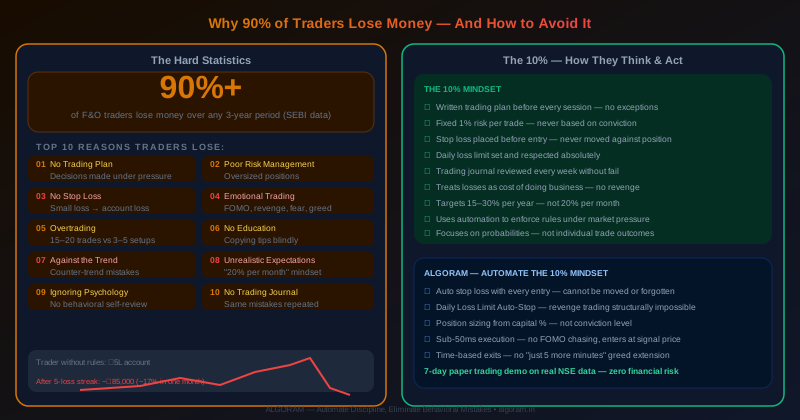
The Uncomfortable Truth About Trading
Most people who start trading lose money. Not because the market is rigged. Not because they're unintelligent. Not because they had bad luck. They lose because of predictable, avoidable behavioral patterns that nobody warned them about — and that social media trading culture actively disguises.
The trading gurus on Instagram showing ₹2 lakh profits in a single session aren't showing you the 11 months of losses before that day. The YouTube thumbnails of "I turned ₹50,000 into ₹5 lakh in 3 months" don't mention the 85% of people who tried the same approach and lost everything. The Telegram tips channels that promise 80% accuracy are optimistically reporting selective wins while quietly ignoring the losses.
This creates a population of retail traders who enter the market with completely miscalibrated expectations — and exit, often poorer, within 2 years. The pattern has repeated for decades.
This guide doesn't sugarcoat it. It tells you exactly what causes trading losses — the real psychological and behavioral patterns, not surface-level excuses — and what the profitable minority actually does differently.
Is the 90% Statistic Real?
SEBI's data is consistently cited: over any 3-year period, more than 90% of F&O traders have net losses. The exact number varies by study and timeframe, but the directional truth is consistent and stark — the large majority of retail derivatives traders lose money.
What's important is understanding why. The statistic isn't evidence that markets are unbeatable. Institutional traders — mutual funds, hedge funds, algorithmic trading firms — consistently profit in the same markets where retail traders consistently lose. The market is the same. The outcome is different because the discipline, risk management, and execution approach are completely different.
The market doesn't cause retail trader losses. Retail trader behavior causes retail trader losses. If the market caused losses, professionals would also lose. They don't. The market is neutral — it rewards discipline and punishes the lack of it.
10 Reasons Why Traders Lose Money
Trading Without a Written Plan
Most retail traders have no written trading plan. They decide entry, exit, stop loss, and position size in real-time — under live market pressure, with P&L moving, while emotions are running. This is the worst possible environment for decision-making.
A trading plan defines all critical decisions in advance: which instruments to trade, what conditions trigger entry, where the stop loss goes, what the target is, how much capital to risk, and what conditions mean "no trade today." Every professional trader — human or algorithmic — operates from a pre-defined plan.
Write your complete trading plan before market opens. Every session. If you can't define it in writing before the market opens, you're not ready to trade.
Poor Risk Management — Sizing Positions on Conviction
The single most financially destructive pattern: increasing position size on setups that "look strong." When a trade looks obvious — everyone on Telegram is talking about it, the chart is perfect, the stars are aligned — retail traders size up significantly. These are precisely the trades most likely to be crowded, priced in, and about to reverse.
Professional position sizing is mechanical: risk a fixed 1–2% of capital per trade, regardless of conviction. This keeps any individual loss manageable and gives the strategy statistical runway to play out. Related: Risk Management in Algo Trading
Maximum 1% risk per trade on a ₹5 lakh account = ₹5,000 maximum loss. This never changes regardless of how "certain" the setup looks.
Not Using Stop Loss Orders
"It'll come back" are the four most expensive words in trading. When a losing trade is held without a stop loss, the trader shifts from a trading decision to a hoping decision. The original trade thesis may have been wrong — price has confirmed this by moving against the position — but psychological commitment to the trade overrides the logical exit.
Small losses are a cost of doing business in trading. Every professional trader has many small losses. The ones who survive have defined limits on how large any loss can get. Without stops, one bad trade can undo weeks of gains.
Define stop loss before entering. Place it immediately. Never move it against your position. In ALGORAM, stops are placed automatically with every entry — cannot be forgotten or delayed.
Emotional Trading — Fear, Greed, FOMO, Revenge
The four emotions that destroy trading accounts:
- Fear causes exits from winning trades too early — "I'll take ₹500 now before it reverses" — cutting the profitable trades short while losses are held
- Greed causes holding losing positions too long — "just a bit longer and it'll come back" — which is what turns small losses into large ones
- FOMO (Fear of Missing Out) causes chasing trades that have already moved — entering at worse prices with worse risk-reward, then panicking when the move stalls
- Revenge trading after losses means entering immediately after a loss to "get it back" — under maximum emotional stress, with oversized position, with no plan
Automation removes the human from these emotional moments. ALGORAM's Daily Loss Limit Auto Stop prevents revenge trading. Automated exits prevent greed-held losers. Defined entry prices prevent FOMO chasing.
Overtrading
More trades does not mean more profit. It means more transaction costs, more opportunities for behavioral errors, more capital deployed in low-quality setups, and more cognitive fatigue leading to worse decisions. Most strategies generate 2–5 high-quality signals per day at most. Retail traders often take 15–20 trades, diluting their edge with noise.
Define your setup criteria precisely. Only take trades that meet all criteria. If the daily limit of defined setups is 3 and you've taken 3, stop — even if the market is still moving.
Lack of Education — Copying Tips and Following Influencers
Trading looks easy from the outside. A chart, a few indicators, a buy or sell decision. In reality it's a skill that takes years to develop — just like surgery or engineering. The majority of new retail traders skip the education phase entirely, buying "stock tips" from Telegram channels or copying trades from social media influencers whose actual track record is unknown.
No tips channel has 80% accuracy over 500+ trades when verified independently. No Instagram trader has sustained 100% monthly returns for more than a few months. These claims are marketing, not track records.
Learn before you earn. Paper trade for minimum 30 days before deploying real capital. Build your own strategy. Never trade based on someone else's unverified signal.
Trading Against the Trend
"Buy the dip" and "short the top" are appealing because catching reversals feels clever. But trend trading has a much better statistical track record for most timeframes. Markets trend more than they reverse. Counter-trend traders are right sometimes spectacularly, but they are wrong more often — and when they're wrong, the loss can be large because the trend continues against their position.
Identify the prevailing trend first. Trade with it, not against it. Use FII/DII data, price structure (HH/HL), and VWAP to confirm trend direction before any entry.
Unrealistic Expectations
Social media trading culture promises returns of 10–30% per month. Professional hedge funds target 15–25% per year. When retail traders build their trading plans around 20% monthly returns, they take the position sizes required to generate those returns — which are enormous relative to their capital. The first losing streak, which always comes, destroys the account.
Target 15–30% per year as a long-term profitable trader. Focus on consistency over magnitude. Even 2% per month, compounded, is exceptional performance.
Ignoring Trading Psychology
Most traders spend significant time on technical analysis and virtually no time studying their own behavioral patterns. The indicators on your chart cannot help you when you panic-exit a winning position at 3:25 PM on expiry day. Understanding why you made a specific decision — and recognising the psychological pattern that caused it — is what enables you to avoid repeating it.
Keep a trading journal. After every trade: what was the setup, what was the plan, what actually happened, and crucially — what emotion affected your decision? Patterns emerge within 2–3 weeks of consistent journaling.
Not Keeping a Trading Journal
Traders who don't journal make the same mistakes repeatedly — sometimes for years — because the pattern is never identified. A trader who keeps a journal and reviews it weekly has a mechanism for catching behavioral patterns early: "I notice my worst trades are always 30 minutes after my first loss of the day." This is actionable. Without the journal, the pattern is invisible.
Log every trade: entry/exit, setup, planned vs actual, P&L, and emotional state at the time. Review weekly. Identify the top 1–2 behavioral patterns causing losses and address one per month.
Common Mistakes Specifically in Options Trading
Options add several layers of complexity beyond price direction — and additional ways to lose money even when directional analysis is correct:
- Buying options without understanding implied volatility. Buying a Nifty CE when India VIX is at a 6-month high means paying maximum premium — and IV crush alone can cause losses even if NIFTY moves in the right direction.
- Ignoring theta (time decay). Long options lose value every day regardless of price movement. Holding options through the low-volume mid-session (12:00–1:30 PM) is paying theta without getting any directional advantage.
- Trading weekly expiries recklessly. Weekly options have aggressive gamma risk near expiry. ATM options can move 100–200% in 30 minutes on expiry day. Beginners treating expiry day like a regular session are playing in the highest-risk session of the market calendar.
- Selling options without risk management. Uncovered option selling has theoretically unlimited loss. Selling calls without defined buy-back levels, position sizing, and daily loss limits is account-destroying territory.
How Successful Traders Think Differently
The Role of Risk Management — Survival Before Profit
The professional trading philosophy is counterintuitive: think about risk before reward on every trade. The market will create countless opportunities tomorrow. Your capital is finite. Protecting capital today ensures you're present to take advantage of tomorrow's opportunities.
Three numbers every trader needs to know before opening any trade:
- Maximum loss on this trade (stop loss level × position size) — the absolute worst-case scenario
- Maximum daily loss — the total I'll lose today before stopping completely
- Current drawdown from peak — if this is approaching 15%, something is wrong and needs review
For the complete guide: Risk Management in Algo Trading — Professional Techniques and Top 10 Trading Mistakes That Destroy Accounts
The Social Media Trading Trap
The trading content ecosystem on Instagram, Telegram, and YouTube has created a specific kind of retail trader: financially motivated, FOMO-driven, and fundamentally miscalibrated about what trading actually looks like for professionals.
Here's what social media trading culture shows you: the winning days. The 5-figure profits. The screenshots. The "I turned ₹1 lakh into ₹15 lakh" stories. What it doesn't show: the 47 losing trades before the big win. The account that was blown twice before the winning one. The fact that the "trading guru" makes more money selling courses than trading.
The result is a massive population of new traders who enter the market expecting to make 10% per week, and who have no emotional or financial framework for handling the reality of consistent small losses on the path to long-term profitability.
Social media says: "₹50,000 → ₹3 lakh in 2 months"
Reality: 500 people tried this. 450 lost money. 40 broke even. 10 profited. The 10 are the ones you see posting.
Social media says: "87% accuracy tips"
Reality: No independently verified tips channel has maintained 87% accuracy over 500+ consecutive tips. The math doesn't work at any position size that generates meaningful returns.
The Psychology of the Losing Trade
There's a specific sequence that happens in most losing trades, and it's almost entirely psychological:
- Entry: Trader enters with a defined stop loss. This is the rational phase.
- Price moves against position: Stop loss is approaching. Rational decision: honor the stop.
- Emotional phase begins: "It's just temporary volatility. It'll come back. Moving the stop just a little."
- Stop is moved: Now there is no defined maximum loss. The position continues moving against the trader.
- Hope phase: "If it just comes back to my entry I'll exit at breakeven." Now the trade goal has shifted from profit to recovery.
- Panic phase: Price is now far past the original stop. Loss is now large. Panic exit at the worst price.
This sequence is replayed in accounts all over India every trading day. The original entry may have been correct. The stop loss was correctly placed. The loss came from step 3 — the emotional override. And that's the step automation eliminates entirely.
How Technology Reduces Trading Mistakes
The insight that separates professional institutional trading from retail trading is this: the risk of human behavioral failure in execution is so well-documented and so consistent that institutional traders have systematically removed humans from execution entirely — replacing them with algorithmic systems that execute rules without emotional deviation.
This isn't because professionals lack discipline. It's because even highly disciplined humans make worse decisions under live market pressure than they would under calm conditions. Removing the human from the execution moment improves performance measurably and consistently.
For retail traders, no-code algorithmic trading platforms make this same approach available without requiring programming knowledge or institutional infrastructure.
How No-Code Algorithmic Trading Helps Retail Traders
ALGORAM is built around one insight: most retail trading losses aren't caused by bad strategy — they're caused by inconsistent execution of strategies that actually have an edge. The platform addresses this by automating execution, enforcing risk rules, and removing the behavioral variables that cause underperformance.
Specifically for the problems in this article:
- No written plan: In ALGORAM, the strategy configuration is the written plan. Entry criteria, stop loss, target, position size, daily limit — all defined and locked before trading begins.
- Poor position sizing: Position sizes are calculated from capital percentage rules. Conviction level has no input. Every trade gets the same percentage risk.
- Stop loss moved: Stop losses are placed simultaneously with entry via broker API. The trader cannot move them during the trade.
- Revenge trading: Daily Loss Limit Auto Stop halts all trading when the configured threshold is hit. Revenge trading is structurally impossible.
- FOMO entries: The system only enters at defined signal conditions. Price has to meet your criteria — the algorithm doesn't chase.
- Overtrading: Only defined setups execute. The algorithm doesn't get bored or anxious about missing moves.
The 7-day paper trading demo lets you see exactly how this works on real NSE live data — with no financial risk. Read: How Beginners Can Start Algo Trading Without Coding
🧠 Stop Trading Against Your Own Psychology
ALGORAM executes your strategy without emotional interference — stop losses, daily limits, position sizing all enforced automatically. 7-day free demo on real NSE data.
Practical Tips to Become a Profitable Trader
🚀 Launch Offer — First 100 Customers Only
Conclusion
The 90% statistic isn't a verdict on traders' intelligence. It's a description of a behavioral pattern that's entirely preventable. The traders in that 90% aren't losing because the market beat them — they're losing because fear, greed, FOMO, and revenge trading are beating them. The market is just the backdrop.
The 10% who consistently profit aren't executing some secret strategy. They're following written plans. They're sizing positions mathematically. They're honoring stop losses. They're not revenge trading. They're treating their trading account as a business, not a slot machine. And they're reviewing their performance honestly enough to catch their own behavioral patterns before they become permanent holes in their equity.
These are learnable skills. None of them require native genius. All of them require consistent application under live market pressure — which is where automation earns its place. Because applying rules consistently under emotional pressure is, demonstrably, where most humans fail. And where algorithms, by design, cannot.
Start disciplined trading: → ALGORAM 7-day free paper trading demo
Best offer: → Open 5paisa for 3 months free access
Master risk management: → Risk Management in Algo Trading
Understand what actually works: → What is Algo Trading? Complete Guide
See the top mistakes in detail: → Top 10 Trading Mistakes That Destroy Accounts
Frequently Asked Questions

Ankit was in the 90% before he was in the 10%. He blew two accounts before understanding that his strategy was never the problem — his behavioral patterns were. "The market didn't take my money. My own emotions did." He built ALGORAM specifically to address this: automating the execution of rules that traders know but consistently violate under pressure.