Introduction
You see the signal. Nifty has just broken above a key resistance with strong volume. Your setup is perfect. You open the trading terminal, navigate to the options chain, select the right strike, enter the quantity, and click buy.
Fifteen seconds have passed.
The CE you wanted at ₹95 is now trading at ₹118. You've already paid a 24% premium before the trade has even begun.
This is the fundamental problem with manual trade execution in fast-moving markets — and it happens not just occasionally, but on almost every trade. The gap between signal and execution isn't just an inconvenience. It's a structural cost that compounds across hundreds of trades and silently destroys a strategy's edge.
Automated entry and exit eliminates this problem entirely. Not by being faster than the fastest human — by being a completely different category of participant. While a human identifies, decides, and clicks in seconds, an automated system identifies, evaluates, and executes in milliseconds — before the market has moved.
What Is Automated Entry and Exit Trading?
Automated entry and exit trading is a system where trade orders are placed and managed entirely by software, based on pre-defined rules — without any manual input from the trader at the time of execution.
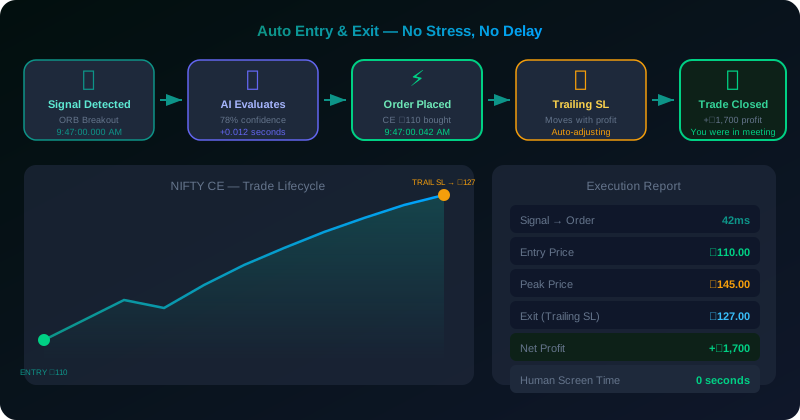
When a signal condition is met — say, RSI crosses below 30 with volume expansion on the 15-minute chart — the system doesn't wait for a human to notice, decide, and click. It places the buy order immediately, simultaneously sets the stop-loss at the calculated level, defines the target, and activates the trailing stop. All of this happens in under 50 milliseconds.
The "exit" side is equally important. Automated exit means the system closes positions when conditions are met — target reached, stop-loss triggered, trailing stop activated, or time-based exit conditions met — without any emotional interference, hesitation, or manual delay.
Automation doesn't just replace the click. It replaces the entire human decision chain: noticing the signal → evaluating it → deciding to act → opening the terminal → entering details → clicking buy. Every step in that chain takes time and introduces error. Automation compresses all of it into a single near-instant action.
Why Manual Trade Execution Creates Problems
1. Delayed Entry — The Hidden Cost
Even the fastest manual traders take 5–15 seconds from signal recognition to order placement. In normal equity trading, this is manageable. In intraday Nifty and Bank Nifty options — where premiums can move 20–30% in under 60 seconds on volatile days — a 15-second delay is catastrophic.
Consider the math: if you're consistently entering options 10–20% higher than the signal price due to execution delay, your break-even point is already significantly compromised before you've taken a single trade.
2. Emotional Decision Making
Manual trading requires a human to pull the trigger on every entry and exit. Under real-time pressure — watching a position move, feeling the weight of recent losses or gains — that human will not always execute the strategy as planned.
They'll hesitate on an entry because the last three trades lost. They'll hold a losing position longer than the stop-loss dictates because they "feel" it will turn around. They'll take profits too early because they're nervous. These aren't character flaws — they're universal human responses to financial stress. But they destroy strategy performance over time.
3. Missed Opportunities
Markets don't wait for you to finish a meeting, check a notification, or get back to your desk. A valid ORB breakout at 9:47 AM doesn't care that you're in a client call. A VWAP pullback entry at 10:23 AM doesn't pause while you navigate to your broker terminal.
Manual trading means systematically missing every trade that happens when you're not watching. For working professionals — which describes the majority of Indian retail traders — that's a substantial portion of valid setups every week.
4. Inconsistent Execution Quality
A manual trader's execution quality varies enormously: by time of day (fatigue), recent results (confidence), market conditions (stress), and external distractions. The same strategy, run manually, can produce very different results on a focused Monday morning versus a distracted Friday afternoon.
Good strategies deserve consistent execution. Manual trading rarely provides it.
5. Limited Monitoring Capacity
A human can meaningfully monitor one, perhaps two instruments at a time. Running Nifty options, Bank Nifty options, and two stock positions simultaneously — watching for signals, managing exits, tracking stops — is cognitively impossible without degrading quality across all of them.
SEBI data consistently shows over 90% of F&O traders lose money over any 3-year period. The primary cause isn't bad strategy — it's inconsistent, emotionally compromised manual execution. The strategy works; the execution of it doesn't.
How Automated Entry Improves Trade Execution
Instant Signal-to-Order Execution
When ALGORAM's monitoring engine identifies that all entry conditions are met for a configured strategy, it places the order via direct broker API in under 50 milliseconds. Not 5 seconds. Not 15 seconds. Fifty milliseconds — faster than your eye blinks.
This matters enormously in practice. A Bank Nifty CE at ₹120 when the signal fires might be at ₹135 by the time a manual trader executes. ALGORAM enters at ₹120. Over a month of trading, this difference in average entry quality compounds significantly into overall performance.
Rule-Based Entries Remove Hesitation
The algorithm doesn't feel nervous after three consecutive losing trades. It doesn't overthink a valid signal because it "doesn't feel right." When the pre-defined conditions are met, the order is placed — identically whether it's the first trade of the month or the fiftieth.
This consistency is the most underappreciated advantage of automation. Good strategies have positive expectancy — they work over a large sample of trades. But that expectancy only materialises if every valid signal is taken. Manual traders routinely skip valid signals after losses, or size up on signals after wins, or otherwise deviate from the plan. Automation eliminates all of this.
Multi-Instrument Parallel Monitoring
ALGORAM simultaneously monitors all configured instruments — Nifty, Bank Nifty, stocks, stock options — and executes entries on any of them the moment conditions are met. A human trader managing the same portfolio would need to split their attention, inevitably missing some signals and catching others late.
ALGORAM's OI and Volume-Based Signals add a critical layer to entry quality. The system evaluates Open Interest changes and volume patterns at the strike level before executing options entries — filtering out setups where the OI picture doesn't confirm the directional bias. This reduces false entries that pass technical indicator checks but lack institutional conviction.
How Automated Exit Improves Trade Execution
Automatic Target Booking
When a target is pre-defined and entered as a limit sell order at trade initiation, profit-taking happens at exactly the planned level — without the greed-driven decision to "let it run a bit more" that so often turns a winner into a smaller winner or a breakeven.
Automatic target booking also means you don't need to watch the position. You can be in a meeting, at lunch, or doing anything else. When the target is hit, the position closes. You get a notification. Done.
Trailing Stop Loss — Protecting Profits While Letting Winners Run
A trailing stop loss is one of the most powerful exit tools in trading — and one of the hardest to implement manually with any consistency.
The concept: as a trade moves in your favour, the stop price automatically rises (for long trades), locking in increasing amounts of profit while still allowing the trade to continue if momentum persists. When the market reverses by the specified trailing amount, the stop triggers and the position closes.
In ALGORAM, trailing stops activate automatically after the position reaches a specified profit threshold. No manual adjustment needed. No watching the screen to decide when to move the stop. No forgetting to update it during a busy moment.
Example: You enter Nifty CE at ₹100 with a trailing stop of ₹15. As premium rises to ₹140, the trailing stop moves to ₹125, locking in ₹25 profit minimum. If it rises to ₹170, trailing stop moves to ₹155. If it then falls to ₹155, the position closes automatically at a ₹55 profit. You captured the move without watching a single tick.
Stop Loss Execution — Discipline When It Matters Most
The hardest trade to make manually is the losing exit. When a trade is against you and approaching your stop, every psychological instinct says: wait a little longer, it might turn around, the loss isn't real until you take it.
ALGORAM doesn't experience this. When the stop-loss price is hit, the sell order executes. Immediately. Without hesitation. Without giving back another ₹5,000 hoping for a reversal that doesn't come.
This sounds simple. In practice, it's one of the most valuable things automation does — it enforces discipline precisely when human psychology is most unreliable.
⚡ Experience Automated Execution — Free for 7 Days
Watch ALGORAM's auto entry and exit run on real NSE market data. Zero risk. No capital required. See sub-50ms execution in action.
Manual Trading vs Automated Trading: Full Comparison
| Factor | Manual Trading | Automated Trading (ALGORAM) |
|---|---|---|
| Execution Speed | 5–30 seconds | Under 50 milliseconds |
| Entry Accuracy | Varies with attention and emotion | Identical on every signal |
| Slippage | High — especially in fast markets | Minimal — direct API at signal price |
| Stop Loss Adherence | Often moved or ignored under pressure | System-enforced, immovable |
| Trailing Stop | Manual adjustment — usually missed | Automatic, real-time, no input needed |
| Emotional Influence | High — affects every decision | Zero — logic only |
| Discipline | Inconsistent under pressure | 100% consistent every session |
| Risk Management | Self-enforced — fails when it matters | System-enforced, cannot be overridden |
| Instruments Monitored | 1–2 at a time realistically | All configured instruments simultaneously |
| Available Hours | Requires active attention | Cloud-based, trades independently |
| Daily Loss Limit | Self-discipline — frequently violated | Auto-stops trading at set threshold |
| Scalability | Degrades with more instruments | Scales with zero additional effort |
How ALGORAM Improves Trade Execution
ALGORAM was built around a single premise: good strategies deserve perfect execution. Every feature in the platform addresses a specific execution failure point that Indian retail traders experience in manual trading.
Complete trade lifecycle automated. Signal fires → order placed → SL set → target defined → trailing stop activated. Under 50ms, no manual steps.
Automatic trailing stop adjusts as profit builds — locking in gains while letting winners run. No manual adjustment ever needed.
Combines daily loss limits, per-trade SL enforcement, and position sizing to prevent any single day from causing outsized damage.
When daily losses hit your pre-set limit, ALGORAM stops trading for the day automatically. No override possible. Capital protected.
Open Interest and volume analysis at the strike level adds institutional conviction filter before options entries are executed.
Run Nifty options, Bank Nifty options, and stock strategies simultaneously. Each executes independently with its own risk parameters.
Start, stop, and monitor all strategies from your phone. Full visibility and control from anywhere — no desktop required.
All strategies run on ALGORAM are backtested across 20 years of NSE data before deployment. Performance tracking continues live.
7-day paper trading demo on real market data. Setup in under 60 seconds. Beginner Mode simplifies for new users.
Real-Life Case Study: Manual vs Automated Execution
Same trading day. Same strategy. Two traders. Here's how the results diverged.
The difference between –₹3,200 and +₹1,700 wasn't the strategy — both traders used the same ORB approach. The difference was: Vikram's system entered at the signal price. Priya entered 22% higher. Vikram's system exited at the trailing stop. Priya held past her stop and exited in panic. Two different execution systems. Five thousand rupees difference on a single trade.
Benefits Checklist: Automated Entry and Exit
Common Mistakes Traders Make That Automation Solves
Moving the Stop Loss
The most costly single mistake in retail trading. A trader sets a stop at ₹95. The position hits ₹96. Instead of closing, they move the stop to ₹88 "just to give it a bit more room." When the automated system's stop is placed, it executes at that price. Period. ALGORAM doesn't have a "give it more room" option.
Revenge Trading After Losses
After two or three losing trades, many manual traders increase position size on the next trade to "make it back faster." ALGORAM's position sizing is based on the pre-set capital allocation rules — it never sizes up out of emotion. When the daily loss limit is hit, it stops trading entirely.
Overtrading
Manual traders, especially on quiet days, often create trades where none exist — taking setups that don't meet their own criteria because they "need" to trade. ALGORAM only fires when all specified conditions are met. Silence from the system means no valid setups — exactly as it should be.
Premature Exits
Booking profits at 50% of the target because you're nervous is one of the most common ways traders underperform their own strategy. ALGORAM's exits happen at defined target levels or trailing stop levels — not when anxiety peaks.
Late Exits After the Target Is Passed
The reverse problem: watching a winning position overshoot the target and waiting for "more" — then watching it reverse. Automated target orders execute the moment the price is hit. The profit is booked. Done.
The Future of Automated Trade Execution
Automated execution is not a feature in trading — it's becoming the baseline expectation. Here's where the technology is headed and what it means for Indian retail traders.
AI-Enhanced Signal Quality
The next evolution beyond rule-based automation is AI that evaluates the probability of each signal before deciding to execute. ALGORAM already implements this with its AI signal filtering layer — evaluating market regime, VIX, OI patterns, and time-of-day historical data to filter approximately 25% of lower-probability signals before execution. This adaptive layer will become more sophisticated as AI models are trained on larger datasets and longer live market histories.
Real-Time Options Chain Intelligence
Advanced automated systems are moving toward real-time options chain analysis integrated directly into execution decisions — selecting optimal strikes based on current IV, OI distribution, and delta requirements rather than fixed strike selections. ALGORAM's Option Chain Analysis feature already begins this journey, using OI and volume patterns at the strike level to validate options entries.
Smart Capital Allocation Across Strategies
Future automated systems will dynamically shift capital between strategies based on real-time performance attribution — automatically allocating more to what's working in current market conditions and less to what isn't. ALGORAM's Smart Capital Allocation feature enables this today, with the sophistication of allocation algorithms continuing to improve.
Multi-Exchange and Global Market Integration
As Indian markets become more integrated with global derivatives flows, automated systems will increasingly need to factor in SGX Nifty overnight movements, US Federal Reserve meeting outcomes, and global commodity prices as pre-market filters for intraday strategy activation. The cloud infrastructure supporting these systems will evolve to incorporate these feeds as standard inputs.
"In five years, the question won't be whether to use automated execution. It'll be which automated system you use and how well it's calibrated for your risk profile. Manual intraday trading in F&O will be as competitive as manual HFT is today — structurally disadvantaged."
— Ankit Patel, Founder & MD, ALGORAM🚀 Launch Offer — First 100 Customers Only
Conclusion
The gap between a good trading strategy and good trading results is almost always execution. Manual execution introduces delays, emotions, inconsistency, and structural disadvantages that no amount of strategy refinement can overcome.
Automated entry and exit doesn't just make you faster. It makes you consistent. It makes your stops real. It makes your targets actually get booked. It removes the single biggest variable in trading performance — the human executing the strategy — and replaces it with a system that does exactly what you planned, every time.
ALGORAM was designed specifically for Indian retail traders who understand this. Whether you're a working professional who can't watch markets during office hours, an experienced trader tired of emotional deviations, or a beginner who wants to start with professional-grade execution from day one — automated entry and exit is the foundation everything else is built on.
Start with the 7-day paper trading demo. Watch automated execution happen in real market conditions. Then decide.
Try it free: → 7-day ALGORAM paper trading demo
Best deal: → Open 5paisa via ALGORAM for 3 months free
Learn more: → What is Algo Trading? Complete Beginner's Guide
Strategy guide: → Top 10 Algo Trading Strategies for Professional Traders
Manual vs auto: → Manual Trading vs Automated Trading: Which Wins?
Frequently Asked Questions

Ankit built ALGORAM after experiencing firsthand the gap between having a good strategy and being able to execute it consistently. Having traded Indian markets manually for over a decade before developing ALGORAM's automated execution engine, he understands exactly where manual execution fails — and designed every feature in this guide to solve those failure points specifically.