Why NIFTY Options Buying Suits Retail Traders
Options buying has one critical advantage over selling: defined risk. When you buy a NIFTY CE or PE, the maximum you can lose is the premium paid. You wake up the next day, no matter what the market does, knowing your worst-case loss is already defined. This makes options buying psychologically easier to manage — and practically simpler to risk-manage.
Compare this to options selling: undefined risk on the naked leg, margin requirements, overnight exposure to gap risk. For retail traders with limited capital and a day job, options buying is often the more practical starting point.
The challenge: options buying has lower win rates than selling. You need both discipline and a positive expected value setup — the right entry, the right stop, and the right target — every single time. This is where automation provides a significant advantage.
Options Buying vs Selling for NIFTY
| Factor | Options Buying | Options Selling |
|---|---|---|
| Maximum Risk | Defined — premium paid | Unlimited (naked) / defined (spreads) |
| Win Rate | 45–58% typical | 60–75% typical |
| Theta Impact | Works against you | Works for you |
| Best Market | Trending / breakout | Sideways / low VIX |
| Capital Needed | Lower — premium only | Higher — margin required |
| Overnight Risk | Limited to premium | Gap risk on sold legs |
| High VIX Impact | Expensive premiums | Higher premium income |
When to Buy NIFTY CE vs PE
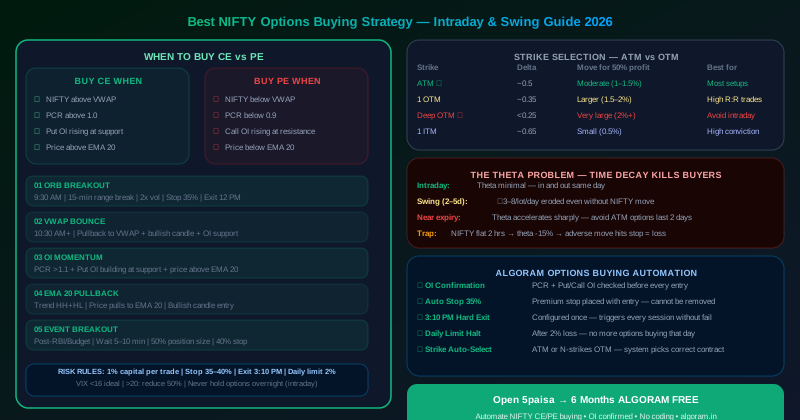
The single most important decision in options buying is direction. Get direction wrong, and even perfect timing and strike selection can't save you. Here's the objective checklist for each direction:
- NIFTY above VWAP
- PCR above 1.0 (bullish)
- Put OI building at support
- Price above EMA 20
- India VIX below 16
- FII net buyers (previous day)
- NIFTY below VWAP
- PCR below 0.9 (bearish)
- Call OI building at resistance
- Price below EMA 20
- India VIX rising (below 20)
- FII net sellers (previous day)
The more of these conditions align, the higher the probability setup. A setup where all 6 align is rare — but when it does, it's the highest-conviction entry. Never trade a setup where fewer than 3 conditions align.
Setup 1 — Opening Range Breakout (ORB)
The opening range (9:15–9:30 AM) captures overnight sentiment and gap resolution. A breakout from this range — confirmed by high volume — often signals the day's directional trend. Add OI confirmation: if Call OI is unwinding above the breakout level (CE), or Put OI is unwinding below the breakdown level (PE), the move has institutional backing. Target: 1.5–2x the opening range size as price movement.
Setup 2 — VWAP Bounce Entry
VWAP is the institutional benchmark — the average price where volume-weighted trading has occurred. When NIFTY is trending up and pulls back to VWAP, institutions often add to long positions here. If a bullish candle forms at VWAP + Put OI is increasing at this level (fresh Put writing = institutional long bias), buy CE. The VWAP is a dynamic support/resistance that self-adjusts throughout the day. Related: Price Action + Option Chain Analysis
Setup 3 — OI Momentum Confirmation
Option chain OI reveals institutional positioning. When Put OI is building rapidly at a support level while price holds above it — institutions are writing Puts (bullish bet). This, combined with PCR above 1.1 and price above VWAP, gives high-confidence CE buy. ALGORAM processes this OI confirmation automatically — no manual option chain review needed. Related: Option Chain S&R Analysis
Setup 4 — EMA 20 Pullback
In a strong uptrend (price making higher highs and higher lows on 5-min chart), EMA 20 acts as dynamic support. When NIFTY pulls back to EMA 20 and forms a bullish candle (higher close, bullish body), this is a continuation entry. Apply the same in reverse for downtrends and PE buying. Most reliable between 10:00 AM–2:00 PM when trend is established.
Setup 5 — Event-Based Breakout
Events like RBI policy, Budget, and quarterly GDP create significant NIFTY moves. However, buying options before the event means paying high IV premiums that collapse immediately after the announcement (IV crush). The safer approach: wait for the initial reaction (5–10 minutes post-announcement), then buy the CE or PE that's moving with direction after the opening volatility settles. Use 50% of normal position size on event days.
ATM vs OTM — Which Strike to Buy?
This is one of the most common questions from options buyers — and the answer matters significantly for profitability:
| Strike | Delta | Cost | Move Needed for 50% Profit | Best For |
|---|---|---|---|---|
| ATM (At the Money) | ~0.5 | Higher premium | Moderate (1–1.5% NIFTY) | Most intraday setups |
| 1 Strike OTM | ~0.35 | Moderate | Larger (1.5–2% NIFTY) | Higher R:R, directional trades |
| 2+ Strikes OTM | <0.25 | Cheap | Very large (2%+ NIFTY) | Avoid for intraday |
| 1 Strike ITM | ~0.65 | Expensive | Small (0.5% NIFTY) | High-conviction, low-volatility |
Recommendation: ATM or 1 strike OTM for most intraday setups. Deep OTM options are tempting because they're cheap — but they need NIFTY to move significantly just to show meaningful premium appreciation. ATM gives the best balance of cost vs responsiveness to NIFTY's actual moves.
The Theta Problem — How Time Decay Affects Buyers
Theta is options buying's biggest adversary. Every day you hold a long option, time decay erodes some of the premium — even if NIFTY doesn't move at all.
- Intraday buyers: Theta impact is minimal — you're in and out the same day. Not a significant concern.
- Swing buyers (2–5 days): ATM NIFTY options lose approximately ₹3–8 per lot per day in low-VIX environments just from theta. Plan for direction to move quickly.
- Near-expiry buyers: Theta accelerates sharply in the last 2 days before expiry. ATM options on expiry day lose value extremely rapidly if NIFTY stays flat. Only buy expiry-day options with very specific directional conviction and tight stops.
The most common losing pattern in options buying: buy a CE, NIFTY stays flat for 2 hours, theta erodes 15% of premium, then a small adverse move takes you to stop-loss. The trap: holding past your defined stop-loss hoping for a recovery. By the time NIFTY reverses, theta has eaten so much premium that the recovery still shows a loss. Stop-losses on options must be automatic.
Risk Management Rules for Options Buyers
- Never risk more than 1% of capital on any single options trade. On ₹5 lakh account: ₹5,000 max risk per trade.
- Stop-loss at 35–40% of premium paid. Entry at ₹150 CE → stop at ₹90–97. Automated, non-negotiable.
- Daily loss limit: 2% of capital. When ₹10,000 is lost on ₹5 lakh account, trading stops. Revenge-buying options after losses is the fastest way to blow an options account.
- Time exit: 3:10 PM for all intraday positions. Holding options past 3:15 PM means theta exposure overnight or on expiry day — unacceptable for intraday strategies.
- Never buy NIFTY options when VIX is above 20 without halving position size. High VIX = expensive premiums + unpredictable moves = poor options buying conditions.
Full risk guide: Risk Management in Algo Trading — Complete Guide
5 Common NIFTY Options Buying Mistakes
- Buying deep OTM options for "cheap premium." They feel low-risk because they cost less — but NIFTY needs to move 2%+ for them to double. This rarely happens in a single intraday session.
- Not using stop-losses on options. "It's only ₹200" quickly becomes ₹0. Options can go to zero. Always automate the stop.
- Buying options in high-IV environments. When VIX spikes above 18–20, premiums are expensive. Even if your direction is correct, IV crush on the way down can eliminate your gain. Wait for VIX to stabilise or switch to selling strategies.
- Holding winning options too long out of greed. Options buying profits disappear faster than they appear. When you hit your target, exit. The instinct to "let it run" on options costs more than it gains — theta and reversal risk both work against you.
- Trading options near expiry without understanding gamma risk. On expiry day, ATM options can move 200–300% in 20 minutes — or collapse to zero in 10. Without automated stops, expiry-day options trading is extremely dangerous.
Automate NIFTY Options Buying with ALGORAM
Options buying setups described in this article are difficult to execute manually with the required discipline — stops get missed, theta causes panic exits, FOMO triggers suboptimal entries. ALGORAM automates the entire process:
- Automatic strike selection: Specify ATM or N strikes OTM — system selects the correct contract at signal time
- OI confirmation layer: ALGORAM checks PCR, Put OI, and Call OI before every entry — reducing false signals
- Auto stop-loss at 35% premium: Placed simultaneously with entry — cannot be forgotten or delayed
- Hard 3:10 PM time exit: Configured once, triggers every session — no manual intervention
- Daily loss limit halt: When limit is hit, no more options buying that day — preventing revenge trading
Related: No-Code Algo Trading for Options Traders | How to Start Algo Trading in India
📈 Automate Your Options Buying Strategy
OI confirmation, auto stop-loss, time exits, daily limits — all automated. 7-day free paper trading demo on real NSE data.
🚀 Launch Offer — First 100 Customers
Conclusion
NIFTY options buying is not a lottery — it's a disciplined probability game. The setups in this guide — ORB breakout, VWAP bounce, OI momentum, EMA pullback — all have historical edges when applied with proper discipline: correct strike selection (ATM), defined stop-losses (35% of premium), 1:2 minimum risk-reward, time-based exits, and daily loss limits.
The biggest challenge isn't finding the setup. It's executing it consistently, stopping when you should stop, and not letting emotion override the rules. That's where automation earns its place. ALGORAM ensures that your well-designed options buying rules execute identically on trade 1 and trade 500 — without the FOMO, the greed, the panic that degrades manual options buying performance over time.
Demo: 7-day free paper trading
Option chain analysis: OI S&R Guide
Risk management: Complete Risk Guide
BN strategies: Bank Nifty Algo Strategy
Frequently Asked Questions

Ankit traded NIFTY options manually for 8 years before automating his strategies on ALGORAM. "Options buying taught me more about discipline than any other instrument. The theta clock ticking means you can't afford to be wrong and undisciplined at the same time. Automation solved the discipline problem — the strategy handles itself."