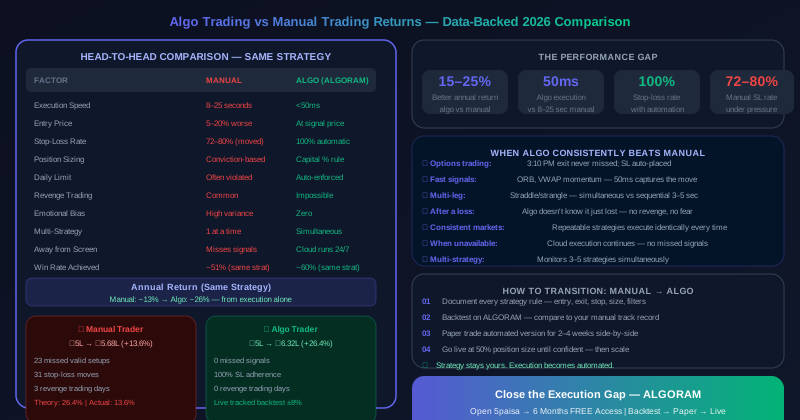
The Real Question
When traders ask "which gives better returns — algo or manual?" they're usually asking the wrong question. They're imagining that algo trading has a magic strategy that outperforms what they trade manually.
The reality is more nuanced: the strategy is typically the same. A NIFTY ORB breakout is an ORB breakout whether you execute it manually or algorithmically. The edge — the statistical advantage of the setup — doesn't change based on how the trade is placed.
What changes is execution quality. And execution quality directly determines whether the theoretical edge of a strategy is fully realised in practice — or whether behavioral variance erodes it.
The Performance Gap — What the Data Shows
The 15–25% annual return improvement is not a dramatic algorithmic insight — it comes entirely from execution: better entry prices, consistent stop-losses, no revenge trading, consistent position sizing. Every one of these differences is behavioral, not strategic. And every one of them compounds significantly over a year of trading.
How Execution Speed Affects Returns
NIFTY moves fast. On an active session, a breakout can consume 30–50 points in 15 seconds. A manual trader who sees the signal, evaluates it, reaches for the keyboard, and places the order has typically entered 10–30 points later than the signal price. On a ₹150 ATM CE, this represents an immediate 7–20% worse entry.
Multiply this across 200+ trade entries per year:
- Average slippage per trade from manual delay: 10–25 NIFTY points
- Impact on ATM option premium: 5–15% worse entry price
- On 200 trades per year at ₹2,000 average position size: ₹10,000–30,000 annual performance drag from entry slippage alone
- On a ₹3 lakh trading account: that's 3–10% of capital annually, just from slow entries
ALGORAM's API execution completes in under 50ms. The signal triggers, the order places, the stop-loss is simultaneously set — before a human could even click "buy."
The Hidden Cost of Emotional Manual Trading
The most significant performance gap between algo and manual trading isn't execution speed — it's consistency during adverse conditions.
Consider what happens to a manual trader during a 5-loss streak (which every strategy has, statistically):
- After loss 1: normal. Takes the next setup per plan.
- After loss 2: slightly cautious. Still following plan.
- After loss 3: questioning the strategy. Takes next setup hesitantly, slightly smaller.
- After loss 4: doubt is significant. Misses a setup that looked "too risky." This setup wins.
- After loss 5: either stops trading (misses the recovery) or revenge trades with oversized position to recover quickly.
The algorithm's experience during the same 5-loss streak: takes every valid setup with identical position size, identical stop-loss, no hesitation, no emotional state change. When the edge reasserts (which it does, statistically), the algorithm is fully positioned to capture it. The manual trader often isn't.
"I traded NIFTY manually for 8 years. My strategy was sound — I knew this from backtesting. But every year, my actual returns were 20–30% below what the backtest predicted. When I automated the same strategy on ALGORAM, live returns tracked the backtest within 8%. The strategy didn't change. My behavior did — by removing myself from execution."
Algo vs Manual Trading — Complete Comparison
| Factor | Manual Trading | Algo Trading (ALGORAM) |
|---|---|---|
| Execution Speed | 8–25 seconds | <50ms |
| Entry Price Quality | 5–20% worse than signal | At or near signal price |
| Stop-Loss Adherence | 72–80% (often moved) | 100% automatic |
| Position Sizing | Conviction-based (variable) | Capital % rule (consistent) |
| Daily Loss Limit | Often violated after losses | Auto-enforced, no override |
| Revenge Trading | Common after losses | Impossible — daily limit stops it |
| Emotional Consistency | High variance | Zero — algorithm has no emotions |
| Multi-Strategy Monitoring | 1 strategy practical | Multiple strategies simultaneously |
| Performance Tracking | Manual journal (often skipped) | Automatic — every trade logged |
| Overnight/Away Execution | Requires screen presence | Cloud execution continues always |
| Strategy Creativity | Full human creativity | Constrained to defined rules |
| Novel Event Adaptation | Human judgment | Limited to predefined conditions |
Case Study — Same Strategy, Different Execution
Two traders. Same NIFTY VWAP strategy. Same backtested win rate (57%). Same capital (₹5 lakh). 12 months of trading.
The performance gap (26.4% vs 13.6%) came entirely from execution quality. Neither trader had a better strategy. The algorithm simply realised more of the strategy's theoretical edge by executing it consistently.
Realistic Annual Returns — What to Expect
| Trader Type | Expected Annual Return | Key Driver |
|---|---|---|
| Experienced manual trader, disciplined | 10–20% | Good strategy, some behavioral variance |
| Average manual trader | 0–8% (or negative) | Emotional execution, missed stops |
| Algo trader, validated strategy | 15–30% | Consistent execution of tested strategy |
| Algo trader, unvalidated strategy | Variable or negative | Consistent execution of poor strategy |
| Nifty 50 Index (benchmark) | 12–14% | Passive market return |
Algo trading beats manual trading for the same strategy. If the strategy itself has no edge, algo trading will execute it consistently into consistent losses. The algo advantage is execution quality — not strategy creation. Strategy design, backtesting, and validation remain the trader's responsibility.
When Manual Trading Can Outperform
Algo trading isn't universally superior. Manual trading has genuine advantages in specific situations:
- Novel market conditions: Events with no historical precedent (COVID-type events, geopolitical surprises) require human judgment. An algorithm without these patterns in training data will apply standard rules to extraordinary situations — which can be suboptimal.
- Discretionary macro analysis: Understanding why a market is moving — FII flow narratives, RBI sentiment, global risk appetite — is qualitative judgment that algorithms don't naturally incorporate.
- Small, illiquid instruments: Where bid-ask spreads are wide and algorithmic execution may increase slippage. Manual execution with patience can sometimes achieve better prices.
The practical conclusion: for structured, repeatable strategies in liquid instruments (NIFTY, Bank Nifty options), algo execution wins. For discretionary macro or novel-event trading, human judgment remains relevant.
When Algo Trading Consistently Wins
- Options trading: Time-based exits (3:10 PM) are non-negotiable. Manual traders miss them. Algo never does.
- High-frequency setups: ORB, VWAP momentum — signals that require fast execution to capture the initial move.
- Multi-leg strategies: Straddle/strangle execution simultaneously in under 50ms vs 3–5 seconds for manual sequential orders.
- After a loss: The period immediately following a loss is when manual traders make their worst decisions. Algo doesn't know it just had a loss.
- Consistent markets: When market regime is well-understood and strategy rules are validated, automation extracts the edge reliably.
The Best Approach: Human Strategy + Algo Execution
The professional approach isn't "algo vs manual" — it's using each where it excels:
- Human: Strategy design, market regime assessment, backtesting evaluation, risk parameter setting
- Algorithm: Trade execution, stop-loss management, position sizing, daily limit enforcement, time-based exits
This is exactly how institutional traders operate — humans design the strategies, algorithms execute them. ALGORAM brings this professional architecture to retail traders without requiring institutional resources or programming.
How to Transition from Manual to Algo Trading
- Document your current strategy completely: Write every rule — entry, exit, stop, size, filters. If you can't write it down precisely, it's not a strategy yet.
- Backtest your documented strategy on ALGORAM: Compare backtested results to your manual track record. The gap reveals how much behavioral variance has cost you.
- Paper trade the automated version for 2–4 weeks: Side by side with your manual trading if possible. Compare outcomes.
- Go live conservatively: Start at 50% of your normal position size until you trust the system's execution. Scale up as confidence builds.
Related: How to Start Algo Trading in India | Manual vs Automated Trading — Full Comparison
ALGORAM — The Bridge from Manual to Algo
ALGORAM was specifically designed for the transition: experienced manual traders who have a working strategy but are losing performance to behavioral execution errors. The platform lets you:
- Configure your existing strategy through a no-code visual interface — no programming
- Backtest it on 20 years of NSE data to verify the edge
- Paper trade it on live NSE data to verify execution matches your intent
- Deploy it live with automated stop-losses, daily limits, and position sizing enforced
- Monitor performance vs backtested expectations through real-time analytics
The strategy remains yours. The execution becomes automated. That's the performance gap closed.
⚖️ See the Difference Automation Makes
Configure your strategy, backtest against your manual track record, and run 7 days of paper trading — all free.
🚀 Launch Offer — First 100 Customers
Conclusion
Algo trading vs manual trading isn't really a competition between strategies — it's a comparison of execution quality. The data is consistent: for the same strategy, algorithmic execution delivers better returns, primarily by eliminating the behavioral variance that degrades manual performance.
Faster entries, consistent stop-losses, mathematical position sizing, zero revenge trading, daily limit enforcement — these aren't flashy advantages. But compounded over 200+ trades per year, they produce the 15–25% performance gap between algo and manual execution of identical strategies.
The honest answer: if your manual strategy has an edge but your actual returns consistently underperform your backtested expectations, the gap is behavioral. Automation closes that gap — consistently, mechanically, and without requiring you to be better than you are under emotional pressure.
Compare your approach: Manual vs Automated Trading Full Guide
Start with algo trading: How to Start Algo Trading in India
Validate first: What is Backtesting? Complete Guide
Risk management: Risk Management Guide
Free demo: 7-day ALGORAM paper trading demo
Frequently Asked Questions

Ankit spent 8 years as a manual trader before building ALGORAM. "I ran the same VWAP strategy manually for 3 years, then automated it. The first year automated, my returns were 22% — vs 11–14% manually. I hadn't changed anything except who executed the trades. That gap is what ALGORAM is built to close for every retail trader in India."