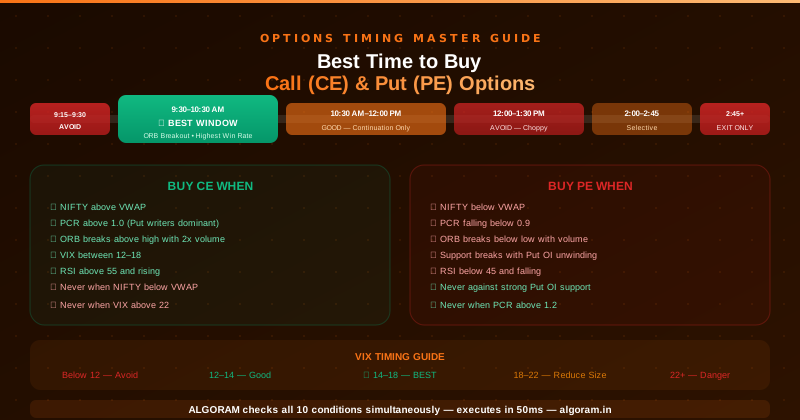
Why Timing is the Most Critical Variable for Option Buyers
Option buying is unique compared to equity trading because two variables are working against you simultaneously: the underlying price must move in your direction AND it must move fast enough to overcome theta (daily time decay) and in the right volatility environment to overcome IV compression. A stock buyer can be patient. An option buyer cannot.
Every day that passes without the expected move, your option loses value — even if the underlying is flat. Buy too early, and theta erodes your premium before the move happens. Buy too late, and the premium has already expanded (you're buying at peak IV). Buy in the wrong market regime (sideways/low-VIX), and even a correct directional call loses money.
This guide solves the timing problem: when exactly to buy CE, when to buy PE, what conditions to wait for, and what conditions to avoid completely. Related: Option Buying vs Option Selling — Complete Guide
Best Intraday Windows — A Complete Time Map
The first 15 minutes of trading absorbs overnight news, SGX Nifty premium/discount, large institutional opening orders, and algorithmic activity. Price swings are extreme and often reverse sharply. Options that spike in the first 2 minutes frequently collapse by 9:25 AM. This window is for observation only — mark the high and low of this period (your Opening Range for ORB strategy). Do not place any option buy order during this window.
This is the highest-probability intraday window for directional option buying. After opening volatility settles, institutional momentum is established. The ORB breakout (above 9:30 AM high = buy CE; below 9:30 AM low = buy PE) with 2x+ volume is the single most reliable options entry available in Indian markets. Add VWAP confirmation: if NIFTY is above VWAP when CE entry triggers, win probability increases significantly. Options bought at 9:30–9:45 AM on a trending day have the full session to achieve their target before theta becomes significant.
By 10:30 AM, the market's direction for the day is typically established. Trend continuation entries — VWAP pullback bounces, EMA 20 support bounces, OI-confirmed support bounces — remain valid in this window. These entries have slightly less time than the 9:30 AM window, so target should be 1.2–1.5x range rather than 1.5–2x. Avoid entering positions without a confirmed technical setup in this window — random buying in a trending market without defined entry rules has poor risk-reward.
The 12:00–1:30 PM window is the most dangerous for option buyers. Volume drops sharply, bid-ask spreads widen, and false signals increase dramatically. Any "breakout" in this window that isn't accompanied by strong volume is almost certainly a fake-out. Options bought in this window face aggressive theta decay with minimal time for the trade to work. Professional traders either have positions from the morning or are flat during lunch. For beginners, this is a mandatory rest period.
Afternoon sessions sometimes produce genuine breakout setups driven by US pre-market futures activity, late FII data releases, or delayed follow-through from morning catalysts. A 2:00–2:45 PM option buy is valid only if: (a) a strong technical setup is present (not just general direction feeling), (b) NIFTY has been building momentum since 1:30 PM, and (c) the target is achievable by 3:00 PM with a tight stop. Never hold an afternoon option buy past 3:10 PM — theta in the final 20 minutes makes the position unfavorable even if direction is correct.
The last 45 minutes of trading brings institutional squaring-off, derivative hedging, and extreme volatility that's directionally unreliable. Option premiums behave erratically. Most intraday positions are squared off in this window — meaning the moves you see are often position-closing activity, not genuine directional conviction. All option positions must be closed by 3:10 PM at the latest. Never buy options here for intraday — you have 20 minutes maximum for the trade to work, which is insufficient for most setups.
Best Time to Buy CE — Complete Rules
Buying a Call option (CE) is a bullish bet — you profit when NIFTY rises above your strike price. Here are all the conditions that make a CE purchase high-probability:
Best Time to Buy PE — Complete Rules
Buying a Put option (PE) is a bearish bet — you profit when NIFTY falls below your strike. PE buying opportunities are often sharper and faster than CE, because market falls tend to be quicker than rallies. Additional conditions for PE:
India VIX and Optimal Options Buying Conditions
Why low VIX is bad for option buyers: When VIX is below 12, options are extremely cheap — but that's because the market isn't moving. A correct direction call with VIX at 10 might produce a 5% gain on your option even if NIFTY moves 0.5% — simply because there's no volatility expansion to amplify your premium. You need market movement AND the premium expansion that comes with it.
Many traders think "VIX is low = buy cheap options." This is backwards. Low VIX means low movement, which means options are cheap for a reason — because they'll probably expire worthless. The best buying conditions are when VIX is at 14–18 (moderate) and rising — indicating the market is starting to expect larger moves, which means your premium will expand as the market moves. Rising VIX from 14 to 17 = option premium expansion even before the underlying moves in your direction.
PCR Signals for CE/PE Timing
| PCR Value & Trend | Signal | CE or PE? | Action |
|---|---|---|---|
| PCR above 1.2 and rising | Strong bullish — Put writers increasing | CE buying | High conviction CE with proper setup |
| PCR 1.0–1.2 and stable | Moderate bullish | CE preferred | Wait for ORB/VWAP setup confirmation |
| PCR 0.9–1.1 and neutral | Sideways market | Neither | Selling environment — avoid buying CE or PE |
| PCR 0.7–0.9 and falling | Moderate bearish — Call writers increasing | PE preferred | Wait for breakdown confirmation with volume |
| PCR below 0.7 and falling | Strong bearish signal | PE buying | High conviction PE but also reversal risk — check if extreme |
Watch PCR direction more than its absolute value. PCR moving from 1.05 → 1.2 during the session means institutional bullish conviction is increasing in real time. PCR moving from 1.1 → 0.85 means sellers are taking control — bearish shift. Related: How to Read Option Chain Guide
Best Expiry Cycle for Option Buying
| Trade Type | Best Expiry | Days to Expiry | Why |
|---|---|---|---|
| Intraday CE/PE buy | Current week | Any (same day exit) | Highest liquidity, tight spreads |
| 2–3 day swing | Next week expiry | 7–10 days | Balanced theta vs premium. Enough time |
| 5–7 day trade | 2 weeks out | 10–14 days | Less theta pressure but wider spreads |
| Positional (1–3 weeks) | Monthly expiry | 15–30 days | Minimal weekly theta cycle impact |
| NEVER for swing trades | Current expiry if <2 days | <2 days | Theta too aggressive — unfavorable risk |
When NOT to Buy Options — The Critical Danger Zones
- 9:15–9:30 AM: Opening range absorption period. False signals, extreme bid-ask spreads. Wait.
- 12:00–1:30 PM: Lunch hour. Low volume, choppy, false breakouts. Mandatory rest.
- VIX above 22: Options are extremely expensive. Even correct direction trades can lose due to IV normalization (IV crush). Wait for VIX to settle.
- Just before major events (RBI, Budget, FOMC): IV is elevated pre-event and will collapse post-event regardless of direction. Either avoid buying or wait until post-announcement when IV has settled.
- Expiry day for anything other than intraday: Theta is destructive. Only buy expiry day options if you have a clear intraday catalyst and will exit within 2–3 hours.
- Within 2 days of weekly expiry for swing trades: Even correct directional trades can result in losses if the market doesn't move fast enough to overcome daily theta.
- PCR between 0.9–1.1 without a clear catalyst: Neutral market is a sideways market. Option buyers lose money in sideways markets. This is when sellers make money.
- Against a major OI-confirmed level: If the option chain shows massive Call OI at the next resistance and you're buying CE right below it — the institutional wall may prevent the move from occurring. Check OI before buying.
Pre-Trade CE/PE Buying Checklist
| Pre-market checks |
| ✅ VIX checked — is it in 12–18 range? |
| ✅ PCR read — direction aligned with trade idea? |
| ✅ FII/DII data — institutional bias matches direction? |
| ✅ Major OI levels marked — support/resistance identified? |
| ✅ Any events today (RBI, FOMC, earnings, expiry)? |
| Entry checks |
| ✅ Time window is correct (9:30–10:30 AM or 10:30–12 PM)? |
| ✅ NIFTY above VWAP (for CE) or below VWAP (for PE)? |
| ✅ Volume at entry is 2x+ average? |
| ✅ ADX above 20 (trend is present)? |
| ✅ RSI above 55 (CE) or below 45 (PE)? |
| Risk management |
| ✅ Stop-loss set at 35% of premium? |
| ✅ Risk per trade ≤ 1% of total capital? |
| ✅ Time exit set at 3:10 PM? |
| ✅ Daily loss limit still has room? |
Automate CE/PE Timing with ALGORAM
The biggest execution challenge for option buyers isn't knowing the conditions — it's acting precisely when ALL conditions align, without hesitation, without emotional interference, in under a few seconds. By the time a manual trader confirms all 8–10 conditions above and executes, the entry price has moved.
ALGORAM solves this by processing all conditions simultaneously and executing in under 50ms when they're all met:
- Time window restriction: Strategy only activates between 9:30–10:30 AM (or configured window) — never fires in the first 15 minutes or after 3:10 PM
- VWAP filter: CE entry only when NIFTY is above VWAP; PE entry only when below
- PCR threshold: CE only when PCR above 1.0; PE only when below 0.9
- VIX gate: All option buying paused if India VIX exceeds configured threshold
- Volume confirmation: Entry only when volume exceeds 20-period average at breakout
- Automated stop-loss: 35% stop placed instantly on order fill — never manually managed
- 3:10 PM forced exit: All positions closed regardless of P&L — no emotional "just a bit more"
Related: Best Intraday Strategy for Beginners | NIFTY Options Buying Strategy
⏱ Perfect CE/PE Timing — Automated
All 10 conditions checked simultaneously. Execute in 50ms when they align. Never miss the right moment again.
Special Offer — First 100 Customers
Conclusion
The difference between profitable and unprofitable option buyers is rarely strategy selection — it's timing and condition management. The right strategy at the wrong time (buying CE when VIX is 22, PCR is 0.85, and the market is choppy at 12:30 PM) consistently loses money. The same strategy with proper timing filters (9:30 AM ORB breakout, VIX 14–18, PCR above 1.0, above VWAP, 2x volume) has a genuinely positive expected value.
Use the checklist in this guide before every trade. If more than 2 conditions are red, skip the trade. The best option buyers are selective — they wait for the full setup to appear and execute decisively when it does. ALGORAM automates all of this so the conditions are checked and the entry is executed without the emotional friction that makes manual execution difficult.
Frequently Asked Questions

Ankit identified option timing as the #1 factor separating profitable option buyers from the 90% who lose — and built it into ALGORAM's automated condition-checking system. "I used to keep a physical checklist next to my trading terminal. Now ALGORAM checks 10 conditions simultaneously in 50ms. The setup is the same. The execution is infinitely better."