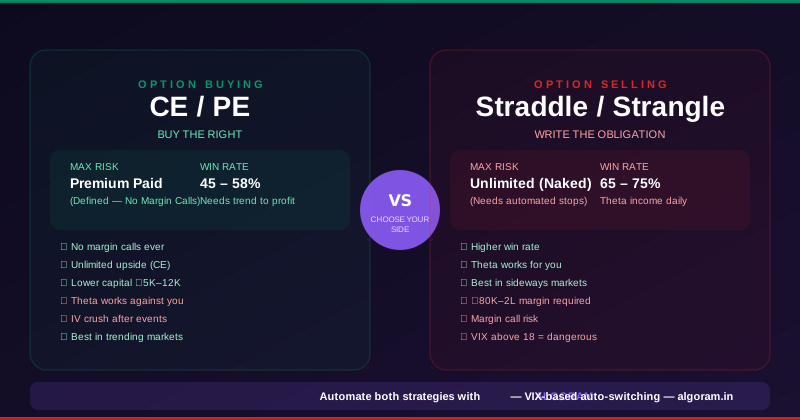
The Fundamental Difference
Every option trade has two sides: a buyer and a seller. The buyer pays a premium and receives a right — to buy (Call) or sell (Put) the underlying at a set price. The seller collects that premium and takes on the obligation to fulfill the contract if exercised.
This creates a fundamentally different P&L structure:
- Option buyer: Pays ₹150 upfront. Maximum loss: ₹150. Maximum profit: theoretically unlimited (CE) or very large (PE). Needs the underlying to move significantly in their direction.
- Option seller: Collects ₹150 upfront. Maximum profit: ₹150. Maximum loss: theoretically unlimited (naked). Earns premium whether market moves or stays flat.
Both can be profitable. Both can be disastrous without proper risk management. The question isn't which is "better" — it's which suits your capital, temperament, market read, and current market regime.
Option Buying — Complete Profile
Option Selling — Complete Profile
Head-to-Head Comparison
| Factor | Option Buying | Option Selling |
|---|---|---|
| Maximum Risk | Premium paid (defined) | Theoretically unlimited (naked) |
| Maximum Profit | Unlimited (CE) / large (PE) | Premium collected (capped) |
| Win Rate | 45–58% | 65–75% |
| Theta (Time Decay) | Enemy — erodes premium daily | Friend — earns daily |
| Capital Required | Low (premium only) | High (margin ₹80K–2L+) |
| Margin Call Risk | None | Yes — adverse moves require more margin |
| Best Market | Trending / volatile | Sideways / low VIX |
| VIX Preference | Any (high VIX = big moves) | Below 14 ideal |
| Beginner Suitable | Yes — limited risk | No — naked selling is dangerous |
| IV Crush Impact | Severely negative | Positive |
| Monitoring Required | Less intensive (defined risk) | Constant (unlimited risk) |
The Theta Factor — Why Time is the Key Variable
Theta is the daily rent that option buyers pay and option sellers collect. Every calendar day, an ATM NIFTY option loses approximately ₹5–15 in premium value purely from time passing — regardless of whether NIFTY moves at all. This accelerates dramatically in the final 7 days before expiry.
| Days to Expiry | ATM NIFTY Option Theta/Day | Impact on Buyer | Impact on Seller |
|---|---|---|---|
| 30 days | ~₹5–8 | Slow drain | Steady income |
| 15 days | ~₹10–15 | Moderate drag | Increasing income |
| 7 days | ~₹20–35 | Accelerating loss | Best period for sellers |
| 2 days (expiry week) | ~₹50–100 | Extreme — buy only with clear catalyst | Maximum theta collection |
| Expiry day | Full remaining value | Options expire worthless if OTM | Maximum profit if OTM |
The practical implication: Buying options with 7+ days to expiry gives time for your thesis to play out. Buying options with 1–2 days to expiry means you need to be right immediately — the market must move in your direction before today's session ends. For sellers, the last 7 days before expiry are the prime theta collection window.
Implied Volatility — The Hidden Destroyer of Option Buyers
IV (Implied Volatility) is the market's expectation of future price movement embedded in option premiums. When IV is high, options are expensive. When IV falls, option prices decline — even if the underlying moves in your expected direction.
This creates the dreaded IV crush scenario: NIFTY gaps up 0.8% after RBI policy. You bought CE before the announcement when IV was at 18. After the announcement, IV drops from 18 to 12. Despite NIFTY moving in your favour, your CE premium barely budges — the directional gain is cancelled by IV compression.
Never buy options when India VIX is above 20 without significantly reducing position size. At high VIX, premiums are expensive — and IV mean-reversion (IV falling back to normal) works against buyers even when direction is correct. Ideal buying condition: VIX between 12–16, starting to rise, with a clear directional trigger (breakout, FII buying, macro catalyst).
When to Buy Options — The Right Conditions
- Trending sessions: NIFTY establishing clear directional momentum after 9:30 AM with increasing volume and VWAP confirmation
- Post-consolidation breakouts: When NIFTY has been range-bound for 2–3 days and breaks out on volume with OI confirmation
- Rising PCR (above 1.1): Institutions writing Puts indicates underlying bullish institutional bias — favours CE buying
- VIX rising but below 18: Increasing volatility expectation means premiums will expand in your favour if direction is correct
- Start of new trend: EMA 9 crossing above EMA 21 on daily chart for the first time after a correction
When to Sell Options — The Right Conditions
- VIX below 14: Low volatility = stable market = options unlikely to make explosive moves against your short position
- PCR between 0.9–1.1 (neutral): No strong directional bias = market likely to stay range-bound = ideal selling conditions
- Within 7 days of expiry: Theta acceleration works hardest for sellers in this window
- After a major event: Post-event IV crush is predictable — sell immediately after announcement when IV is highest
- NIFTY in defined range: When Max Pain and OI data suggest NIFTY will stay between two strikes — sell both wings
Related: Option Chain S&R Analysis | NIFTY Options Buying Strategy
5 Market Scenarios — Which Strategy Wins?
NIFTY gaps up 0.5%, breaks above previous day high with 2x volume, PCR rises to 1.2, FII net buyers. This is a directional day — option buying is clearly superior. Sellers of Calls are squeezed; buyers of CE collect significant premium as NIFTY continues higher. ORB breakout CE entry at 9:30 AM captures the full day's move.
VIX at 12.5, PCR at 1.0, NIFTY oscillating ±80 points for the whole session. Option buyers on both CE and PE get theta-eaten with no move to rescue them. The option seller who sold an OTM Strangle at 10:30 AM collects both premiums as expiry approaches with NIFTY staying range-bound.
VIX spikes from 14 to 22 due to geopolitical news. NIFTY swings ±300 points intraday. Option sellers with short positions face margin calls and large MTM losses. Directional buyers who caught the initial move ride 200–400% premium appreciation on a single ATM CE or PE. High VIX consistently favours buyers.
Thursday 10:00 AM: BN is near 51,000, VIX at 13.5, PCR at 0.95. Opening volatility has settled. The ATM Straddle seller collects ₹280 in combined premium. By 3:00 PM, BN has moved only ±200 points — both the CE and PE seller exits with 65% of premium collected. Theta decay of expiry day harvested effectively.
Before announcement: both CE and PE premium elevated — selling is risky (could be directional move). Buying is also risky (IV crush post-event). The professional move: wait for the initial reaction (5–10 minutes post-announcement), identify direction, then buy the winning leg with IV settling at a lower level. Or sell IV immediately post-event when it's still elevated but direction is establishing. Both strategies can work — timing and execution matter more than the strategy label.
Capital Requirements — Real Numbers
| Strategy | Capital Required | Source of Requirement |
|---|---|---|
| Buy 1 NIFTY ATM CE/PE | ₹5,000–12,000 | Premium payment only |
| Sell 1 NIFTY ATM CE | ₹90,000–1.3L | SEBI margin requirement (SPAN + Exposure) |
| Sell NIFTY ATM Straddle | ₹1.5L–2.2L | Both legs margin (some netting) |
| Buy 1 BN ATM CE/PE | ₹3,000–8,000 | Premium payment only |
| Sell 1 BN ATM CE | ₹60,000–1L | SEBI margin requirement |
| Sell BN ATM Straddle | ₹90,000–1.5L | Both legs margin (some netting) |
| Bull Put Spread (sell 1 PE, buy 1 lower PE) | ₹15,000–30,000 | Defined risk spread reduces margin |
Which is Better for Beginners?
Start with option buying. Here's why this is the right answer for most beginners:
- Risk is completely defined. You cannot lose more than your premium. No margin call wakes you at 3 AM because NIFTY gapped against your short position overnight.
- Simpler position management. One leg, one stop-loss, one target. Option selling (especially straddles) requires managing multiple legs and understanding combined Greeks.
- Lower capital requirement. ₹25,000–50,000 is enough to start option buying with proper risk management. Selling requires ₹2–5 lakh minimum for a meaningful portfolio.
- Learning curve is gentler. Understanding how your CE/PE responds to NIFTY moves, theta, and IV is the foundation. Only after mastering buying should you explore the selling side.
The path: Master NIFTY Options Buying → understand Greeks → explore spreads → then naked selling with automated risk management.
Naked option selling without automated stop-losses is the most common way retail traders blow up their accounts. One bad expiry day — NIFTY moves 400 points against your sold strikes — can eliminate months of premium income in a single session. If you trade option selling without ALGORAM's automated stop-loss and daily loss limit, you are relying entirely on your ability to exit manually during fast-moving markets. That's not a strategy — it's a risk.
The Professional Combined Approach
Experienced traders don't pick a side — they switch based on market regime:
- VIX below 14 + PCR neutral (0.9–1.1) + no major event: → Option selling (straddle or strangle)
- VIX rising + NIFTY breaking key level + PCR moving decisively: → Option buying (directional CE or PE)
- VIX between 14–18 + mild trend: → Defined-risk spreads (bull put spread or bear call spread)
- VIX above 20: → Reduce all positions. High VIX means surprise-risk is elevated. Both buying and selling are dangerous at extremes.
ALGORAM can automate this regime-switching. Configure a VIX threshold: below 14, activate the selling strategy. Above 16, activate the buying strategy. The platform monitors VIX in real time and adjusts strategy activation accordingly — without you watching screens all day. Related: How AI is Changing Stock Market Trading
Automate Both Strategies with ALGORAM
The biggest challenge with running both buying and selling strategies is execution discipline — especially switching between them based on market conditions. ALGORAM handles this automatically:
- Multi-leg simultaneous execution: Straddle and strangle deployed in under 50ms — both legs at once, no sequential slippage
- Automated stop-losses on sold positions: Individual leg stops and combined position P&L stop — the safety net that manual sellers miss
- VIX-based strategy switching: Configure selling strategy to activate below VIX threshold, buying strategy above — auto-regime switching
- Daily loss limit: Both strategies stop when daily limit is hit — no override possible
- Time-based exits: 3:10 PM exit configured once, triggers every session
Related: Bank Nifty Algo Strategy | No-Code Algo for Options Traders
⚖️ Automate Both Option Strategies
Buy when markets trend. Sell when markets consolidate. ALGORAM switches automatically based on VIX and PCR — no manual monitoring.
Special Offer — First 100 Customers
Conclusion
Option buying vs option selling is not a competition — it's a toolkit. Each approach has environments where it consistently outperforms, and environments where it consistently underperforms. Understanding which conditions favour each strategy, and switching between them systematically, is what separates professional options traders from retail gamblers.
For beginners: start with buying. Limited risk, simpler execution, and lower capital. Master the directional setups — ORB, VWAP, OI-confirmed momentum — before touching selling. When you do explore selling, automate the risk management first. No professional options seller manages stop-losses manually in fast-moving markets — and neither should you.
Frequently Asked Questions

Rahul managed both option buying and selling portfolios across 3 market cycles before building ALGORAM's options automation engine. "The traders who get hurt are the ones who commit to one side religiously. Markets don't care about your preference — they reward the trader who adapts to regime. Automation makes regime-switching instantaneous and objective."