What is Intraday Trading?
Intraday trading means buying and selling a financial instrument — equity shares, futures, or options — within the same trading session. Every position opened must be closed before 3:30 PM (NSE auto-squares off open positions at 3:15–3:20 PM). You profit from the price movement within that single day, not from long-term appreciation.
The appeal is obvious: daily income potential, no overnight risk, and the ability to profit in both rising and falling markets. The challenge is equally obvious: markets move unpredictably, emotions run high, and most beginners enter without a tested strategy or proper risk management.
This guide gives you the exact strategies, rules, and frameworks that separate the 10% of intraday traders who consistently profit from the 90% who don't. Related: Why 90% of Traders Lose Money
Why Most Beginners Fail at Intraday Trading
Before getting to strategies, understand the failure modes. They're behavioral, not strategic:
- No defined entry rules: Trading on gut feeling or tips rather than defined, repeatable conditions
- No stop-loss: Holding losing positions hoping they'll recover — they often don't
- Overtrading: Taking 8–12 trades per day, most of which don't meet proper setup criteria
- Revenge trading: After a loss, immediately entering another trade to "get the money back"
- Too many instruments: Watching 15 stocks simultaneously, executing poorly on all of them
- No backtesting: Deploying a strategy live that has never been validated on historical data
The good news: every one of these is a behavioral problem, not a market knowledge problem. Fix the behavior — or automate it away — and the same market setups that hurt you start working in your favour. Related: Algo vs Manual Trading Returns
Before You Start — Non-Negotiables
- Choose ONE instrument: NIFTY 50 index options or one large-cap stock. Not both. Not 10 stocks.
- Learn ONE strategy first: ORB is the best starting point. Master it before adding anything else.
- Paper trade for 30 days minimum: Run your strategy on live data with virtual capital. This builds pattern recognition and tests execution without financial risk. ALGORAM's 7-day free demo covers this.
- Set a daily loss limit: Maximum you'll lose in a single day before stopping entirely. 2% of capital is the professional standard.
- Trade only with risk capital: Money you can afford to lose completely. Not rent, not savings, not borrowed funds.
Deep guide: Risk Management in Trading — Complete Guide
Strategy 1 — Opening Range Breakout (ORB)
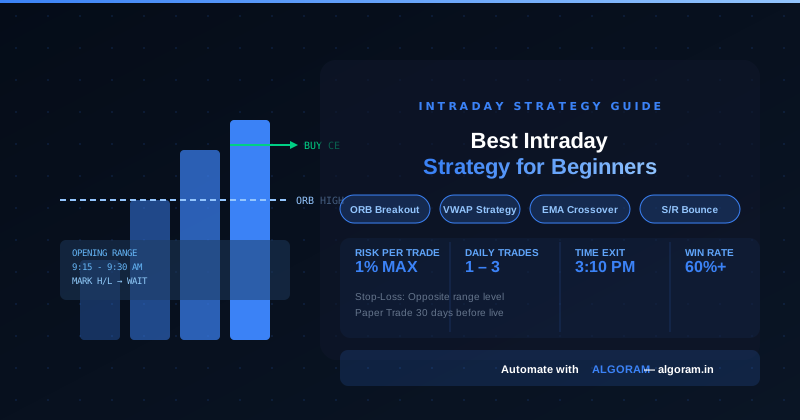
The 9:15–9:30 AM opening range captures the first reaction to overnight news, global markets (SGX Nifty, Dow futures), and any domestic events. When this range breaks with high volume — institutions are taking a directional bet. Tag along. Target: 1.5–2x the size of the opening range as NIFTY point move. If the target isn't hit by 12:00 PM, exit flat — the momentum has faded. Add OI confirmation: Call OI declining at breakout level = genuine CE move. Related: Best Time to Trade NIFTY
Why ORB Works for Beginners
ORB has three qualities that make it the ideal first strategy: clear rules (the range is objective — no interpretation needed), defined risk (stop is the opposite end of the range), and a time limit (exit by 12 PM removes guesswork). You either win quickly or exit with a controlled loss. There's no ambiguity about what to do.
Strategy 2 — VWAP Strategy
VWAP is the institutional benchmark. When NIFTY is trending up and dips to VWAP, it's often institutions buying the dip at their average price. A bullish candle at this level — hammer, engulfing, or strong close — is the entry trigger. Add Put OI confirmation: increasing Put OI at VWAP support means institutions are defending the level with fresh Put writing. Related: Price Action + Option Chain Analysis
Strategy 3 — EMA Crossover
EMA crossover is a momentum strategy — it works on trending days and fails on sideways days. Add a filter: only take EMA crossover entries when India VIX is below 16 (low volatility favours trending) and NIFTY has already established a directional bias post 10:00 AM. Avoid taking EMA crossovers in the first 30 minutes — too much noise. Best applied to NIFTY 5-min chart for options buying entry signals. Pair with RSI above 55 (buy) or below 45 (sell) for extra confirmation.
Strategy 4 — Support and Resistance Bounce
Key support levels in NIFTY are not random — they align with maximum Put OI strikes in the option chain. When NIFTY approaches a strike with the heaviest Put OI (call it 24,000 or 25,500 — whatever the current Max Pain level is), institutional Put writers will defend that level aggressively. This creates a predictable bounce zone. Read the option chain before market open: the highest Put OI strike is your primary support for the day. Related: How to Identify S&R Using Option Chain
Strategy 5 — Opening Gap Strategy
NIFTY gaps occur when global overnight news (US Fed, geopolitical events, FII activity) pushes SGX Nifty significantly from the previous close. Small gaps (0.3–0.7%) typically fill within the first 30–60 minutes. Large gaps (1%+) often continue in the gap direction. The decision point: wait until 9:30 AM. If price has stabilised or is pulling back toward yesterday's close, the gap is filling — trade in that direction. If price continues strongly from the open with high volume, the gap is continuing.
Best Time Windows for Intraday Trading
| Time Window | Character | Best Strategy | Risk Level |
|---|---|---|---|
| 9:15–9:30 AM | Opening volatility, gap absorption | Wait — mark opening range only | Very High |
| 9:30–10:30 AM | ORB momentum, highest moves | ORB Breakout, Gap Strategy | Medium |
| 10:30 AM–12:00 PM | Trend continuation, VWAP phase | VWAP, EMA Crossover, S/R Bounce | Lower |
| 12:00–1:30 PM | Low volume, choppy, misleading | Avoid — high false signal rate | High |
| 2:00–2:45 PM | Afternoon breakout, US pre-market | Momentum setups only | Medium |
| 2:45–3:30 PM | Squaring off, volatile close | Exit all positions by 3:10 PM | High |
Risk Management — The Non-Negotiables
Strategy selection matters far less than risk management. A mediocre strategy with excellent risk management will outlast an excellent strategy with poor risk management every time. The rules:
- 1% maximum risk per trade. On ₹1 lakh: ₹1,000 max loss per trade. Period. If the stop is too far to allow 1% risk, skip the trade.
- 2% daily loss limit. After losing ₹2,000 on a ₹1 lakh account in one day, stop trading. Log what happened. Come back tomorrow fresh.
- Maximum 3 trades per day. More than 3 usually means overtrading. The 4th, 5th, 6th trade is almost always emotional, not strategic.
- Never move your stop-loss away from price. Moving a stop-loss from ₹150 to ₹130 because "it looks like it might recover" is the single most common way beginners turn small losses into large ones.
- Exit by 3:10 PM — always. Holding into the close means theta decay (for options), auto square-off risk, and unnecessary overnight anxiety.
5 Intraday Mistakes Every Beginner Makes
- Trading the first 15 minutes. 9:15–9:30 AM is pure noise. Professional traders watch and wait. Beginners buy the opening spike and get crushed when it reverses within minutes.
- Averaging down losing positions. If a trade goes against you and you buy more to "lower your average" — you've turned a small mistake into a large one. Stop-losses exist for this reason.
- Switching strategies mid-session. "VWAP isn't working today so let me try ORB" — you've now backtested neither strategy on today's conditions. Stick with your plan.
- Trading news events without a plan. RBI policy, Budget, quarterly results — these create extreme volatility. Without a pre-defined plan for event trading, you're gambling. Related: How FII DII Activity Affects NIFTY
- Not recording every trade. If you don't journal entries, exits, reasoning, and outcomes — you're not learning. Every trade is data. Track it.
Pre-Trade Checklist — Every Morning
Automate Your Intraday Strategy with ALGORAM
Every strategy in this guide — ORB, VWAP, EMA Crossover, S/R Bounce — can be automated on ALGORAM without writing a single line of code. Configure your entry conditions through the visual strategy builder, set your stop-loss type (fixed %, ATR-based, or level-based), add a time-based 3:10 PM exit, and enable daily loss limit. The platform executes in under 50ms when your conditions are met — capturing better entry prices than manual execution and enforcing risk rules without emotional override.
- Paper trading mode: 7 days on real NSE data, virtual capital — validate your setup before going live
- Backtesting: Test on 20 years of NSE data — see actual historical performance before risking capital
- OI integration: ALGORAM processes option chain data and can use OI confirmation as part of entry logic
- Cloud execution: Strategy runs even if you close your browser — no missed signals
Related: How to Start Algo Trading in India | No-Code Algo Trading for Beginners
📈 Automate Your Intraday Strategy
ORB, VWAP, EMA crossover — configure once, execute automatically. 7-day free paper trading on real NSE data.
Special Offer — First 100 Customers
Conclusion
The best intraday trading strategy for beginners in India isn't the most complex one — it's the one you understand completely, can execute consistently, and have validated on real data before going live. The ORB strategy checks all these boxes. Simple rules, defined risk, clear exit. Master it over 30 days of paper trading, then go live conservatively with 1% risk per trade.
The five strategies in this guide — ORB, VWAP, EMA Crossover, S/R Bounce, Gap Strategy — cover the major intraday setups that work consistently in Indian markets. Pick one. Practice it. Measure it. Only then consider adding another. And when you're ready to automate, ALGORAM removes the execution errors that turn good strategies into poor results.
Step 1: Learn ORB strategy thoroughly → Top 10 Algo Strategies
Step 2: Paper trade 30 days → ALGORAM free demo
Step 3: Learn risk management → Risk Management Guide
Step 4: Understand option chain → Option Chain S&R Guide
Frequently Asked Questions

Ankit traded NIFTY intraday manually for 8 years before automating his strategies. "The ORB strategy was the first thing I ever backtested properly. When I saw it had a 61% win rate on 3 years of NIFTY data, I stopped looking for 'better' strategies and just automated it. That decision changed my trading results more than any other." He built ALGORAM to give every Indian retail trader the same advantage.