The Honest Answer
Here's what most trading platform marketing won't tell you: algo trading can absolutely be profitable — and it can also lose money consistently, if approached incorrectly.
The technology itself is neutral. An algorithm executes rules. If those rules have a positive statistical edge over many trades, the algorithm will realize that edge consistently. If the rules have no edge, or if they're based on overfitted historical patterns that don't generalize to live markets, the algorithm will execute consistently — straight into losses.
This guide covers the realistic picture: what actual profitability looks like for retail algo traders in India, what separates successful algo traders from unsuccessful ones, and what the structured path to profitable algo trading looks like. No false promises. Just the practical reality.
Realistic Return Expectations
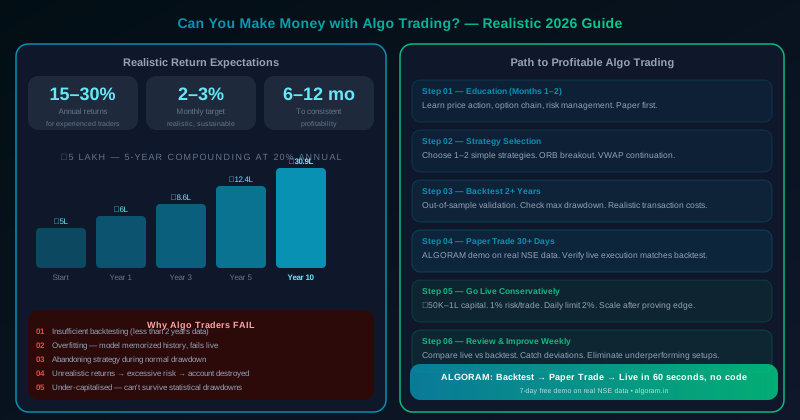
Let's put 15–30% annual returns in context: the Nifty 50 index has generated approximately 12–14% CAGR over the past decade. A well-managed algo trading account that consistently generates 20–25% annually is outperforming most institutional funds — and nearly all retail investors. These are genuinely excellent returns.
The problem arises when traders enter with expectations of 20–30% monthly returns — numbers that require either enormous risk, exceptional luck, or fabricated track records. Any strategy claiming consistent 20% monthly returns over 12+ months either carries extreme risk or is lying.
₹5 lakh at 20% annually: Year 1 = ₹6L, Year 3 = ₹8.6L, Year 5 = ₹12.4L, Year 10 = ₹30.9L
₹5 lakh at 2% monthly (compounded): Year 1 = ₹6.8L, Year 3 = ₹16L, Year 5 = ₹37.5L
Sustainable 20% annually creates extraordinary wealth over time. Chasing 100%+ monthly returns ends in account destruction.
Why Some Algo Traders Consistently Succeed
The algo traders who build profitable, sustainable track records share several common characteristics:
- They validate their edge before deploying capital. Minimum 2+ years of backtesting data, out-of-sample validation, and 30+ days of paper trading. They know what their strategy's win rate, max drawdown, and average profit/loss look like before a single rupee goes live.
- They treat risk management as non-negotiable. Fixed 1–2% risk per trade. Daily loss limits enforced. Maximum drawdown monitored. The strategy survives losing streaks because position sizes are calibrated to survive them.
- They have realistic expectations. They're not trying to make 30% per month. They're trying to consistently apply a tested approach and let the statistical edge compound over time.
- They review performance systematically. Weekly review of live performance vs. backtested expected performance. Deviations are investigated. Behavioral issues are caught early.
- They treat it as a business, not a lottery. Consistent processes, defined rules, systematic improvement. Not "one big win" thinking.
Why Many Algo Traders Fail
Understanding failure modes is more valuable than just understanding success:
- Insufficient backtesting: Deploying a strategy after testing on 3–6 months of data is almost meaningless. Markets go through cycles — trending, sideways, high-volatility, low-volatility. You need 2+ years minimum to see behavior across different regimes.
- Overfitting: A strategy can be tuned to work perfectly on historical data while having no real edge on live data. The more parameters you optimize on historical data, the higher the overfitting risk. Test on data the model has never seen (out-of-sample testing) to validate genuinely.
- Abandoning strategies during normal drawdowns: Every profitable strategy has losing streaks. A strategy with 60% win rate will have 5–6 consecutive losses periodically. Traders who switch strategies during these drawdowns never let any strategy's edge play out.
- Under-capitalisation: A ₹25,000 account with 1% risk per trade can only risk ₹250 per trade. Transaction costs alone significantly eat into small accounts. Minimum ₹50,000–1 lakh is practical for Nifty options algo trading.
- Chasing unrealistic returns: Targeting 20%+ monthly returns forces position sizes and risk levels that guarantee account destruction on the first significant drawdown.
Manual Trading vs Algo Trading — Which Is More Profitable?
| Factor | Manual Trading | Algo Trading |
|---|---|---|
| Strategy Execution | Inconsistent — emotional override common | 100% consistent — rules always followed |
| Entry Timing | 8–25 seconds from signal to order | <50ms via broker API |
| Stop Loss Adherence | Frequently moved or ignored | Auto-placed, never modified |
| Position Sizing | Based on conviction — oversized on "strong" setups | Calculated from capital % rules every trade |
| Daily Loss Limit | Often violated after bad mornings | Enforced automatically — no override |
| Scalability | One strategy, limited hours | Multiple strategies, all market hours |
| Required Attention | Full screen time during market hours | Minimal — monitoring from phone |
| Backtesting Ability | Manual chart scrolling — subjective | Systematic on 20 years of data |
The data is clear: for the same strategy, algo trading will typically outperform manual trading because it eliminates the behavioral variance that degrades manual execution. A strategy with a 58% theoretical win rate might achieve 51% in manual execution due to FOMO entries, late exits, and stop loss violations. The same strategy automated achieves the 58% because every rule is followed.
What Is a Trading Edge — And Why Everything Depends on It
A trading edge is a statistical advantage: over many trades, your wins are larger or more frequent than your losses by enough margin to be profitable after transaction costs. This is the foundation that everything else is built on.
Algo trading without an edge is just automating losses. The algorithm will execute consistently — which means consistently losing if the underlying logic has no positive expectancy.
How to evaluate whether your strategy has an edge:
- Backtest on minimum 2 years of data — ideally 5+ years including at least one major market event
- Evaluate out-of-sample — test on data the optimization didn't see
- Check win rate and average win/loss ratio — ensure positive expectancy (win rate × avg win > loss rate × avg loss)
- Evaluate max drawdown — can you psychologically and financially survive this drawdown while the strategy recovers?
Related: Top 10 Algo Trading Strategies Used by Professional Traders
Why Backtesting Is Non-Negotiable
Backtesting is the process of running your strategy against historical market data to evaluate how it would have performed. It's the primary tool for validating whether a strategy has a genuine edge before risking live capital.
ALGORAM provides backtesting on 20 years of NSE historical data — spanning the 2008 financial crisis, 2013 currency crisis, 2020 COVID crash, and 2022 rate-hike volatility. A strategy that remains profitable across all these periods has demonstrated robustness across multiple market regimes.
Look-ahead bias: Using future data to generate signals (common error in manual backtesting)
Overfitting: Optimizing parameters on the same data used to evaluate performance
Ignoring transaction costs: Slippage and brokerage can eliminate marginal edges
Too short a test period: 6 months may capture only one market regime — not representative
Risk Management — The Difference Between Profitable and Not
Two traders with the same strategy, same backtested win rate, same market. One uses proper risk management. One doesn't. Over 12 months, the results will be dramatically different — as shown by the Trader A vs Trader B case study in our risk management guide.
The three risk management rules that most directly determine algo trading profitability:
- 1% risk per trade, maximum. This determines whether you survive losing streaks. At 1%, 50 consecutive losses reduce capital by ~40%. At 10%, 7 consecutive losses halve your account.
- 2% daily loss limit. When daily losses hit 2% of capital, all trading stops. This prevents bad days from becoming catastrophic — and prevents revenge trading after initial losses.
- Maximum drawdown review. When drawdown from peak exceeds 15–20%, pause the strategy and review. Something may have changed — market regime, strategy degradation, or parameter drift.
For comprehensive coverage: Risk Management in Algo Trading — Professional Guide
The Structured Path to Profitable Algo Trading
Best Beginner Algo Trading Strategies for India
For first-time algo traders on ALGORAM, these well-tested approaches have proven track records across multiple market conditions:
- Nifty ORB (Opening Range Breakout): Enter when price breaks the 15-minute opening range on 3x+ average volume. OI confirmation optional but strongly recommended. Clear rules, high liquidity, defined stop at opening range. Best for: 9:30–11:30 AM window.
- Bank Nifty VWAP Strategy: Long CE above VWAP with rising Put OI at S1 confirmation. Long PE below VWAP with rising Call OI at R1. Time exit: 3:10 PM. Best for: trending sessions after 9:30 AM.
- Weekly Theta Selling: Short ATM or near-ATM Straddle when VIX is below 15 and PCR is 0.9–1.1 (neutral). Auto-close at 80% premium collected or 3:10 PM. Best for: non-expiry Thursdays, low-VIX environments.
Related: How Beginners Can Start Algo Trading Without Coding
How Much Capital Do You Need?
Minimum practical capital for Nifty options algo trading: ₹50,000–1 lakh. At 1% risk per trade on ₹50,000 = ₹500 maximum loss per trade. This allows approximately 2 lots of Nifty options at ATM premiums below ₹250, which is workable.
More comfortable capital for a multi-strategy approach: ₹2–5 lakh. This allows proper position sizing across strategies and provides sufficient drawdown cushion for the strategy to prove its edge without capital constraints forcing premature exits.
How ALGORAM Helps You Build Profitable Algo Trading
ALGORAM doesn't guarantee profits — no legitimate platform does. What it provides is the infrastructure to execute your strategy more consistently than you can manually:
- 20-year backtesting engine — validate your edge on NSE historical data before any live capital
- 7-day paper trading demo — verify live execution matches your backtest before deploying capital
- Automatic risk enforcement — stop losses, daily limits, position sizing all enforced without override
- AI signal filtering — OI + volume + price action evaluated simultaneously for every entry
- No-code strategy builder — configure strategies through visual interface, no programming
- Mobile monitoring — cloud-based execution continues during your working hours with push notifications
📈 Start Your Algo Trading Journey
7-day paper trading demo on real NSE data. Build, backtest, and see your strategy execute — without any financial risk.
🚀 Launch Offer — First 100 Customers
Conclusion
Can you make money with algo trading? Yes — with the right approach, realistic expectations, and the discipline to follow a systematic process.
Algo trading's advantage over manual trading is not that it predicts markets better — it's that it executes your strategy better. Consistent execution of a sound strategy, with proper risk management, over enough trades to let the statistical edge play out: that's the formula that actually works.
The traders who fail at algo trading typically fail for identifiable, preventable reasons: insufficient backtesting, unrealistic return expectations, inadequate risk management, or abandoning strategies during normal drawdowns. None of these failures are inevitable. All of them are addressable with a structured approach.
Start with the demo: → ALGORAM 7-day free paper trading demo
Best offer: → Open 5paisa for 3 months free access
Strategy foundation: → What is Algo Trading? Complete Guide
Risk management: → Risk Management in Algo Trading
Top strategies: → Top 10 Algo Trading Strategies
Frequently Asked Questions

Ankit has been algo trading Indian markets for 15 years. His realistic view: "Algo trading works — but it works because it executes your strategy consistently, not because it magically generates returns. The edge has to come from the strategy. Automation just ensures you realize it." He built ALGORAM to make that consistent execution available to every retail trader.