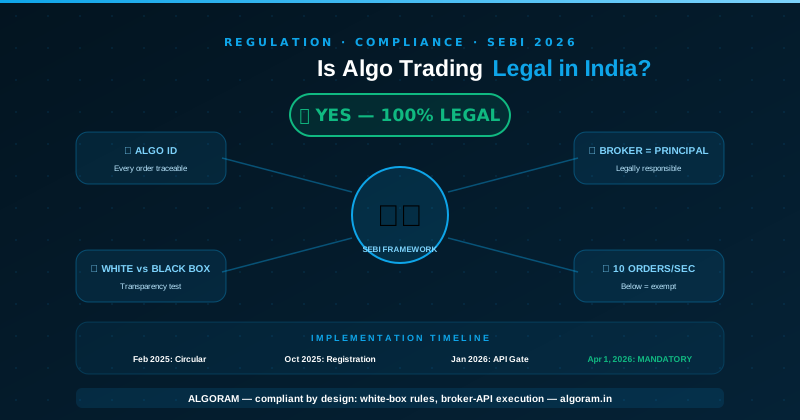
The Direct Answer — Yes, Algo Trading is Legal in India
Let's settle the question that keeps most hesitant traders from starting: algorithmic trading is completely legal for retail investors in India. It is not a grey area, not a loophole, and not something SEBI is trying to shut down. In fact, SEBI has done the opposite — it built a dedicated regulatory framework specifically so retail traders can automate safely, with clear rights, clear responsibilities, and clear accountability when things go wrong.
What confused many traders is that for over a decade, India's algo rules (first framed in 2012) were written for institutions — retail automation existed in a regulatory vacuum. That vacuum is what SEBI closed with its February 4, 2025 circular on "Safer Participation of Retail Investors in Algorithmic Trading" — fully mandatory across all stockbrokers from April 1, 2026. The official circular is available on SEBI's website.
So the real question isn't "is it legal?" — it's "am I doing it through a compliant setup?" This guide answers exactly that.
A Short History of Algo Regulation in India
- 2008: Algorithmic trading formally permitted with the introduction of Direct Market Access (DMA) — institutions only, in practice
- 2012: SEBI's first algo framework — designed for institutional and proprietary desks
- 2019–2024: Broker APIs and Python tools made retail automation explode — algo share of NSE stock futures volume rose from 39% in FY15 to roughly 73% by FY26. Retail was automating at scale with no dedicated rulebook
- February 4, 2025: SEBI issues the retail algo circular — the first framework written specifically for retail participation
- April 1, 2026: Framework fully mandatory for all stockbrokers in India
Why SEBI Created the Retail Framework
Three forces drove the regulation — and understanding them tells you exactly what the rules are designed to prevent:
- Retail losses at scale. SEBI's own research found that over 90% of individual F&O traders lose money, and net losses for individual traders widened 41% to roughly ₹1.05 lakh crore in FY25 alone. A significant contributor: unregulated "black box" subscription platforms selling automated strategies with zero transparency, zero backtesting disclosure, and zero accountability when they failed. Related: Why 90% of Traders Lose Money
- No traceability. Before Algo IDs, exchanges literally could not audit which orders were algorithmic and which were manual. If a strategy caused abnormal market activity, there was no way to trace it back to its source.
- Enforcement pressure. High-profile actions — most notably SEBI barring global firm Jane Street in July 2025 over alleged manipulative algorithmic practices — made surveillance capability non-negotiable.
Read the framework as a consumer protection law, not a restriction. Every rule in it targets one of two things: opaque platforms selling untested strategies to retail traders, or untraceable automated orders destabilizing markets. If you're a retail trader using a transparent, broker-integrated platform — the framework is built FOR you, not against you.
The Implementation Timeline — How We Got to Mandatory
The Circular
SEBI issues circular SEBI/HO/MIRSD/MIRSD-PoD/P/2025/0000013 — "Safer Participation of Retail Investors in Algorithmic Trading." Broker-as-principal model, Algo IDs, empanelment, and the white/black box classification are all defined here.
Original Deadline (Deferred)
The framework was originally scheduled to take effect August 1, 2025, but was deferred — twice — to give brokers and exchanges time to build registration systems, SOPs, and surveillance infrastructure.
Registration Begins
Brokers began registering retail algo products with the exchanges. Exchanges (NSE, BSE) published empanelment criteria, turnaround times for algo registration, and operational FAQs.
Onboarding Restriction
Non-compliant brokers were barred from onboarding new retail API clients — the first hard enforcement gate.
Fully Mandatory
The complete framework became mandatory for all stockbrokers in India. Every algo order now requires an exchange-assigned Algo ID. This is the regime we trade under today.
The Core Rules — What the Framework Actually Says
| Rule | What It Means | Who It Affects |
|---|---|---|
| Algo ID on every order | Each automated order carries an exchange-assigned identifier — a digital fingerprint traceable to the registered strategy | Everyone — enforced automatically by broker systems |
| Broker = Principal | Your broker is legally responsible for every algo running through their platform, including due diligence on providers and grievance redressal | Brokers (your protection improves) |
| Provider empanelment | Algo platforms must empanel with exchanges and operate through registered brokers — direct exchange access is prohibited | Algo platforms like ALGORAM |
| Secure API access | Static IP whitelisting, two-factor authentication, no open APIs — every automated order originates from a known, secured source | API users and platforms |
| Kill switch + audit logs | Brokers must be able to instantly disable a malfunctioning algo and maintain 5-year logs of all algo activity | Brokers and exchanges |
| No guaranteed returns | Algo providers are prohibited from claiming guaranteed profits — full stop | Every platform's marketing |
White Box vs Black Box — The Classification That Matters Most
The framework's most consequential distinction for retail traders is between two types of algorithms:
| White Box (Execution Algos) | Black Box Algos | |
|---|---|---|
| Logic visibility | Fully visible and replicable — you see every rule | Hidden — you cannot see how decisions are made |
| Examples | Rule-based strategies you configure: ORB breakout, VWAP entries, your own stop-loss and target logic | "Subscribe to our secret AI strategy" products |
| Regulatory burden | Standard exchange registration only | Provider must be a SEBI-registered Research Analyst + maintain documented research reports per strategy |
| Logic changes | Update within registration norms | Any logic change = re-register as an entirely new algo |
| Trader's verification duty | Verify platform's broker integration | Verify the provider's RA registration number on SEBI/exchange websites BEFORE subscribing |
The practical test: if a platform cannot — or will not — explain exactly how its strategy decides entries and exits, it's a black box. Under the framework, it needs Research Analyst registration to be offered legally. No RA number = walk away.
The 10 Orders-Per-Second Rule — Most Retail Traders Are Exempt
SEBI drew a clean line between casual retail automation and high-frequency activity: 10 orders per second, per exchange, within any calendar second.
- Below 10 OPS: Self-built or white-box strategies used for personal trading need no separate exchange registration. You're classified as a regular API user.
- Above 10 OPS: The strategy must be formally registered with the exchange through your broker before it can continue running.
- Reality check: Virtually every retail strategy — ORB, VWAP entries, option buying systems, even multi-leg straddles — operates far below 10 orders per second. If you're reading this as a retail trader, you almost certainly fall in the exempt category.
One more personal-use boundary worth knowing: a self-built algorithm may be used by you and your immediate family (spouse, dependent children, dependent parents). Sharing or selling it beyond that requires going through proper empanelment channels.
What It Means for YOU — By Trader Type
Nothing changes. These regulations apply only to automated order placement. Manual trading through your broker's official app or website is completely outside the framework's scope.
Operational adjustments, not restrictions: secure a static IP (from your ISP or a cloud VPS) and register it with your broker, use 2FA, expect daily logout requirements. Below 10 OPS with white-box logic for personal use — no separate registration needed. Your trading itself doesn't change.
Your job is verification: (1) Is the platform empanelled with the exchange (via a registered broker)? (2) If it offers black-box strategies, does it hold SEBI Research Analyst registration? (3) Does it operate through your broker's API rather than claiming direct exchange access? Verify on NSE/BSE websites or through your broker's approved partner list. A compliant platform will welcome these questions.
Compliance Checklist for Retail Algo Traders
- Confirm your broker is compliant with the retail algo framework (all major brokers completed registration through the Oct 2025 – Apr 2026 glide path)
- If using a platform: verify its exchange empanelment through your broker's approved partner list
- If the strategy logic is hidden: demand the provider's SEBI Research Analyst registration number and verify it on SEBI's website
- Prefer white-box platforms where you see and control every rule — transparency is both safer and regulatorily lighter
- If running your own scripts: set up a static IP and register it with your broker; enable 2FA
- Treat any guaranteed-return claim as disqualifying — it's explicitly prohibited and signals a non-compliant operator
- Keep your own records of strategy logic and trade history — good practice, and aligned with the framework's audit-trail philosophy
Red Flags — How to Spot an Illegal Algo Operation
- 🔴 "Guaranteed monthly returns" — prohibited outright under the framework. Instant disqualifier.
- 🔴 Telegram/WhatsApp "algo subscription" groups asking you to share API keys — unempanelled, unaccountable, and a security disaster
- 🔴 Hidden strategy logic with no RA registration — an illegal black box
- 🔴 Claims of "direct exchange connection" — providers legally cannot connect directly to exchanges; broker integration is mandatory
- 🔴 No broker partnership disclosed — the broker-as-principal model means every legitimate platform names its broker integrations openly
- 🔴 Profit-sharing arrangements ("we take 20% of your profits") — a classic unregulated-operator model
Where ALGORAM Fits in the Compliant Model
ALGORAM was built on exactly the architecture the framework mandates — which is why the regulation strengthens rather than threatens platforms like it:
- Broker-API based: All execution flows through registered broker APIs (including 5paisa) — never direct exchange access
- White-box by design: You see, set, and control every rule — entry conditions, stop-loss, targets, time exits, daily limits. Nothing is hidden, which is both the safer model and the regulatorily lighter one
- Built-in risk controls: Pre-trade checks, automated stop-losses, daily loss limits, and time-based exits mirror the framework's risk-management philosophy. Full guide: Risk Management in Algo Trading
- No guaranteed-return claims: Backtest data and paper trading, not promises — test any strategy on 20 years of historical data and 7 days of live paper trading before risking a rupee
Getting started guide: How to Start Algo Trading in India — Step by Step
⚖️ Trade Automated — The Compliant Way
Transparent white-box rules, broker-API execution, built-in risk controls. See exactly how your strategy works before it trades.
Special Offer — First 100 Customers
Conclusion
Algo trading in India is not just legal — as of April 1, 2026, it's one of the most clearly regulated retail automation regimes in the world. The framework's message is unambiguous: automation is welcome; opacity is not. Algo IDs make every order traceable, broker responsibility gives you genuine recourse, and the white-box/black-box distinction gives you a simple test for any platform: can they show you how it works?
For the ordinary retail trader running rule-based strategies below 10 orders per second through a broker-integrated platform, the practical answer to "is this legal?" is: yes — and it always was. The rules didn't close the door on retail automation. They removed the operators who were giving it a bad name. Verify your setup against the checklist above, prefer transparency, and trade with confidence.
Disclaimer: This article is for educational purposes and reflects the regulatory framework as of its publication date. Regulations evolve — always refer to SEBI and NSE official publications for current requirements. This is not legal or investment advice.
Frequently Asked Questions

Rahul tracked SEBI's retail algo framework from the December 2024 consultation paper through the April 2026 mandatory deadline, aligning ALGORAM's architecture with each requirement as it was finalized. "The framework did the industry a favour — it made transparency the law. Platforms that were always white-box and broker-integrated didn't have to change anything. The ones selling secret guaranteed-profit algos on Telegram did. That's exactly how regulation should work."