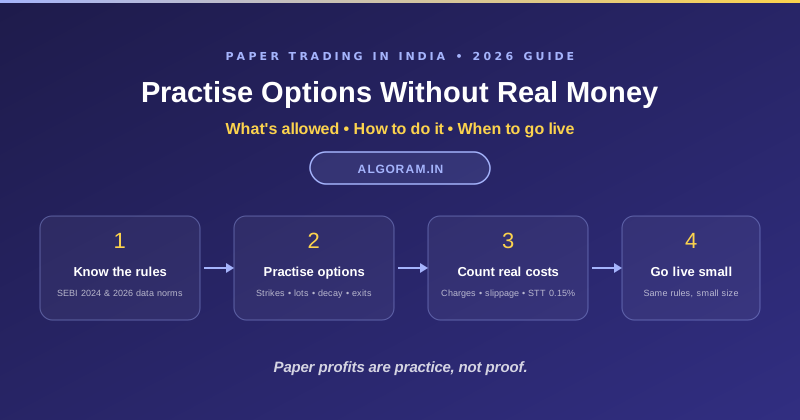
What is Paper Trading?
Paper trading, also called virtual trading, simulated trading or demo trading, means placing practice trades with virtual money. The name comes from the days when traders wrote their trades down on paper. You decide your entry, stop-loss, target and position size exactly as you would with real money, record what happens, and review the results. Nothing is bought or sold on the exchange, and nothing is at risk.
Paper trading is useful for three things:
- Learning the mechanics: order types, lot sizes, strikes, expiries and how premiums move
- Testing your process: whether you can actually follow your rules, trade after trade
- Forward-testing a strategy: seeing how a set of rules behaves as the market unfolds, not just in a backtest
What it can't do is prove that a strategy will make money with real capital. That's what the rest of this guide helps you account for.
पेपर ट्रेडिंग का मतलब है असली पैसे की जगह वर्चुअल पैसे से ट्रेडिंग की प्रैक्टिस करना। आप एंट्री, स्टॉप-लॉस, टारगेट और पोज़ीशन साइज़ वैसे ही तय करते हैं जैसे असली ट्रेड में, पर कोई पैसा दांव पर नहीं होता। पेपर ट्रेडिंग कैसे करें:
- पहले अपने नियम लिखें: कब एंट्री, कहाँ स्टॉप-लॉस, कितना साइज़
- हर ट्रेड को जर्नल में लिखें: समय, स्ट्राइक, एक्सपायरी, एंट्री, एग्ज़िट और कारण
- चार्जेस (STT आदि) और स्लिपेज भी जोड़ें, वरना नतीजे असली से बेहतर दिखेंगे
- 30–50 ट्रेड के बाद नतीजे देखें, फिर छोटे साइज़ से लाइव ट्रेडिंग शुरू करें
Is Paper Trading Legal in India? The 2024 and 2026 Rules
Yes, paper trading itself is legal. What SEBI regulates is the market data that apps use. This matters because many apps that offered "live" virtual trading before 2024 have since changed how they work:
- May 2024: a SEBI circular (in force from 22 June 2024) barred stock exchanges and registered intermediaries such as brokers from sharing real-time price data with third parties, except where needed for the orderly functioning of the market or for regulatory requirements. Data for education and awareness was allowed only with a one-day lag. The target was fantasy-trading and virtual-trading platforms built on live prices.
- November 2024: SEBI publicly cautioned investors against unauthorised apps offering virtual trading, paper trading or fantasy games based on live stock prices.
- May 2026: a new SEBI circular, in force from 1 July 2026, set a uniform 30-day lag for sharing and using market price data in investor education and awareness. NISM's simulation lab is the one exception, with a one-day lag.
Before you rely on any paper-trading app, check where its prices come from and whether they are real-time or delayed. Where your own SEBI-registered broker offers a practice or demo facility, that's the most straightforward route. Be especially careful with apps that charge entry fees or offer cash prizes for virtual trading. A manual journal, where you watch the prices you already see as a broker client and write your trades down, needs no app at all. This is a summary, not legal advice; check the latest SEBI circulars for details.
Ways to Paper Trade in India
| Method | How it works | Good for | Watch out for |
|---|---|---|---|
| Manual journal | Watch prices on your broker's app or charts and record each hypothetical trade in a spreadsheet | Building discipline; costs nothing | Easy to be generous to yourself on fill prices |
| Your broker's practice facility | A demo or virtual mode inside your SEBI-registered broker's platform, where offered | Learning the real order screens | Not every broker offers one; check its features |
| Simulator apps | Third-party apps with virtual capital | Learning mechanics | Data source and delay; cash-prize contests |
| Historical replay | Step through past market days bar by bar | Practising decisions quickly | You can't fully "unknow" what happened next |
| Algo platform test modes | Run a platform's strategies in a test mode before live orders | Checking how automated rules behave | Test results still differ from live fills |
How to Choose a Paper Trading App
Search results for "best paper trading app in India" change constantly, and many apps changed their data feeds after 2024. Rather than trust a ranking, check these six points yourself:
- Data source and delay: who provides the prices, and are they real-time or delayed?
- Options support: can you pick strikes and expiries and trade in lots?
- Realistic orders: market, limit and stop-loss orders, not only "click to buy at the last price"
- Charges included: does it deduct brokerage, STT, exchange fees, GST and stamp duty?
- Virtual capital you set: can you match it to what you'll actually trade?
- No cash prizes or entry fees: practice shouldn't turn into a game with money at stake
Paper Trading Options: What to Practise
Options are where paper trading pays off most, because the mechanics catch new traders out. Practise these until they're automatic:
- Strike and expiry selection: ATM, ITM and OTM strikes behave very differently, and weekly expiries move faster than monthly ones
- Sizing in lots: options trade in lots, so check the current NSE lot size for Nifty, Bank Nifty and the stock you trade before you size
- Stop-losses in premium terms: decide the stop on the option premium you pay, not just on the index level
- Time decay: notice how an option buyer's premium shrinks when the market goes sideways
- Expiry-day behaviour: premiums can swing sharply on expiry day, in both directions
- Selling and hedging: if you plan to sell options, practise with a hedge leg and track the margin it needs
- Charges: STT is 0.15% of the option sell premium since 1 April 2026, on top of exchange fees, GST and stamp duty
New to options? Start with how to read an option chain and option buying vs option selling.
How to Paper Trade: Step by Step
- Write your rulesWhen to enter, where the stop-loss and target go, and how much to trade
- Set realistic capitalUse the amount you'd really trade, not ₹10 lakh of play money
- Define pass criteriaBefore you start: number of trades, maximum drawdown, net result after costs
- Trade and recordLog every trade in your journal as it happens, never afterwards
- Add costs and slippageDeduct charges and assume slightly worse fills than you saw
- Review weeklyCheck rule-breaks, average win vs average loss, and drawdown
The Paper Trading Journal (Template)
A journal turns practice into evidence. Copy these columns into a spreadsheet:
Illustrative example row
| Column | Example |
|---|---|
| Date & time | 21 Oct 2026, 10:12 |
| Instrument | NIFTY call option, ATM strike, weekly expiry |
| Direction & size | Buy, 1 lot |
| Entry / stop / target | ₹100 / ₹90 / ₹120 premium |
| Exit & reason | ₹108, trailing stop hit |
| Gross P&L | +₹8 per unit |
| Charges & slippage | Brokerage, STT, exchange fees, GST, stamp duty, plus ₹0.50 per unit assumed slippage |
| Net P&L | Gross minus charges and slippage |
| Followed rules? | Yes / No, and what was different |
| Notes | Market context, how you felt |
Example values are hypothetical and for illustration only.
How Long Should You Paper Trade?
There's no magic number, but a useful rule of thumb is 30–50 trades over at least a month, covering different conditions: trending days, sideways days and an expiry week or two. Fewer trades than that, and a few lucky results can fool you.
Just as important: don't paper trade forever. After a few months, paper trading stops teaching you much, because it can't simulate fear and greed. Once you've met the pass criteria you set in advance, move to live trading with small size.
Paper Trading vs Backtesting vs Live Trading
| Backtesting | Paper trading (forward test) | Live trading | |
|---|---|---|---|
| Data | Past prices | Prices as the market unfolds | Prices as the market unfolds |
| Speed | Years in minutes | Real time | Real time |
| Fills | Assumed | Assumed | Real, with slippage |
| Costs | Only if you add them | Only if you add them | Always real |
| Emotions | None | Little | Fully present |
| Tells you | How rules behaved historically | Whether you can follow the rules now | Actual results |
Each step is a filter: a strategy that fails a backtest shouldn't reach paper, and one that fails on paper shouldn't reach live. Read more in What is backtesting in trading?
Why Paper Trading Results Flatter You
Almost everyone does better on paper than live. The reasons are predictable, so you can correct for them:
- Perfect fills: paper assumes you got the price you saw. Live, you pay the bid-ask spread and some slippage, especially in fast option moves
- Missing costs: brokerage, STT (0.15% on option sell premium), exchange fees, GST and stamp duty are easy to forget on paper
- No emotions: it's easy to hold a losing virtual trade to its stop. With real money, fear and greed take over
- Delayed data: if your app's prices are delayed, intraday timing on paper won't match the live market
- Liquidity: on paper you can "fill" any size; live, thin strikes won't absorb larger orders
The fix: deduct full charges, assume slightly worse fills, and judge the strategy on net results only.
Common Paper Trading Mistakes
- Oversized virtual capital: practising with ₹10 lakh when you'll trade ₹1 lakh teaches the wrong position sizes
- Resetting after losses: wiping the virtual account hides exactly the drawdowns you need to see
- Logging trades afterwards: memory is generous, so record trades as they happen
- Changing rules mid-test: every change restarts the test
- Ignoring charges: a small gross edge can turn negative after costs
- Treating paper profits as proof: they're practice, not a forecast
Moving From Paper to Live Trading
When you've met your pass criteria, go live small: one lot, the same rules and the same journal. Then compare live results against paper results after a few weeks. A small gap is normal. A big gap usually points to fills, costs or rule-breaking under pressure.
Keep the stakes in perspective. SEBI found that 87.7% of individual F&O traders had net losses in FY26, and options accounted for about 92% of those losses. Paper trading can't change those odds, but it can stop you from losing money on avoidable mistakes while you learn.
If you plan to automate, test the platform's strategies in its test mode before you switch on live orders. ALGORAM, for example, lets you run its strategies in paper mode, where enabled on your account, before turning on automatic live orders, with estimated charges shown in the ledger. Read how ALGORAM works for the full picture.
🚀 Thinking About Automation?
See how ALGORAM's rule-based strategies, risk limits and exits work before you commit any real capital.
Conclusion
Paper trading is the cheapest education in trading, as long as you treat it as practice, not proof. Know the 2024 and 2026 SEBI data rules and choose your method accordingly. Practise the option-specific skills, record every trade with full costs, set pass criteria in advance, and move to live trading with small size once you've met them. Paper profits aren't real, and live results will almost always be a little worse, so build that into your expectations from day one.
Educational content only, not legal or investment advice. SEBI rules on market data change; check the latest circulars on sebi.gov.in. ALGORAM provides algorithmic trading software and related technology services. It is not an investment adviser, research analyst or portfolio manager. Trading in equities and derivatives involves market, execution, liquidity and technology risks; options trading can result in substantial losses. Paper and simulated results may differ materially from live results.
Sources
- SEBI norms on sharing real-time price data (May 2024): LiveLaw; Business Standard
- SEBI caution on virtual-trading apps using live data (Nov 2024): MediaNama
- 30-day lag for educational price data from 1 July 2026: Outlook Money; Kotak Neo
- SEBI study of individual F&O traders, FY26: Business Today
- STT revision effective 1 April 2026: FYERS notice
Frequently Asked Questions

Rahul leads technology at ALGORAM. He writes about testing trading rules properly: backtests, paper trading and the gap between simulated and live results.