Why Psychology is More Important Than Strategy
Here's the uncomfortable math that most Indian traders never confront. Take a strategy with a genuine edge — say 58% win rate at 1:1.5 risk-reward. Executed perfectly, it compounds an account steadily. Now hand that same strategy to a trader who exits winners at half-target out of fear, holds losers past the stop out of hope, doubles size after losses out of anger, and skips valid setups after a bad week. The identical strategy now loses money.
The strategy didn't change. The execution did. This is why the 90% of traders who lose money aren't primarily losing to bad strategies — they're losing to their own nervous systems. Markets are designed to trigger the exact emotional responses that produce bad decisions: fear at bottoms, greed at tops, FOMO in trends, and rage after losses. Related: Why 90% of Traders Lose Money
"The goal of a successful trader is to make the best trades. Money is secondary."
Fear — The Winner Killer
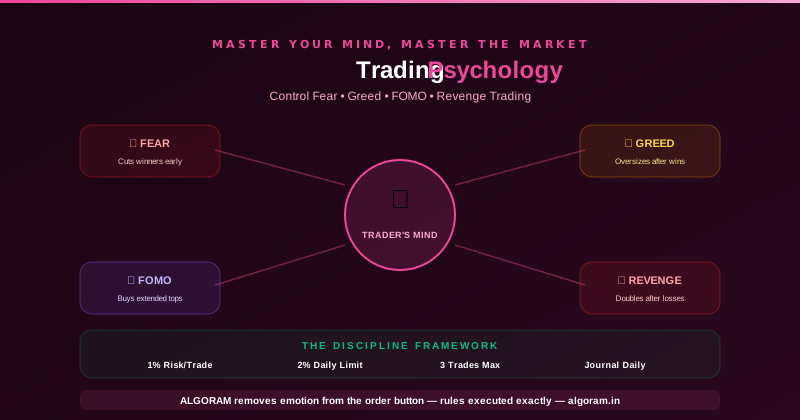
Fear in trading has two faces. Fear of losing makes you exit a winning trade at +30 points when your system's target was +80 — locking in relief instead of profit. Fear of being wrong makes you hesitate on a perfectly valid ORB setup because the last two lost, so you watch the winner leave without you. Both are the same root cause: the outcome of this single trade matters too much to you. That happens when position size is too large relative to capital, or when the capital itself is money you can't afford to lose.
Greed — The Account Inflator
Greed is most dangerous immediately after success. Three winning days in a row, and the brain whispers: you've figured it out — size up. The trader who risked 1% now risks 4% "because the setup is so good." One normal loss at 4x size erases the three wins. Greed also moves targets mid-trade — the trade hits +80 (the plan), but now +150 looks reachable, so you hold... and give it all back when the move reverses. Greed converts a working system into a lottery ticket.
FOMO — The Chase Trap
NIFTY has run 150 points since 9:45 AM. You had no position. Every green candle feels like money leaving your pocket, and at 11:20 AM you finally buy CE — at the exact moment early buyers are booking profits into your order. FOMO entries are systematically the worst-priced entries available, because they occur precisely when a move is extended. In Indian markets, FOMO is amplified by Telegram groups and Twitter screenshots of others' profits — a constant feed of moves you "missed."
Revenge Trading — The Account Killer
A stop-loss hits for −₹1,500. Within four minutes you're in a new trade — double size, opposite direction, no setup — because the market "owes you." This is not analysis; it's the same neurological loop as chasing losses at a casino table. Revenge trading is the single most common path from a manageable losing day to a blown account, because each revenge trade that fails escalates both the anger and the size of the next one. One bad hour can undo six good months.
Overtrading — When Boredom Wears a Setup Costume
Overtrading is rarely about opportunity — it's about discomfort with sitting flat. The lunch-hour chop looks boring, so the trader "finds" a setup that isn't there. Ten trades a day at ₹50–60 brokerage-and-slippage each is ₹500–600 of guaranteed daily cost before any market edge — plus each marginal trade is, by definition, taken at lower conviction than the first ones.
- The cap: 1–3 trades per day, maximum. Trade 4 onwards requires the day's highest-conviction setup — which almost never exists.
- The label test: At entry, mark every trade in your journal as setup trade or impulse trade. Most overtraders discover 70% of their losses come from the impulse column.
- The reframe: Sitting flat during chop IS a position — it's the position of not donating money to noise. Professionals are flat most of the day.
The Cognitive Biases — Hope, Confirmation, Loss Aversion
| Bias | How It Destroys P&L | The Counter-Rule |
|---|---|---|
| Loss aversion | Losses hurt ~2x more than gains feel good → you cut winners early and hold losers past the stop | Automated stops and targets that execute without consulting your feelings |
| Hope vs reality | "It will come back" — holding a −40% option because realizing the loss hurts | A close beyond your invalidation level = exit. Hope is not a level. |
| Confirmation bias | Once positioned, you see only evidence agreeing with your trade and dismiss the OI building against you | Write the invalidation condition BEFORE entry — then your only job is checking if it occurred |
| Recency bias | Three losses → "the strategy is broken" → abandon it right before its winning streak | Judge the system on 30+ trades minimum. Backtest data outvotes last week. Backtesting guide |
| Overconfidence | A winning streak convinces you the rules no longer apply to you → size up, skip filters | Fixed 1% sizing formula, applied identically on day 1 and day 100 of a streak |
"The investor's chief problem — and even his worst enemy — is likely to be himself."
The Professional Trading Routine — Discipline as Structure
Discipline is not a personality trait — it's the output of a repeatable routine. Willpower fails under stress by design; routines don't consult willpower.
Pre-Market Routine (8:45–9:15 AM)
- Check SGX Nifty / global cues — gap expectation for today
- Check India VIX — which strategy regime is appropriate today?
- Read the option chain — mark Max Put OI (support) and Max Call OI (resistance). Guide: How to Read Option Chain
- Note today's events (RBI, expiry, results) and decide in advance whether you'll trade them
- Write today's plan in one line: the setup you'll trade, max trades, max loss
- Emotional check: Stressed, unwell, or angry about yesterday? Today is a paper-trading or no-trading day. This single rule saves more money than any indicator.
During Market Rules
- No trades 9:15–9:30 AM — observation only
- Enter only the written setup; label every entry setup/impulse in real time
- After any stop-out: 15-minute mandatory cooling break, screen minimized
- Daily loss limit hit → terminal closed, walk away — the review happens tonight, not now
Post-Market Review (after 3:30 PM)
- Journal every trade (framework below) while the memory is fresh
- Score the day on rule-following, not P&L: a losing day where every rule was followed is a good day; a winning day built on rule-breaks is a dangerous day
- One line: what will I do differently tomorrow?
The Trading Journal Framework
The journal is the single highest-ROI habit in trading, because it quantifies the one thing you can't see from inside your own head: the gap between what your system earned and what you earned. That gap is your psychology, in rupees.
| Field | What to Record |
|---|---|
| Setup | Named setup (ORB / VWAP pullback / OI bounce) — or "impulse" if honest answer is none |
| Plan before entry | Entry, stop, target written BEFORE the order |
| Actual execution | Real entry/exit — deviations from plan highlighted |
| Emotional state | One word at entry: calm / anxious / FOMO / revenge / bored |
| Rule compliance | Yes/No: did this trade follow every written rule? |
| Weekly review | P&L split by: setup vs impulse, calm vs emotional entries — the pattern will shock you |
Case Study — One Emotional Day, Quantified
9:40 AM: Valid ORB setup triggers. Trader hesitates (fear — yesterday's loss) and skips it. NIFTY runs 90 points. 10:50 AM: FOMO entry at the extended top, no setup — stopped for −₹1,800. 11:05 AM: Revenge entry, double size, opposite direction — stopped for −₹3,600. 11:30 AM: Third trade to "get back to breakeven" — −₹2,100. Day total: −₹7,500 — nearly 4x the daily limit that should have stopped him at −₹2,000. Meanwhile, the system he was supposedly trading had exactly one signal that day — the 9:40 ORB — which produced +₹2,700. System: +₹2,700. Trader: −₹7,500. The ₹10,200 gap is the cost of psychology — in one session.
How Automation Removes Emotional Bias
Every fix in this article shares one structure: decide the rule in a calm moment, then remove your ability to renegotiate it in an emotional one. That is precisely what rule-based automation is. An automated system:
- Cannot feel FOMO — it waits for the configured setup with infinite patience, and takes it in under 50ms when it appears (no hesitation after losses, either)
- Cannot revenge trade — after a stop-out, it simply waits for the next valid signal
- Cannot move a stop out of hope — the stop placed at entry is the stop that executes
- Cannot override the daily loss limit — at −2%, all strategies deactivate until tomorrow, and there is no button to argue with
- Cannot oversize on confidence — position sizing is a formula applied identically every trade
This is how ALGORAM approaches discipline: the trader designs the system with a clear head — setup, filters, risk rules — validates it on 20 years of backtest data and 7 days of paper trading, and then the platform executes it without emotional access to the order button. Your psychology still exists. It just stops costing money. Related: Algo vs Manual Trading Returns
The 30-Day Trading Discipline Challenge
For 30 consecutive trading days:
1. Complete the pre-market checklist before the first trade
2. Enter only written setups — zero impulse trades
3. Risk exactly 1% per trade — no exceptions in either direction
4. Hard stop at the 2% daily loss limit
5. Maximum 3 trades per day
6. Journal every trade with an emotional-state note
7. 15-minute cooling break after every stop-out
Scoring: Each day is pass/fail on rule-following ONLY — ignore P&L for the entire month. One broken rule = failed day; a failed day resets the streak. Most traders fail within the first week — that failure is the diagnosis. Traders who complete 30 consecutive compliant days almost universally report that their P&L improved as a side effect. Discipline was the missing edge all along.
🧠 Let the System Hold the Discipline
Your rules, executed without fear, greed, FOMO or revenge — entry, stop, target and daily limits enforced automatically. 7-day free paper trading.
Special Offer — First 100 Customers
Conclusion
Every trader eventually learns the same lesson, cheaply or expensively: the market is not your primary opponent — your own nervous system is. Fear cuts your winners, greed inflates your size, FOMO buys your tops, and revenge trading burns the account. None of these are fixed by more indicators or a better strategy. They're fixed by structure: defined risk, written setups, hard limits, a routine, a journal — and ultimately by removing your emotions' access to execution altogether.
Start tonight: set up the journal. Start tomorrow: run the pre-market checklist and take the 30-day challenge. And when you're ready to make the rules unbreakable, automate them — because the checklist only protects you if it's applied on exactly the days you least want to apply it.
Frequently Asked Questions

Ankit's own journal from his manual trading years showed a ₹4.2 lakh annual gap between his system's signals and his actual results — all of it psychology. "I didn't build ALGORAM because I found a magic strategy. I built it because I finally admitted that the weakest component in my trading was me at the order button. Automating my rules was the single best trade I ever made."